

Observational Requirements for Modeling of Global ...
39
DISTRIOUTIO N or CLOUD PRO PERTIES
DISTRIBUTION or CLOUD PROPERTIES
."
'"
"
..,
'"
"
co
~
.. .. ..
0
....
" '" ~
v
CLOUD OPT I CAL THICK NESS
CLOUD OPTICA L THICKN ESS
DISTR I BUTION or CLOUD PROPERT I ES
DISTR I BUTION or CLOUD PROPERT I ES
II' r ' _ 'C_C_'_J_ '_ " _ '_ "~I'~'~ ' __________ ~ 'C~ '~"~>' ~'~ ' ~ '~,
10 r'C~'~II~'~"~J'~'~.'~'~' ________ ~'~C'~'~'~'~'~.~ •• ~,
70
."
'"
..
"
"
...
'"
'"
..
"
"
co
co
...
'"
. .
co
" '" '"
. .
. .
"
..
. .
0
..
"
" 0
. j
u
" '" ~
<.>
CLOUD OPTICAL TH ICKNESS
CLOUD OPT I CAL TH1CK~E$S
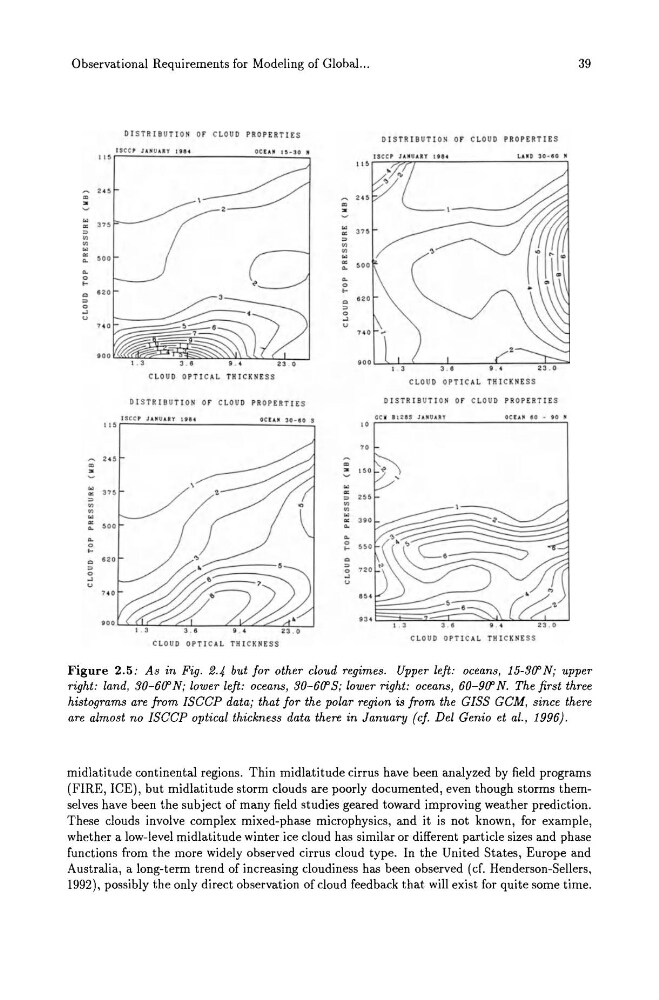
Figure 2.5: As in Fig. 2.4 but for other cloud regimes. Upper left: oceans, 15-[J(1' N; upper
right: land, 30-6(J' N; lower left: oceans, 30-6(J'S; lower right: oceans, 60-9(J' N. The first three
histograms are from ISCCP data; that for the polar region is from the GISS GCM, since there
are almost no ISCCP optical thickness data there in January (cf. Del Genio et al., 1996).
midlatitude continental regions. Thin midlatitude cirrus have been analyzed by field programs
(FIRE, ICE), but midlatitude storm clouds are poorly documented, even though storms themselves have been the subject of many field studies geared toward improving weather prediction.
These clouds involve complex mixed-phase microphysics, and it is not known, for example,
whether a low-level midlatitude winter ice cloud has similar or different particle sizes and phase
functions from the more widely observed cirrus cloud type. In the United States, Europe and
Australia, a long-term trend of increasing cloudiness has been observed (cf. Henderson-Sellers,
1992), possibly the only direct observation of cloud feedback that will exist for quite some time.
39
DISTRIOUTIO N or CLOUD PRO PERTIES
DISTRIBUTION or CLOUD PROPERTIES
."
'"
"
..,
'"
"
co
~
.. .. ..
0
....
" '" ~
v
CLOUD OPT I CAL THICK NESS
CLOUD OPTICA L THICKN ESS
DISTR I BUTION or CLOUD PROPERT I ES
DISTR I BUTION or CLOUD PROPERT I ES
II' r ' _ 'C_C_'_J_ '_ " _ '_ "~I'~'~ ' __________ ~ 'C~ '~"~>' ~'~ ' ~ '~,
10 r'C~'~II~'~"~J'~'~.'~'~' ________ ~'~C'~'~'~'~'~.~ •• ~,
70
."
'"
..
"
"
...
'"
'"
..
"
"
co
co
...
'"
. .
co
" '" '"
. .
. .
"
..
. .
0
..
"
" 0
. j
u
" '" ~
<.>
CLOUD OPTICAL TH ICKNESS
CLOUD OPT I CAL TH1CK~E$S
Figure 2.5: As in Fig. 2.4 but for other cloud regimes. Upper left: oceans, 15-[J(1' N; upper
right: land, 30-6(J' N; lower left: oceans, 30-6(J'S; lower right: oceans, 60-9(J' N. The first three
histograms are from ISCCP data; that for the polar region is from the GISS GCM, since there
are almost no ISCCP optical thickness data there in January (cf. Del Genio et al., 1996).
midlatitude continental regions. Thin midlatitude cirrus have been analyzed by field programs
(FIRE, ICE), but midlatitude storm clouds are poorly documented, even though storms themselves have been the subject of many field studies geared toward improving weather prediction.
These clouds involve complex mixed-phase microphysics, and it is not known, for example,
whether a low-level midlatitude winter ice cloud has similar or different particle sizes and phase
functions from the more widely observed cirrus cloud type. In the United States, Europe and
Australia, a long-term trend of increasing cloudiness has been observed (cf. Henderson-Sellers,
1992), possibly the only direct observation of cloud feedback that will exist for quite some time.