

450
P. Schliissel
1.0+---~----~--~--~~--~----~
0.8 ---+----,----+
i!'
T=300C
·5 0.6 +--'--=-"'-';-~-=-U Q)
~
a: 0.4 -f---+---=~::----+
0.2
T=T
I
0.0 -t----i---r---+---'"--1r---+---+
o
15
30
45
60
75
90
Incidence Angle [0]
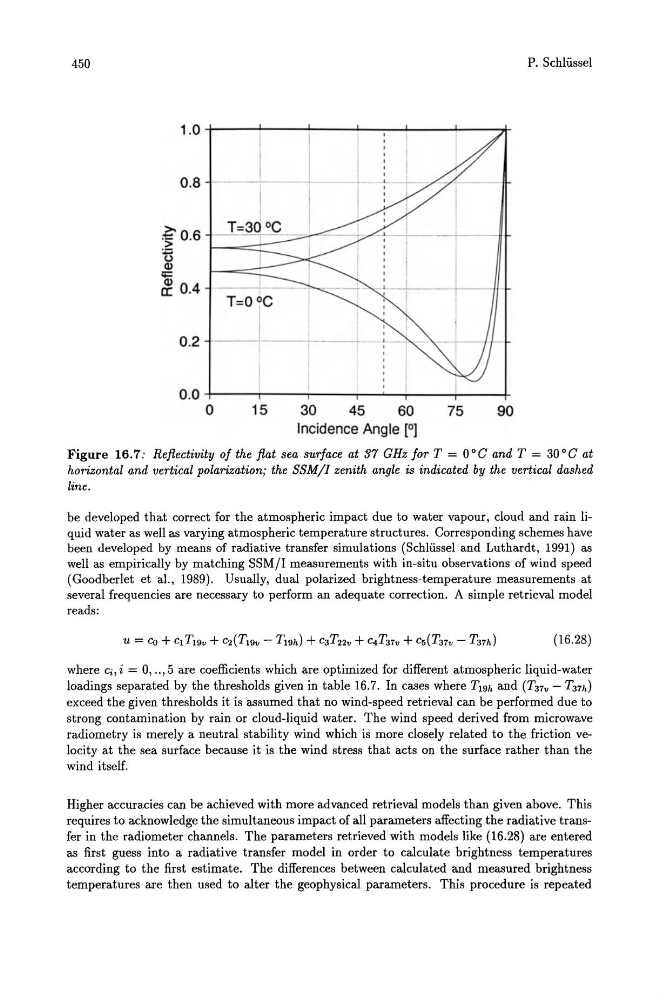
Figure 16.7: Reflectivity of the flat sea surface at 37 GHz for T = 0 0 C and T = 30 0 C at
horizontal and vertical polarization; the SSM/I zenith angle is indicated by the vertical dashed
line.
be developed that correct for the atmospheric impact due to water vapour, cloud and rain liquid water as well as varying atmospheric temperature structures. Corresponding schemes have
been developed by means of radiative transfer simulations (Schliissel and Luthardt, 1991) as
well as empirically by matching SSMjI measurements with in-situ observations of wind speed
(Goodberlet et aI., 1989). Usually, dual polarized brightness-temperature measurements at
several frequencies are necessary to perform an adequate correction. A simple retrieval model
reads:
(16.28)
where Cj, i = 0, .. ,5 are coefficients which are optimized for different atmospheric liquid-water
loadings separated by the thresholds given in table 16.7. In cases where T19h and (T37v - T 37h )
exceed the given thresholds it is assumed that no wind-speed retrieval can be performed due to
strong contamination by rain or cloud-liquid water. The wind speed derived from microwave
radiometry is merely a neutral stability wind which is more closely related to the friction velocity at the sea surface because it is the wind stress that acts on the surface rather than the
wind itself.
Higher accuracies can be achieved with more advanced retrieval models than given above. This
requires to acknowledge the simultaneous impact of all parameters affecting the radiative transfer in the radiometer channels. The parameters retrieved with models like (16.28) are entered
as first guess into a radiative transfer model in order to calculate brightness temperatures
according to the first estimate. The differences between calculated and measured brightness
temperatures are then used to alter the geophysical parameters. This procedure is repeated
P. Schliissel
1.0+---~----~--~--~~--~----~
0.8 ---+----,----+
i!'
T=300C
·5 0.6 +--'--=-"'-';-~-=-U Q)
~
a: 0.4 -f---+---=~::----+
0.2
T=T
I
0.0 -t----i---r---+---'"--1r---+---+
o
15
30
45
60
75
90
Incidence Angle [0]
Figure 16.7: Reflectivity of the flat sea surface at 37 GHz for T = 0 0 C and T = 30 0 C at
horizontal and vertical polarization; the SSM/I zenith angle is indicated by the vertical dashed
line.
be developed that correct for the atmospheric impact due to water vapour, cloud and rain liquid water as well as varying atmospheric temperature structures. Corresponding schemes have
been developed by means of radiative transfer simulations (Schliissel and Luthardt, 1991) as
well as empirically by matching SSMjI measurements with in-situ observations of wind speed
(Goodberlet et aI., 1989). Usually, dual polarized brightness-temperature measurements at
several frequencies are necessary to perform an adequate correction. A simple retrieval model
reads:
(16.28)
where Cj, i = 0, .. ,5 are coefficients which are optimized for different atmospheric liquid-water
loadings separated by the thresholds given in table 16.7. In cases where T19h and (T37v - T 37h )
exceed the given thresholds it is assumed that no wind-speed retrieval can be performed due to
strong contamination by rain or cloud-liquid water. The wind speed derived from microwave
radiometry is merely a neutral stability wind which is more closely related to the friction velocity at the sea surface because it is the wind stress that acts on the surface rather than the
wind itself.
Higher accuracies can be achieved with more advanced retrieval models than given above. This
requires to acknowledge the simultaneous impact of all parameters affecting the radiative transfer in the radiometer channels. The parameters retrieved with models like (16.28) are entered
as first guess into a radiative transfer model in order to calculate brightness temperatures
according to the first estimate. The differences between calculated and measured brightness
temperatures are then used to alter the geophysical parameters. This procedure is repeated