

376
~'r-----r-----~----,,-----r----,25
10
o----YUMA SAND, WI = 0.17, > = 0.5, a = 0
+ - VERNON CLAY, WI = 0.28, > = 0.4$, a = 21 +
• ---MILLER CLAY, WI = 0.33, > = 0.30, a = 0.20
"
,
,6,
,c'
/O~
" %0
P
,
",'0
a
,!po
,6
,
./
/
/
.
+
.;
I
/
I
tiP /! +. / / •
~d1"
• ./~
bOt'
..,.,,;;-'
:.:.-/
,
,
,
,
,
,
/
/
/
/
/
,
.
/
/
/
/
/
/
/
/
/
/
S. Paloscia
l
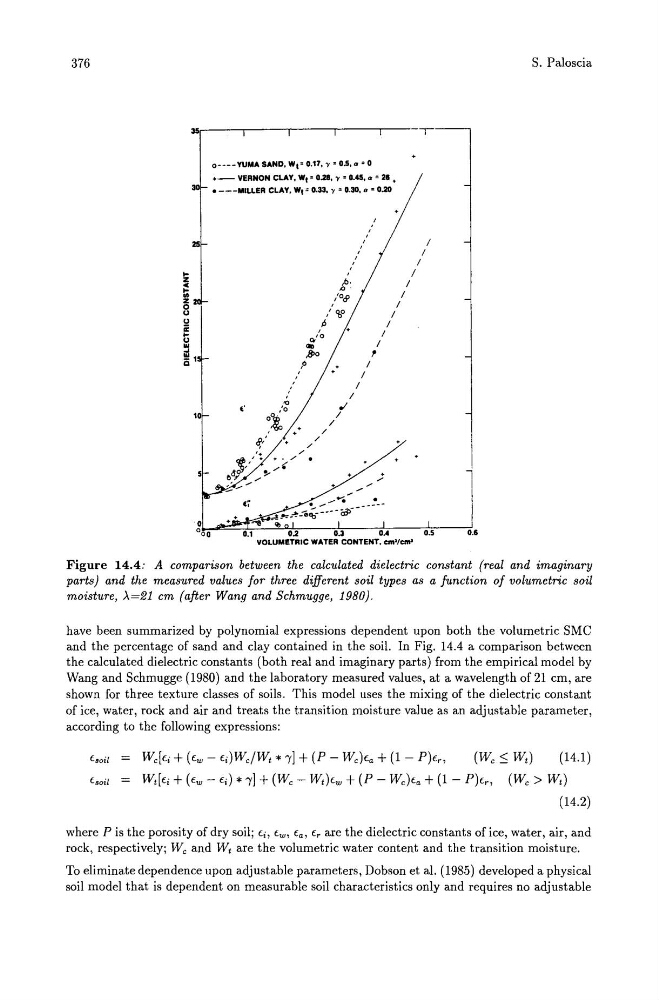
Figure 14.4: A comparison between the calculated dielectric constant (real and imaginary
parts) and the measured values for three different soil types as a function of volumetric soil
moisture, )..=21 cm (after Wang and Schmugge, 1980).
have been summarized by polynomial expressions dependent upon both the volumetric SMC
and the percentage of sand and clay contained in the soil. In Fig. 14.4 a comparison between
the calculated dielectric constants (both real and imaginary parts) from the empirical model by
Wang and Schmugge (1980) and the laboratory measured values, at a wavelength of 21 em, are
shown for three texture classes of soils. This model uses the mixing of the dielectric constant
of ice, water, rock and air and treats the transition moisture value as an adjustable parameter,
according to the following expressions:
(soil
(14.1 )
Esoil
Wt[Ei + (Ew - Ei) * ,] + (We - Wt)Ew + (P - We)Ea + (1 - P)En (We> Wt)
(14.2)
where P is the porosity of dry soil; Ei, Ew , Ea, Er are the dielectric constants of ice, water, air, and
rock, respectively; We and Wt are the volumetric water content and the transition moisture.
To eliminate dependence upon adjustable parameters, Dobson et al. (1985) developed a physical
soil model that is dependent on measurable soil characteristics only and requires no adjustable
~'r-----r-----~----,,-----r----,25
10
o----YUMA SAND, WI = 0.17, > = 0.5, a = 0
+ - VERNON CLAY, WI = 0.28, > = 0.4$, a = 21 +
• ---MILLER CLAY, WI = 0.33, > = 0.30, a = 0.20
"
,
,6,
,c'
/O~
" %0
P
,
",'0
a
,!po
,6
,
./
/
/
.
+
.;
I
/
I
tiP /! +. / / •
~d1"
• ./~
bOt'
..,.,,;;-'
:.:.-/
,
,
,
,
,
,
/
/
/
/
/
,
.
/
/
/
/
/
/
/
/
/
/
S. Paloscia
l
Figure 14.4: A comparison between the calculated dielectric constant (real and imaginary
parts) and the measured values for three different soil types as a function of volumetric soil
moisture, )..=21 cm (after Wang and Schmugge, 1980).
have been summarized by polynomial expressions dependent upon both the volumetric SMC
and the percentage of sand and clay contained in the soil. In Fig. 14.4 a comparison between
the calculated dielectric constants (both real and imaginary parts) from the empirical model by
Wang and Schmugge (1980) and the laboratory measured values, at a wavelength of 21 em, are
shown for three texture classes of soils. This model uses the mixing of the dielectric constant
of ice, water, rock and air and treats the transition moisture value as an adjustable parameter,
according to the following expressions:
(soil
(14.1 )
Esoil
Wt[Ei + (Ew - Ei) * ,] + (We - Wt)Ew + (P - We)Ea + (1 - P)En (We> Wt)
(14.2)
where P is the porosity of dry soil; Ei, Ew , Ea, Er are the dielectric constants of ice, water, air, and
rock, respectively; We and Wt are the volumetric water content and the transition moisture.
To eliminate dependence upon adjustable parameters, Dobson et al. (1985) developed a physical
soil model that is dependent on measurable soil characteristics only and requires no adjustable