

364
Eugene E. Clothiaux, Thomas P. Ackerman, David M. Babb
the resulting spectrum may look nothing like the original spectrum (Figure 13.23c) because of
the effects of turbulence and perhaps a mean vertical wind within the radar resolution volume.
Obviously, any drop size retrievals based solely on the spectrum S!(D) will contain serious
errors. Note, however, that the ratio of the peak of S;(D) (e.g., Figure 13.23a) to the peak of
S!(D) (e.g., Figure 13.23c) is a function only of the turbulent width v". and the modal diameter
Dm and can be calculated for all possible combinations of these two parameters, just as we
have done to generate the three panels in Figure 13.23. This fact motivates Gossard (1994) to
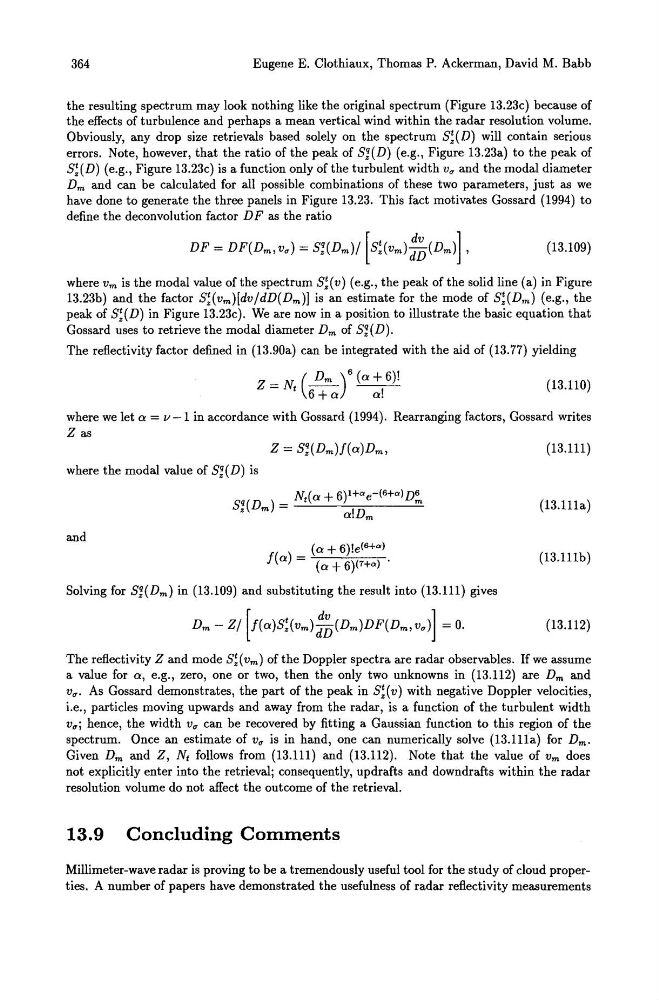
define the deconvolution factor D F as the ratio
(13.109)
where Vm is the modal value of the spectrum S!(v) (e.g., the peak of the solid line (a) in Figure
13.23b) and the factor S;(vm)[dvJdD(Dm)] is an estimate for the mode of S!(Dm) (e.g., the
peak of S!(D) in Figure 13.23c). We are now in a position to illustrate the basic equation that
Gossard uses to retrieve the modal diameter Dm of S~(D).
The reflectivity factor defined in (13.90a) can be integrated with the aid of (13.77) yielding
Z = Nt ( Dm )6 (a+6)!
6+a
a!
(13.110)
where we let a = v-I in accordance with Gossard (1994). Rearranging factors, Gossard writes
Z as
where the modal value of S~(D) is
and
q
_ Nt(a + 6)1+ae-(6+a)D~
Sz(Dm ) -
alD m
(a + 6)!e(6+a)
f(a) = (a + 6)(7+a)
Solving for SHDrn) in (13.109) and substituting the result into (13.111) gives
Dm - ZJ [J(a)S!(vm) :;(Dm)DF(Dm, V".)] = O.
(13.111)
(13.111a)
(13.111b)
(13.112)
The reflectivity Z and mode S!( vm ) of the Doppler spectra are radar observables. If we assume
a value for a, e.g., zero, one or two, then the only two unknowns in (13.112) are Dm and
v".. As Gossard demonstrates, the part of the peak in S!(v) with negative Doppler velocities,
i.e., particles moving upwards and away from the radar, is a function of the turbulent width
v".; hence, the width v". can be recovered by fitting a Gaussian function to this region of the
spectrum. Once an estimate of v". is in hand, one can numerically solve (13.111a) for Dm.
Given Dm and Z, Nt follows from (13.111) and (13.112). Note that the value of Vm does
not explicitly enter into the retrieval; consequently, updrafts and downdrafts within the radar
resolution volume do not affect the outcome of the retrieval.
13.9 Concluding Comments
Millimeter-wave radar is proving to be a tremendously useful tool for the study of cloud properties. A number of papers have demonstrated the usefulness of radar reflectivity measurements
Eugene E. Clothiaux, Thomas P. Ackerman, David M. Babb
the resulting spectrum may look nothing like the original spectrum (Figure 13.23c) because of
the effects of turbulence and perhaps a mean vertical wind within the radar resolution volume.
Obviously, any drop size retrievals based solely on the spectrum S!(D) will contain serious
errors. Note, however, that the ratio of the peak of S;(D) (e.g., Figure 13.23a) to the peak of
S!(D) (e.g., Figure 13.23c) is a function only of the turbulent width v". and the modal diameter
Dm and can be calculated for all possible combinations of these two parameters, just as we
have done to generate the three panels in Figure 13.23. This fact motivates Gossard (1994) to
define the deconvolution factor D F as the ratio
(13.109)
where Vm is the modal value of the spectrum S!(v) (e.g., the peak of the solid line (a) in Figure
13.23b) and the factor S;(vm)[dvJdD(Dm)] is an estimate for the mode of S!(Dm) (e.g., the
peak of S!(D) in Figure 13.23c). We are now in a position to illustrate the basic equation that
Gossard uses to retrieve the modal diameter Dm of S~(D).
The reflectivity factor defined in (13.90a) can be integrated with the aid of (13.77) yielding
Z = Nt ( Dm )6 (a+6)!
6+a
a!
(13.110)
where we let a = v-I in accordance with Gossard (1994). Rearranging factors, Gossard writes
Z as
where the modal value of S~(D) is
and
q
_ Nt(a + 6)1+ae-(6+a)D~
Sz(Dm ) -
alD m
(a + 6)!e(6+a)
f(a) = (a + 6)(7+a)
Solving for SHDrn) in (13.109) and substituting the result into (13.111) gives
Dm - ZJ [J(a)S!(vm) :;(Dm)DF(Dm, V".)] = O.
(13.111)
(13.111a)
(13.111b)
(13.112)
The reflectivity Z and mode S!( vm ) of the Doppler spectra are radar observables. If we assume
a value for a, e.g., zero, one or two, then the only two unknowns in (13.112) are Dm and
v".. As Gossard demonstrates, the part of the peak in S!(v) with negative Doppler velocities,
i.e., particles moving upwards and away from the radar, is a function of the turbulent width
v".; hence, the width v". can be recovered by fitting a Gaussian function to this region of the
spectrum. Once an estimate of v". is in hand, one can numerically solve (13.111a) for Dm.
Given Dm and Z, Nt follows from (13.111) and (13.112). Note that the value of Vm does
not explicitly enter into the retrieval; consequently, updrafts and downdrafts within the radar
resolution volume do not affect the outcome of the retrieval.
13.9 Concluding Comments
Millimeter-wave radar is proving to be a tremendously useful tool for the study of cloud properties. A number of papers have demonstrated the usefulness of radar reflectivity measurements