

Ground-Based Remote Sensing of Cloud Properties ...
361
and Doppler width, to retrieve the particle size distributions in light drizzle and stratus clouds
with no drizzle. For both of these conditions, Frisch et al. (1995) assume that a lognormal
distribution is an adequate model. Therefore, their retrieval amounts to inferring the particle
number density Nt, scaling diameter Dn and distribution width 17, of a lognormal distribution
from the three Doppler moments.
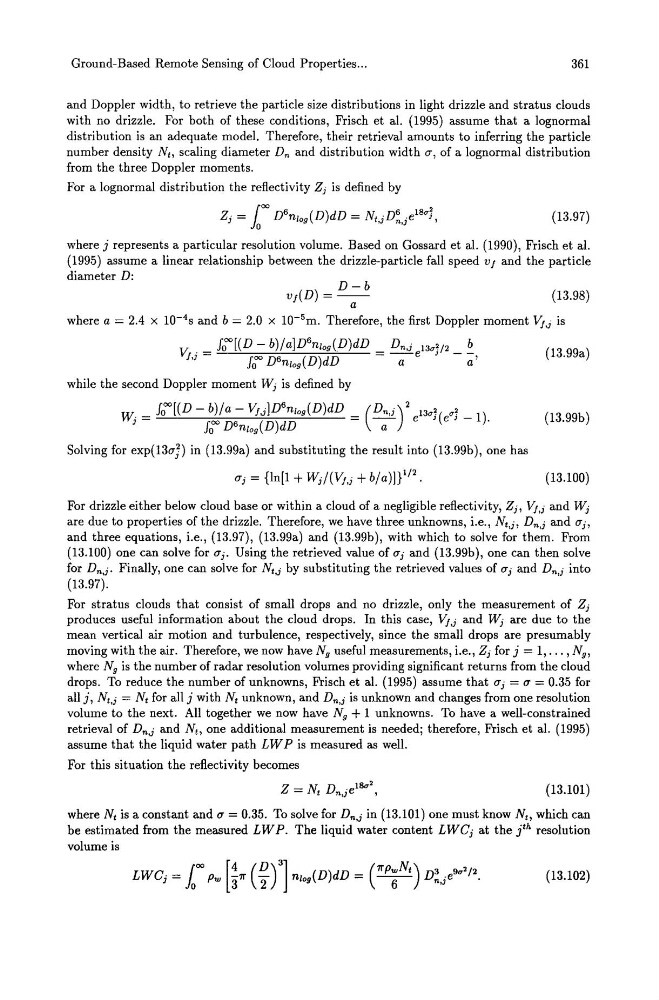
For a lognormal distribution the reflectivity Zj is defined by
(13.97)
where j represents a particular resolution volume. Based on Gossard et al. (1990), Frisch et al.
(1995) assume a linear relationship between the drizzle-particle fall speed Vj and the particle
diameter D:
D-b
vj(D) = - -
a
(13.98)
where a = 2.4 x 1O- 4 s and b = 2.0 x 1O- 5 m. Therefore, the first Doppler moment Vj,j is
Vj . = IoOO[(D - b)/a)D6nlog(D)dD = Dn,j e130"~/2 _ ~
,3
IoOOD6nlog(D)dD
a
a'
while the second Doppler moment Wj is defined by
W . = IoOO[(D - b)/a - Vj,j)D6nlog(D)dD = (Dn,j)2 130"J( O"J _ )
3
1000 D6 n1og (D)dD
a
e e l .
Solving for exp(131JJ) in (13.99a) and substituting the result into (13.99b), one has
IJj = {In[l + Wj/(Vj,j + b/a)]}1/2 .
(13.99a)
(13.99b)
(13.100)
For drizzle either below cloud base or within a cloud of a negligible reflectivity, Zj, Vj,j and Wj
are due to properties of the drizzle. Therefore, we have three unknowns, i.e., Nt,;, Dn,j and IJj,
and three equations, i.e., (13.97), (13.99a) and (13.99b), with which to solve for them. From
(13.100) one can solve for IJj. Using the retrieved value of IJj and (13.99b), one can then solve
for Dn,j' Finally, one can solve for Nt,j by substituting the retrieved values of IJj and Dn,j into
(13.97).
For stratus clouds that consist of small drops and no drizzle, only the measurement of Zj
produces useful information about the cloud drops. In this case, Vj,j and Wj are due to the
mean vertical air motion and turbulence, respectively, since the small drops are presumably
moving with the air. Therefore, we now have Ng useful measurements, i.e., Zj for j = 1, ... , Ng ,
where Ng is the number of radar resolution volumes providing significant returns from the cloud
drops. To reduce the number of unknowns, Frisch et al. (1995) assume that IJj = 17 = 0.35 for
all j, Nt,j = Nt for all j with Nt unknown, and Dn,j is unknown and changes from one resolution
volume to the next. All together we now have Ng + 1 unknowns. To have a well-constrained
retrieval of Dn,j and Nt, one additional measurement is needed; therefore, Frisch et al. (1995)
assume that the liquid water path LW P is measured as well.
For this situation the reflectivity becomes
(13.101 )
where Nt is a constant and 17 = 0.35. To solve for D",j in (13.101) one must know Nt, which can
be estimated from the measured LW P. The liquid water content LWej at the ph resolution
volume is
(13.102)
361
and Doppler width, to retrieve the particle size distributions in light drizzle and stratus clouds
with no drizzle. For both of these conditions, Frisch et al. (1995) assume that a lognormal
distribution is an adequate model. Therefore, their retrieval amounts to inferring the particle
number density Nt, scaling diameter Dn and distribution width 17, of a lognormal distribution
from the three Doppler moments.
For a lognormal distribution the reflectivity Zj is defined by
(13.97)
where j represents a particular resolution volume. Based on Gossard et al. (1990), Frisch et al.
(1995) assume a linear relationship between the drizzle-particle fall speed Vj and the particle
diameter D:
D-b
vj(D) = - -
a
(13.98)
where a = 2.4 x 1O- 4 s and b = 2.0 x 1O- 5 m. Therefore, the first Doppler moment Vj,j is
Vj . = IoOO[(D - b)/a)D6nlog(D)dD = Dn,j e130"~/2 _ ~
,3
IoOOD6nlog(D)dD
a
a'
while the second Doppler moment Wj is defined by
W . = IoOO[(D - b)/a - Vj,j)D6nlog(D)dD = (Dn,j)2 130"J( O"J _ )
3
1000 D6 n1og (D)dD
a
e e l .
Solving for exp(131JJ) in (13.99a) and substituting the result into (13.99b), one has
IJj = {In[l + Wj/(Vj,j + b/a)]}1/2 .
(13.99a)
(13.99b)
(13.100)
For drizzle either below cloud base or within a cloud of a negligible reflectivity, Zj, Vj,j and Wj
are due to properties of the drizzle. Therefore, we have three unknowns, i.e., Nt,;, Dn,j and IJj,
and three equations, i.e., (13.97), (13.99a) and (13.99b), with which to solve for them. From
(13.100) one can solve for IJj. Using the retrieved value of IJj and (13.99b), one can then solve
for Dn,j' Finally, one can solve for Nt,j by substituting the retrieved values of IJj and Dn,j into
(13.97).
For stratus clouds that consist of small drops and no drizzle, only the measurement of Zj
produces useful information about the cloud drops. In this case, Vj,j and Wj are due to the
mean vertical air motion and turbulence, respectively, since the small drops are presumably
moving with the air. Therefore, we now have Ng useful measurements, i.e., Zj for j = 1, ... , Ng ,
where Ng is the number of radar resolution volumes providing significant returns from the cloud
drops. To reduce the number of unknowns, Frisch et al. (1995) assume that IJj = 17 = 0.35 for
all j, Nt,j = Nt for all j with Nt unknown, and Dn,j is unknown and changes from one resolution
volume to the next. All together we now have Ng + 1 unknowns. To have a well-constrained
retrieval of Dn,j and Nt, one additional measurement is needed; therefore, Frisch et al. (1995)
assume that the liquid water path LW P is measured as well.
For this situation the reflectivity becomes
(13.101 )
where Nt is a constant and 17 = 0.35. To solve for D",j in (13.101) one must know Nt, which can
be estimated from the measured LW P. The liquid water content LWej at the ph resolution
volume is
(13.102)