

24
E. Raschke
data, although urgently required. Many studies are made with most available shipborne measurements and summarized in the " Bunker-Atlas from the Northern Atlantic Ocean" by Isemer
and Hasse (1987). Most recent analyses are summarized by Da Silva et al. (1994). An example
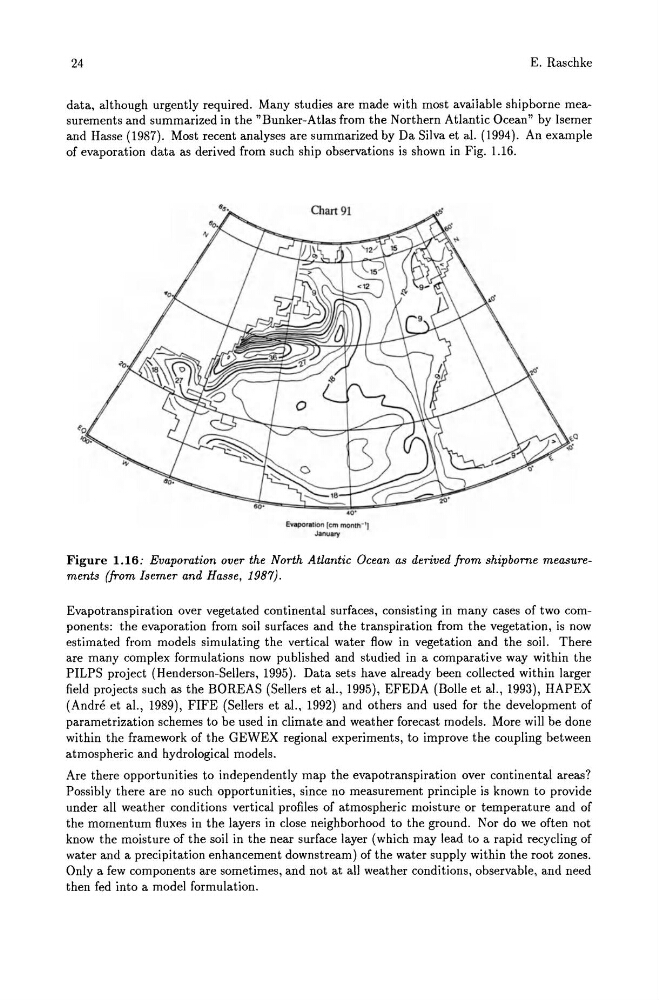
of evaporation data as derived from such ship observations is shown in Fig. 1.16.
EvaporatIon (em month · 1,
JM1u,ry
Figure 1.16: Evaporation over the North Atlantic Ocean as derived from shipbome measurements (from Isemer and Hasse, 1987).
Evapotranspiration over vegetated continental surfaces, consisting in many cases of two components: the evaporation from soil surfaces and the transpiration from the vegetation, is now
estimated from models simulating the vertical water flow in vegetation and the soil. There
are many complex formulations now published and studied in a comparative way within the
PILPS project (Henderson-Sellers, 1995). Data sets have already been collected within larger
field projects such as the BOREAS (Sellers et al., 1995), EFEDA (Bolle et al., 1993), HAPEX
(Andre et al., 1989), FIFE (Sellers et al., 1992) and others and used for the development of
parametrization schemes to be used in climate and weather forecast models. More will be done
within the framework of the GEWEX regional experiments, to improve the coupling between
atmospheric and hydrological models.
Are there opportunities to independently map the evapotranspiration over continental areas?
Possibly there are no such opportunities, since no measurement principle is known to provide
under all weather conditions vertical profiles of atmospheric moisture or temperature and of
the momentum fluxes in the layers in close neighborhood to the ground. Nor do we often not
know the moisture of the soil in the near surface layer (which may lead to a rapid recycling of
water and a precipitation enhancement downstream) of the water supply within the root zones.
Only a few components are sometimes, and not at all weather conditions, observable, and need
then fed into a model formulation.
E. Raschke
data, although urgently required. Many studies are made with most available shipborne measurements and summarized in the " Bunker-Atlas from the Northern Atlantic Ocean" by Isemer
and Hasse (1987). Most recent analyses are summarized by Da Silva et al. (1994). An example
of evaporation data as derived from such ship observations is shown in Fig. 1.16.
EvaporatIon (em month · 1,
JM1u,ry
Figure 1.16: Evaporation over the North Atlantic Ocean as derived from shipbome measurements (from Isemer and Hasse, 1987).
Evapotranspiration over vegetated continental surfaces, consisting in many cases of two components: the evaporation from soil surfaces and the transpiration from the vegetation, is now
estimated from models simulating the vertical water flow in vegetation and the soil. There
are many complex formulations now published and studied in a comparative way within the
PILPS project (Henderson-Sellers, 1995). Data sets have already been collected within larger
field projects such as the BOREAS (Sellers et al., 1995), EFEDA (Bolle et al., 1993), HAPEX
(Andre et al., 1989), FIFE (Sellers et al., 1992) and others and used for the development of
parametrization schemes to be used in climate and weather forecast models. More will be done
within the framework of the GEWEX regional experiments, to improve the coupling between
atmospheric and hydrological models.
Are there opportunities to independently map the evapotranspiration over continental areas?
Possibly there are no such opportunities, since no measurement principle is known to provide
under all weather conditions vertical profiles of atmospheric moisture or temperature and of
the momentum fluxes in the layers in close neighborhood to the ground. Nor do we often not
know the moisture of the soil in the near surface layer (which may lead to a rapid recycling of
water and a precipitation enhancement downstream) of the water supply within the root zones.
Only a few components are sometimes, and not at all weather conditions, observable, and need
then fed into a model formulation.