

Precipitation at the Ground: Radar Techniques
297
IO·=-O--~---:------,!----o--~
D. mm
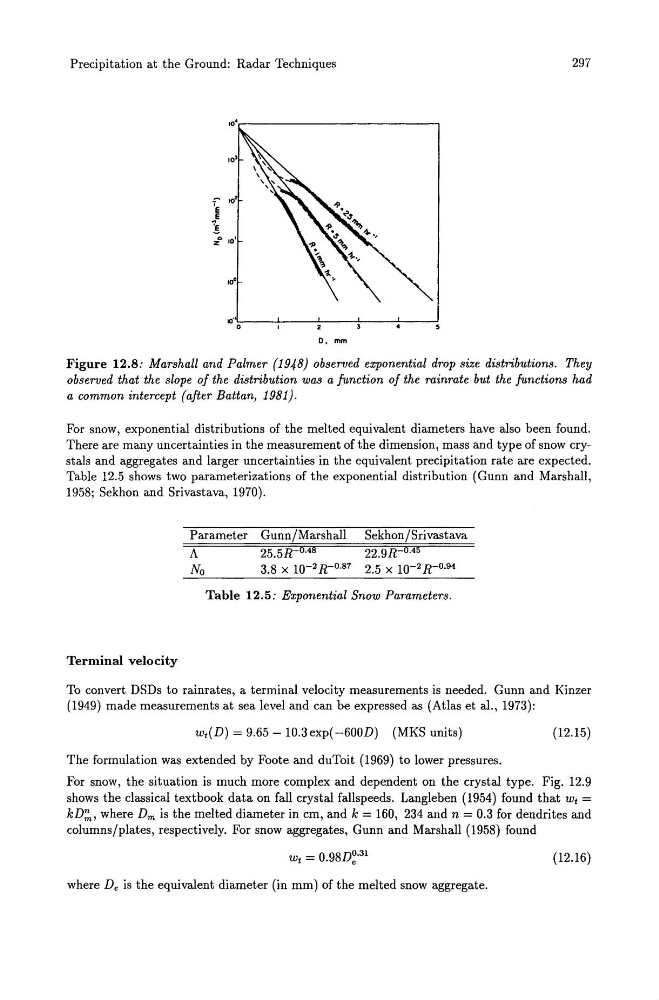
Figure 12.8: Marshall and Palmer (1948) observed exponential drop size distributions. They
observed that the slope of the distribution was a function of the rainrate but the functions had
a common intercept (after Battan, 1981)'
For snow, exponential distributions of the melted equivalent diameters have also been found.
There are many uncertainties in the measurement of the dimension, mass and type of snow crystals and aggregates and larger uncertainties in the equivalent precipitation rate are expected.
Table 12.5 shows two parameterizations of the exponential distribution (Gunn and Marshall,
1958; Sekhon and Srivastava, 1970).
Parameter Gunn/Marshall Sekhon/Srivastava
A
25.5R 0.48
22.9R 0.45
No
3.8 X 10- 2 R- 0 . 87 2.5 x 10- 2 R- 0 . 94
Table 12.5: Exponential Snow Parameters.
Terminal velocity
To convert DSDs to rainrates, a terminal velocity measurements is needed. Gunn and Kinzer
(1949) made measurements at sea level and can be expressed as (Atlas et aL, 1973):
Wt(D) = 9.65 -1O.3exp(-600D) (MKS units)
(12.15)
The formulation was extended by Foote and duToit (1969) to lower pressures.
For snow, the situation is much more complex and dependent on the crystal type. Fig. 12.9
shows the classical textbook data on fall crystal fallspeeds. Langleben (1954) found that Wt =
kD':,., where Dm is the melted diameter in cm, and k = 160, 234 and n = 0.3 for dendrites and
columns/plates, respectively. For snow aggregates, Gunn and Marshall (1958) found
Wt = 0.98D~·31
(12.16)
where De is the equivalent diameter (in mm) of the melted snow aggregate.
297
IO·=-O--~---:------,!----o--~
D. mm
Figure 12.8: Marshall and Palmer (1948) observed exponential drop size distributions. They
observed that the slope of the distribution was a function of the rainrate but the functions had
a common intercept (after Battan, 1981)'
For snow, exponential distributions of the melted equivalent diameters have also been found.
There are many uncertainties in the measurement of the dimension, mass and type of snow crystals and aggregates and larger uncertainties in the equivalent precipitation rate are expected.
Table 12.5 shows two parameterizations of the exponential distribution (Gunn and Marshall,
1958; Sekhon and Srivastava, 1970).
Parameter Gunn/Marshall Sekhon/Srivastava
A
25.5R 0.48
22.9R 0.45
No
3.8 X 10- 2 R- 0 . 87 2.5 x 10- 2 R- 0 . 94
Table 12.5: Exponential Snow Parameters.
Terminal velocity
To convert DSDs to rainrates, a terminal velocity measurements is needed. Gunn and Kinzer
(1949) made measurements at sea level and can be expressed as (Atlas et aL, 1973):
Wt(D) = 9.65 -1O.3exp(-600D) (MKS units)
(12.15)
The formulation was extended by Foote and duToit (1969) to lower pressures.
For snow, the situation is much more complex and dependent on the crystal type. Fig. 12.9
shows the classical textbook data on fall crystal fallspeeds. Langleben (1954) found that Wt =
kD':,., where Dm is the melted diameter in cm, and k = 160, 234 and n = 0.3 for dendrites and
columns/plates, respectively. For snow aggregates, Gunn and Marshall (1958) found
Wt = 0.98D~·31
(12.16)
where De is the equivalent diameter (in mm) of the melted snow aggregate.