

Precipitation at the Ground: Radar Techniques
291
• Radar Range Equation: In interpreting radar received power measurements in terms of
the meteorological parameter Z by the radar range equation, there are many assumptions.
Non-conformity with the assumptions can cause error.
.00 ,-----------------------------------------------------,
2.
!
I'
I
.~
·so
·15
·15
·so
.00
WEST·EAST (KMJ
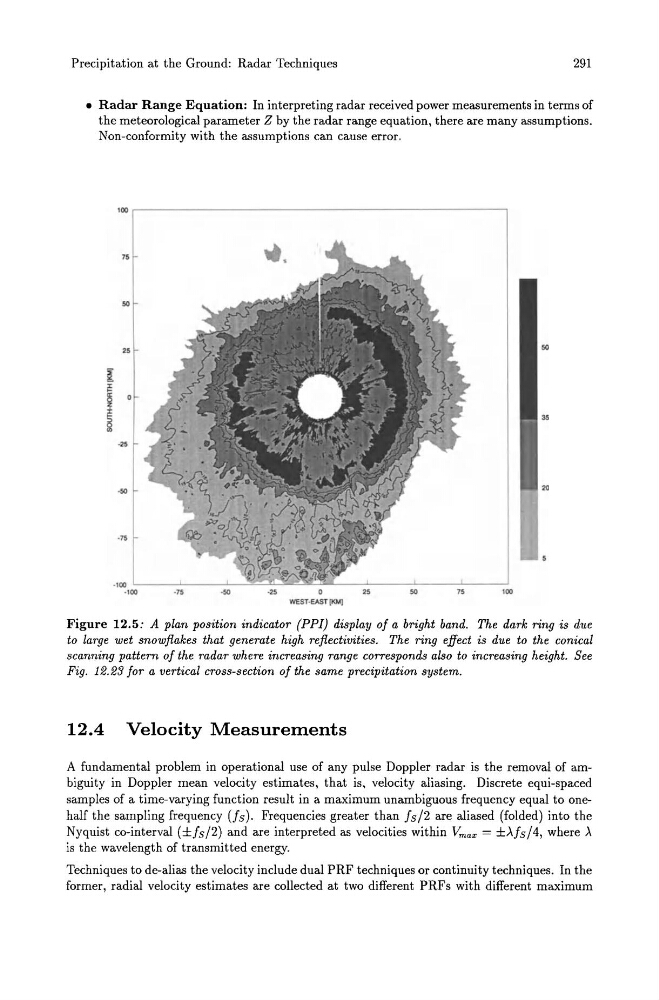
Figure 12.5: A plan position indicator (PPI) display of a bright band. The dark ring is due
to large wet snowflakes that generate high reflectivities. The ring effect is due to the conical
scanning pattern of the radar where increasing range corresponds also to increasing height. See
Fig. 12.23 for a vertical cross-section of the same precipitation system.
12.4 Velocity Measurements
A fundamental problem in operational use of any pulse Doppler radar is the removal of ambiguity in Doppler mean velocity estimates, that is, velocity aliasing. Discrete equi-spaced
samples of a time-varying function result in a maximum unambiguous frequency equal to onehalf the sampling frequency (Is). Frequencies greater than fs/2 are aliased (folded) into the
Nyquist co-interval (±fs/2) and are interpreted as velocities within Vmax = ±)..fs/4, where )..
is the wavelength of transmitted energy.
Techniques to de-alias the velocity include dual PRF techniques or continuity techniques. In the
former, radial velocity estimates are collected at two different PRFs with different maximum
291
• Radar Range Equation: In interpreting radar received power measurements in terms of
the meteorological parameter Z by the radar range equation, there are many assumptions.
Non-conformity with the assumptions can cause error.
.00 ,-----------------------------------------------------,
2.
!
I'
I
.~
·so
·15
·15
·so
.00
WEST·EAST (KMJ
Figure 12.5: A plan position indicator (PPI) display of a bright band. The dark ring is due
to large wet snowflakes that generate high reflectivities. The ring effect is due to the conical
scanning pattern of the radar where increasing range corresponds also to increasing height. See
Fig. 12.23 for a vertical cross-section of the same precipitation system.
12.4 Velocity Measurements
A fundamental problem in operational use of any pulse Doppler radar is the removal of ambiguity in Doppler mean velocity estimates, that is, velocity aliasing. Discrete equi-spaced
samples of a time-varying function result in a maximum unambiguous frequency equal to onehalf the sampling frequency (Is). Frequencies greater than fs/2 are aliased (folded) into the
Nyquist co-interval (±fs/2) and are interpreted as velocities within Vmax = ±)..fs/4, where )..
is the wavelength of transmitted energy.
Techniques to de-alias the velocity include dual PRF techniques or continuity techniques. In the
former, radial velocity estimates are collected at two different PRFs with different maximum