

284
P. Joe
Thus Vmax and rmax are related by the equation:
(12.8)
These relationships show the limits imposed by the selection of the PRF. A high PRF is
desirable to increase the unambiguous velocity; a low PRF is desirable to increase the radar
range. A compromise is required until better technology is available to retrieve the information
unambiguously outside these limits. The relationship also shows that the longer wavelengths
have higher limits. In numerical terms, for a typical S-band radar with a PRF of 1000 Hz,
Vmax = ±25 m S-I, while for an X-band radar Vmax = ±8 m S-I.
Some Doppler radars are fully coherent radars; that is, their transmitters employ very stable
microwave sources, usually Klystrons, which maintain the same phase from pulse to pulse. A
semi coherent radar is more common; the microwave source is usually a magnetron, where the
phase of successive pulses is random. The Doppler information is extracted in the processing by
retaining the phase of each transmitted pulse for comparison. The advantage of the magnetron
is their lower cost. The advantages of the Klystron are the greater stability and ability to
produce higher power. In general, non-coherent radars can be converted relatively easily to a
semi coherent Doppler system. The conversion should also include the more stable coaxial type
magnetron.
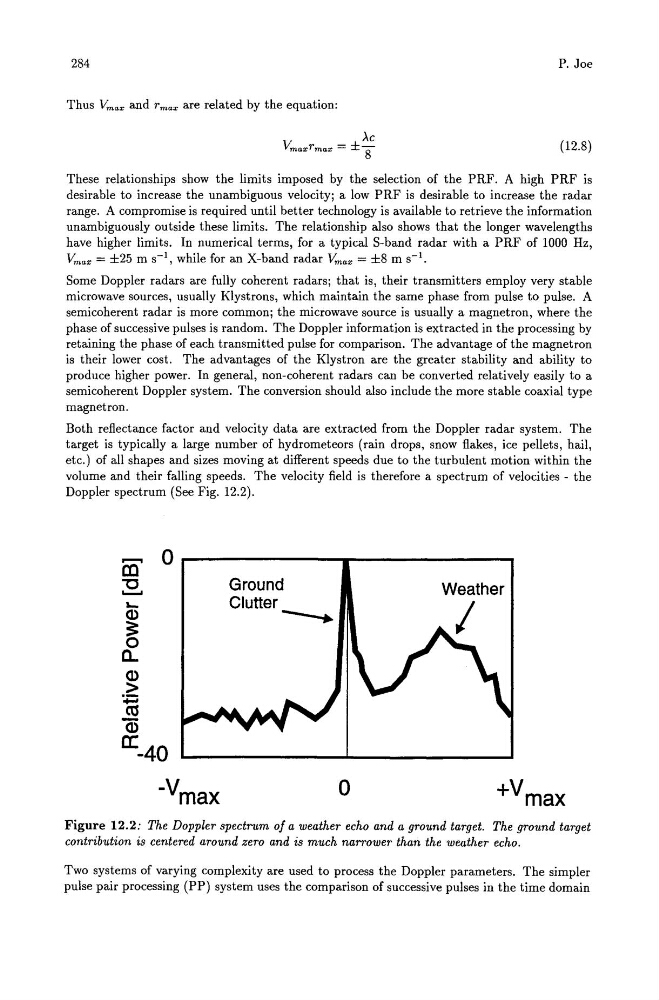
Both reflectance factor and velocity data are extracted from the Doppler radar system. The
target is typically a large number of hydrometeors (rain drops, snow flakes, ice pellets, hail,
etc.) of all shapes and sizes moving at different speeds due to the turbulent motion within the
volume and their falling speeds. The velocity field is therefore a spectrum of velocities - the
Doppler spectrum (See Fig. 12.2).
o
Ground
Clutter
----.
o
Figure 12.2: The Doppler spectrum of a weather echo and a ground target. The ground target
contribution is centered around zero and is much narrower than the weather echo.
Two systems of varying complexity are used to process the Doppler parameters. The simpler
pulse pair processing (PP) system uses the comparison of successive pulses in the time domain
P. Joe
Thus Vmax and rmax are related by the equation:
(12.8)
These relationships show the limits imposed by the selection of the PRF. A high PRF is
desirable to increase the unambiguous velocity; a low PRF is desirable to increase the radar
range. A compromise is required until better technology is available to retrieve the information
unambiguously outside these limits. The relationship also shows that the longer wavelengths
have higher limits. In numerical terms, for a typical S-band radar with a PRF of 1000 Hz,
Vmax = ±25 m S-I, while for an X-band radar Vmax = ±8 m S-I.
Some Doppler radars are fully coherent radars; that is, their transmitters employ very stable
microwave sources, usually Klystrons, which maintain the same phase from pulse to pulse. A
semi coherent radar is more common; the microwave source is usually a magnetron, where the
phase of successive pulses is random. The Doppler information is extracted in the processing by
retaining the phase of each transmitted pulse for comparison. The advantage of the magnetron
is their lower cost. The advantages of the Klystron are the greater stability and ability to
produce higher power. In general, non-coherent radars can be converted relatively easily to a
semi coherent Doppler system. The conversion should also include the more stable coaxial type
magnetron.
Both reflectance factor and velocity data are extracted from the Doppler radar system. The
target is typically a large number of hydrometeors (rain drops, snow flakes, ice pellets, hail,
etc.) of all shapes and sizes moving at different speeds due to the turbulent motion within the
volume and their falling speeds. The velocity field is therefore a spectrum of velocities - the
Doppler spectrum (See Fig. 12.2).
o
Ground
Clutter
----.
o
Figure 12.2: The Doppler spectrum of a weather echo and a ground target. The ground target
contribution is centered around zero and is much narrower than the weather echo.
Two systems of varying complexity are used to process the Doppler parameters. The simpler
pulse pair processing (PP) system uses the comparison of successive pulses in the time domain