

270
C. Simmer
11.8.1 Different footprint resolution of microwave radiometers
The angular beam width () of microwave radiometer depends on frequency and is roughly given
by:
(11.14)
with A the wavelength of the measured radiation and d the diameter of the measuring antenna.
Due to technical restriction (one common antenna for several frequencies) the footprints of the
different channels of a microwave radiometers differ from each other substantially. For SSM/I
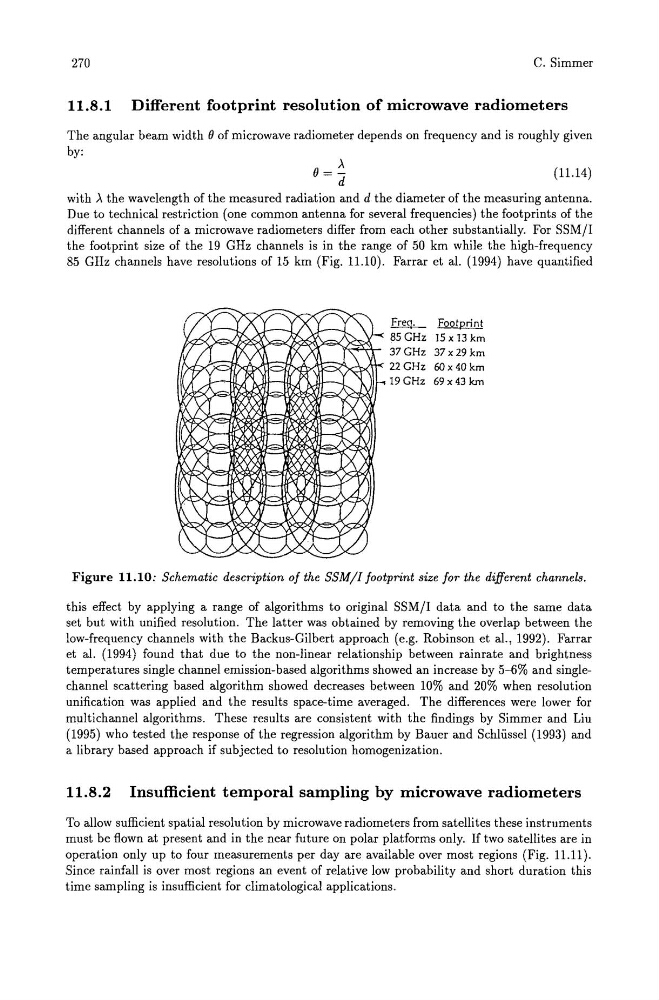
the footprint size of the 19 GHz channels is in the range of 50 km while the high-frequency
85 GHz channels have resolutions of 15 km (Fig. 11.10). Farrar et al. (1994) have quantified
ELm- Footprint
8SGHz 15 x 13 km
37GHz 37x29 km
22GHz 6Ox40 km
19GHz 69x43 km
Figure 11.10: Schematic description of the SSM/I footprint size for the different channels.
this effect by applying a range of algorithms to original SSM/I data and to the same data
set but with unified resolution. The latter was obtained by removing the overlap between the
low-frequency channels with the Backus-Gilbert approach (e.g. Robinson et al., 1992). Farrar
et al. (1994) found that due to the non-linear relationship between rainrate and brightness
temperatures single channel emission-based algorithms showed an increase by 5-6% and singlechannel scattering based algorithm showed decreases between 10% and 20% when resolution
unification was applied and the results space-time averaged. The differences were lower for
multichannel algorithms. These results are consistent with the findings by Simmer and Liu
(1995) who tested the response of the regression algorithm by Bauer and Schliissel (1993) and
a library based approach if subjected to resolution homogenization.
11.8.2 Insufficient temporal sampling by microwave radiometers
To allow sufficient spatial resolution by microwave radiometers from satellites these instruments
must be flown at present and in the near future on polar platforms only. If two satellites are in
operation only up to four measurements per day are available over most regions (Fig. 11.11).
Since rainfall is over most regions an event of relative low probability and short duration this
time sampling is insufficient for climatological applications.
C. Simmer
11.8.1 Different footprint resolution of microwave radiometers
The angular beam width () of microwave radiometer depends on frequency and is roughly given
by:
(11.14)
with A the wavelength of the measured radiation and d the diameter of the measuring antenna.
Due to technical restriction (one common antenna for several frequencies) the footprints of the
different channels of a microwave radiometers differ from each other substantially. For SSM/I
the footprint size of the 19 GHz channels is in the range of 50 km while the high-frequency
85 GHz channels have resolutions of 15 km (Fig. 11.10). Farrar et al. (1994) have quantified
ELm- Footprint
8SGHz 15 x 13 km
37GHz 37x29 km
22GHz 6Ox40 km
19GHz 69x43 km
Figure 11.10: Schematic description of the SSM/I footprint size for the different channels.
this effect by applying a range of algorithms to original SSM/I data and to the same data
set but with unified resolution. The latter was obtained by removing the overlap between the
low-frequency channels with the Backus-Gilbert approach (e.g. Robinson et al., 1992). Farrar
et al. (1994) found that due to the non-linear relationship between rainrate and brightness
temperatures single channel emission-based algorithms showed an increase by 5-6% and singlechannel scattering based algorithm showed decreases between 10% and 20% when resolution
unification was applied and the results space-time averaged. The differences were lower for
multichannel algorithms. These results are consistent with the findings by Simmer and Liu
(1995) who tested the response of the regression algorithm by Bauer and Schliissel (1993) and
a library based approach if subjected to resolution homogenization.
11.8.2 Insufficient temporal sampling by microwave radiometers
To allow sufficient spatial resolution by microwave radiometers from satellites these instruments
must be flown at present and in the near future on polar platforms only. If two satellites are in
operation only up to four measurements per day are available over most regions (Fig. 11.11).
Since rainfall is over most regions an event of relative low probability and short duration this
time sampling is insufficient for climatological applications.