

Retrieval of Precipitation from Satellites
,.......,
..c::
-- 8
S
Q.)
- '" ..... c
'a
~
100-t---,..,-,h-,----'.-,.,-rr'-,--,-,--,.--l f-:::-r-rTTm-rT-,-'-.---.-r-r-:::--+
@~
)f;5~~ ~
1 0 0 ~ ~ ' \ ~ ~ \ ~ \ '
\~ \\:::;==¢.=\ \~\ \ \ ~ \ \ ~ ~ \ ~~/~I ~ ~ : : ' : : : : : : ' : : : / = =
I ~ I = = ; : " ' ' ' '
©
®
so
so 1
~"?i; \J
/'
~
~~ ~
U\
~
o~i
lbJ
1[\
1
- --2;1
0
90
1800
90
180
Scattering Angle [ 0]
Scattering Angle [ 0]
255
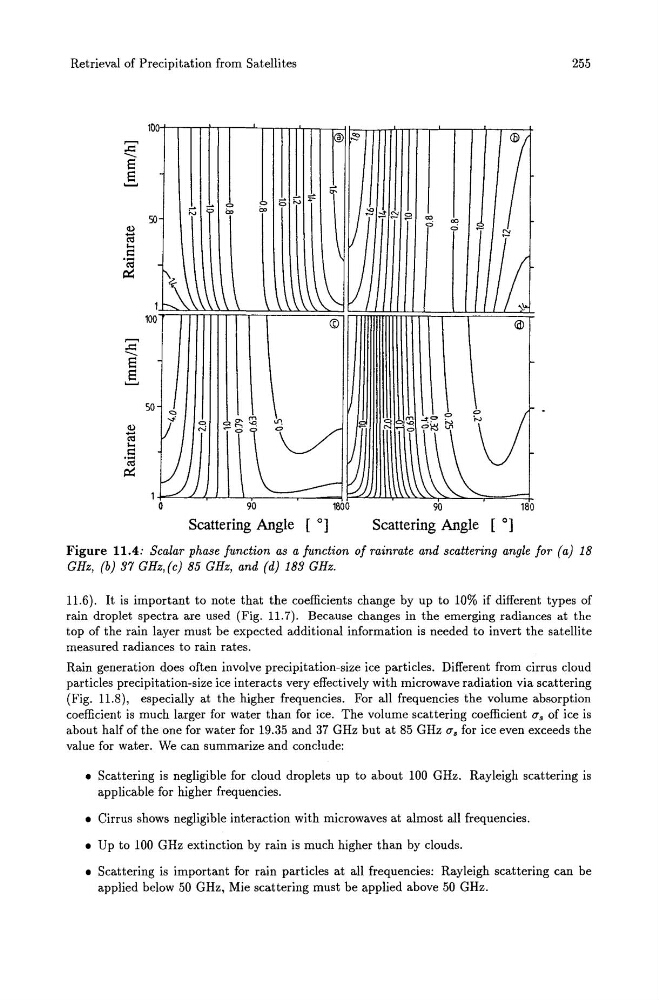
Figure 11.4: Scalar phase function as a function of rainrate and scattering angle for (aJ 18
GHz, (b) 37 GHz,{c) 85 GHz, and (d) 183 GHz.
11.6). It is important to note that the coefficients change by up to 10% if different types of
rain droplet spectra are used (Fig. 11.7). Because changes in the emerging radiances at the
top of the rain layer must be expected additional information is needed to invert the satellite
measured radiances to rain rates.
Rain generation does often involve precipitation-size ice particles. Different from cirrus cloud
particles precipitation-size ice interacts very effectively with microwave radiation via scattering
(Fig. 11.8), especially at the higher frequencies. For all frequencies the volume absorption
coefficient is much larger for water than for ice. The volume scattering coefficient (7. of ice is
about half of the one for water for 19.35 and 37 GHz but at 85 GHz (7. for ice even exceeds the
value for water. We can summarize and conclude:
• Scattering is negligible for cloud droplets up to about 100 GHz. Rayleigh scattering is
applicable for higher frequencies.
• Cirrus shows negligible interaction with microwaves at almost all frequencies.
• Up to 100 GHz extinction by rain is much higher than by clouds.
• Scattering is important for rain particles at all frequencies: Rayleigh scattering can be
applied below 50 GHz, Mie scattering must be applied above 50 GHz.
,.......,
..c::
-- 8
S
Q.)
- '" ..... c
'a
~
100-t---,..,-,h-,----'.-,.,-rr'-,--,-,--,.--l f-:::-r-rTTm-rT-,-'-.---.-r-r-:::--+
@~
)f;5~~ ~
1 0 0 ~ ~ ' \ ~ ~ \ ~ \ '
\~ \\:::;==¢.=\ \~\ \ \ ~ \ \ ~ ~ \ ~~/~I ~ ~ : : ' : : : : : : ' : : : / = =
I ~ I = = ; : " ' ' ' '
©
®
so
so 1
~"?i; \J
/'
~
~~ ~
U\
~
o~i
lbJ
1[\
1
- --2;1
0
90
1800
90
180
Scattering Angle [ 0]
Scattering Angle [ 0]
255
Figure 11.4: Scalar phase function as a function of rainrate and scattering angle for (aJ 18
GHz, (b) 37 GHz,{c) 85 GHz, and (d) 183 GHz.
11.6). It is important to note that the coefficients change by up to 10% if different types of
rain droplet spectra are used (Fig. 11.7). Because changes in the emerging radiances at the
top of the rain layer must be expected additional information is needed to invert the satellite
measured radiances to rain rates.
Rain generation does often involve precipitation-size ice particles. Different from cirrus cloud
particles precipitation-size ice interacts very effectively with microwave radiation via scattering
(Fig. 11.8), especially at the higher frequencies. For all frequencies the volume absorption
coefficient is much larger for water than for ice. The volume scattering coefficient (7. of ice is
about half of the one for water for 19.35 and 37 GHz but at 85 GHz (7. for ice even exceeds the
value for water. We can summarize and conclude:
• Scattering is negligible for cloud droplets up to about 100 GHz. Rayleigh scattering is
applicable for higher frequencies.
• Cirrus shows negligible interaction with microwaves at almost all frequencies.
• Up to 100 GHz extinction by rain is much higher than by clouds.
• Scattering is important for rain particles at all frequencies: Rayleigh scattering can be
applied below 50 GHz, Mie scattering must be applied above 50 GHz.