

Retrieval of Precipitation from Satellites
253
the same magnitude and show similar spectral behaviour as for water for small wavelengths up
to the thermal infrared window. In the microwaves the real part approaches a constant value
of about 1. 78 and the imaginary part is very small.
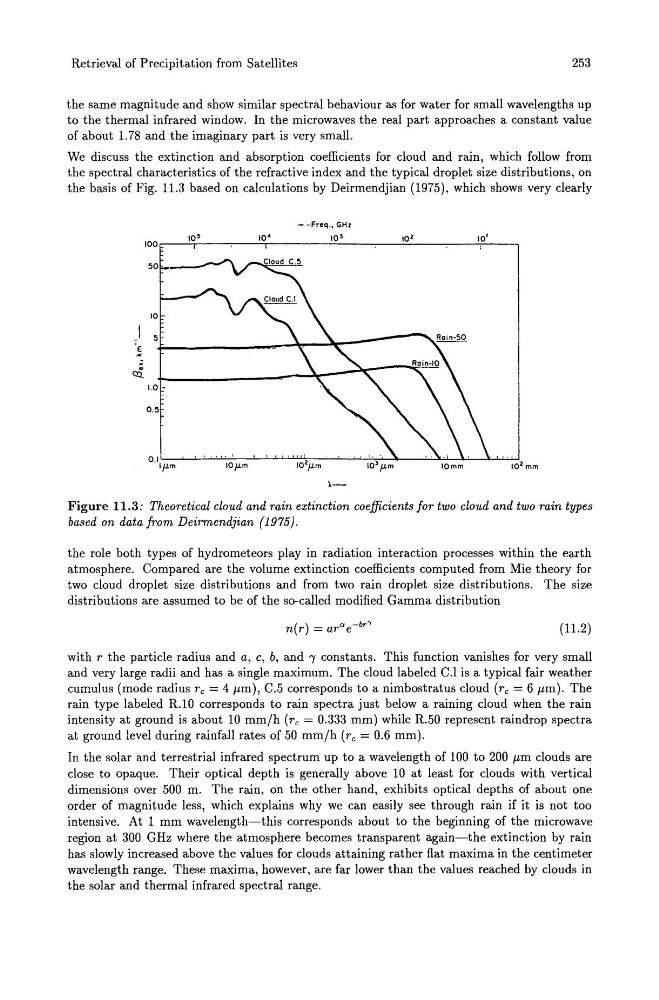
We discuss the extinction and absorption coefficients for cloud and rain, which follow from
the spectral characteristics of the refractive index and the typical droplet size distributions, on
the basis of Fig. 11.3 based on calculations by Deirmendjian (1975), which shows very clearly
- -Freq., GHz
10 5
10"
10 3
t02
10'
100~"""------:';~~~-1
'~
IOmm
I02mm
Figure 11.3: Theoretical cloud and rain extinction coefficients for two cloud and two rain types
based on data from Deirmendjian (1975).
the role both types of hydrometeors play in radiation interaction processes within the earth
atmosphere. Compared are the volume extinction coefficients computed from Mie theory for
two cloud droplet size distributions and from two rain droplet size distributions. The size
distributions are assumed to be of the so-called modified Gamma distribution
n(r) = ar"'e- brO
(11.2)
with r the particle radius and a, c, b, and I constants. This function vanishes for very small
and very large radii and has a single maximum. The cloud labeled C.l is a typical fair weather
cumulus (mode radius rc = 4 /Lm), C.5 corresponds to a nimbostratus cloud (rc = 6 /Lm). The
rain type labeled R.lO corresponds to rain spectra just below a raining cloud when the rain
intensity at ground is about 10 mm/h (rc = 0.333 mm) while R.50 represent raindrop spectra
at ground level during rainfall rates of 50 mm/h (rc = 0.6 mm).
In the solar and terrestrial infrared spectrum up to a wavelength of 100 to 200 /Lm clouds are
close to opaque. Their optical depth is generally above 10 at least for clouds with vertical
dimensions over 500 m. The rain, on the other hand, exhibits optical depths of about one
order of magnitude less, which explains why we can easily see through rain if it is not too
intensive. At 1 mm wavelength-this corresponds about to the beginning of the microwave
region at 300 GHz where the atmosphere becomes transparent again-the extinction by rain
has slowly increased above the values for clouds attaining rather flat maxima in the centimeter
wavelength range. These maxima, however, are far lower than the values reached by clouds in
the solar and thermal infrared spectral range.
253
the same magnitude and show similar spectral behaviour as for water for small wavelengths up
to the thermal infrared window. In the microwaves the real part approaches a constant value
of about 1. 78 and the imaginary part is very small.
We discuss the extinction and absorption coefficients for cloud and rain, which follow from
the spectral characteristics of the refractive index and the typical droplet size distributions, on
the basis of Fig. 11.3 based on calculations by Deirmendjian (1975), which shows very clearly
- -Freq., GHz
10 5
10"
10 3
t02
10'
100~"""------:';~~~-1
'~
IOmm
I02mm
Figure 11.3: Theoretical cloud and rain extinction coefficients for two cloud and two rain types
based on data from Deirmendjian (1975).
the role both types of hydrometeors play in radiation interaction processes within the earth
atmosphere. Compared are the volume extinction coefficients computed from Mie theory for
two cloud droplet size distributions and from two rain droplet size distributions. The size
distributions are assumed to be of the so-called modified Gamma distribution
n(r) = ar"'e- brO
(11.2)
with r the particle radius and a, c, b, and I constants. This function vanishes for very small
and very large radii and has a single maximum. The cloud labeled C.l is a typical fair weather
cumulus (mode radius rc = 4 /Lm), C.5 corresponds to a nimbostratus cloud (rc = 6 /Lm). The
rain type labeled R.lO corresponds to rain spectra just below a raining cloud when the rain
intensity at ground is about 10 mm/h (rc = 0.333 mm) while R.50 represent raindrop spectra
at ground level during rainfall rates of 50 mm/h (rc = 0.6 mm).
In the solar and terrestrial infrared spectrum up to a wavelength of 100 to 200 /Lm clouds are
close to opaque. Their optical depth is generally above 10 at least for clouds with vertical
dimensions over 500 m. The rain, on the other hand, exhibits optical depths of about one
order of magnitude less, which explains why we can easily see through rain if it is not too
intensive. At 1 mm wavelength-this corresponds about to the beginning of the microwave
region at 300 GHz where the atmosphere becomes transparent again-the extinction by rain
has slowly increased above the values for clouds attaining rather flat maxima in the centimeter
wavelength range. These maxima, however, are far lower than the values reached by clouds in
the solar and thermal infrared spectral range.