

250
C. Simmer
This radiation originates either from the earth-atmosphere system itself or from the sun (passive
remote sensing) or has been produced by an artificial radiation source (active remote sensing).
We will see, that in the case of precipitation the interpretation process always consists of the
following two steps:
1. Parameters describing the activity of the raining process are determined from the radiance
field.
2. These parameters are interpreted in terms of the rain rate at the surface.
In the following, we abbreviate the rainrate at the surface with RR. We must accept that there
is no direct signal of RR in the measured radiances. The closest we can get to RR with passive
methods is a rough measure of liquid water or ice in the atmospheric column. Active methods
like the rain radar on TRMM (Tropical Rainfall Measurements Mission, e.g. Simpson et al.,
1988) will in the future provide profiling of thee quantities and also estimates of rain-drop fall
velocities, but there will never be a direct equivalent to RR.
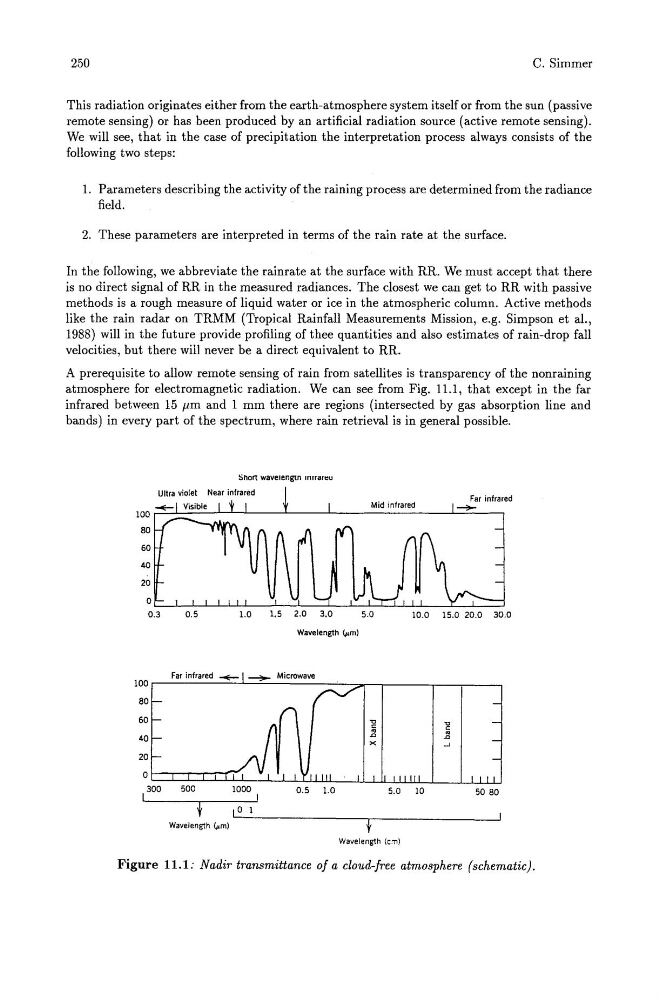
A prerequisite to allow remote sensing of rain from satellites is transparency of the nonraining
atmosphere for electromagnetic radiation. We can see from Fig. 11.1, that except in the far
infrared between 15 {lm and 1 mm there are regions (intersected by gas absorption line and
bands) in every part of the spectrum, where rain retrieval is in general possible.
80
60
40
20
5nort wavelengtn Imraleu
Mid infrared
Far infrared
-0L-~~~~~~L-__ ~ __ ~ __ ~ __ ~~~~~~ __ ~ __ ~ __ ~
0.3
0.5
1.0
1.5 2.0 3.0
5.0
10.0 15.0 20.0 30.0
Wavelength (,.m)
1oor---------~~~------------~--r_----_r--_r--__,
80
60
40
20
~~0~0:I:5~0~0:r:c~~~~~-L1J~li---~~lL~Lli1-~--JL~LLJ
I
5.0
10
50 80
f
Wavelength (I'm)
t
Wavelength (c:nl
Figure 11.1: Nadir transmittance of a cloud-free atmosphere {schematic}.
C. Simmer
This radiation originates either from the earth-atmosphere system itself or from the sun (passive
remote sensing) or has been produced by an artificial radiation source (active remote sensing).
We will see, that in the case of precipitation the interpretation process always consists of the
following two steps:
1. Parameters describing the activity of the raining process are determined from the radiance
field.
2. These parameters are interpreted in terms of the rain rate at the surface.
In the following, we abbreviate the rainrate at the surface with RR. We must accept that there
is no direct signal of RR in the measured radiances. The closest we can get to RR with passive
methods is a rough measure of liquid water or ice in the atmospheric column. Active methods
like the rain radar on TRMM (Tropical Rainfall Measurements Mission, e.g. Simpson et al.,
1988) will in the future provide profiling of thee quantities and also estimates of rain-drop fall
velocities, but there will never be a direct equivalent to RR.
A prerequisite to allow remote sensing of rain from satellites is transparency of the nonraining
atmosphere for electromagnetic radiation. We can see from Fig. 11.1, that except in the far
infrared between 15 {lm and 1 mm there are regions (intersected by gas absorption line and
bands) in every part of the spectrum, where rain retrieval is in general possible.
80
60
40
20
5nort wavelengtn Imraleu
Mid infrared
Far infrared
-0L-~~~~~~L-__ ~ __ ~ __ ~ __ ~~~~~~ __ ~ __ ~ __ ~
0.3
0.5
1.0
1.5 2.0 3.0
5.0
10.0 15.0 20.0 30.0
Wavelength (,.m)
1oor---------~~~------------~--r_----_r--_r--__,
80
60
40
20
~~0~0:I:5~0~0:r:c~~~~~-L1J~li---~~lL~Lli1-~--JL~LLJ
I
5.0
10
50 80
f
Wavelength (I'm)
t
Wavelength (c:nl
Figure 11.1: Nadir transmittance of a cloud-free atmosphere {schematic}.