

240
C. Weitkamp
Laser
Wavelength
Atmosphere
AH,O in
In
AD
AN,
AH,O absorption
solar blind practical
(nm) (nm) (nm) @Ao
region
use
KrF
248
263
273
Very strong
Yes
Yes
KrF + C02 S1
257
273
284
Very strong
Yes
No
Nd:YLF x 4
263
280
291
Strong
Yes
No
Nd:YAG x 4
266
284
295
Moderate
Barely
Little
XeCI
308
332
357
Weak
No
Yes
Ruby x 2
347
378
398
Absent
No
In early days
XeF
353
383
403
Absent
No
Yes
Nd:YAG x 3
355
388
408
Absent
No
Yes
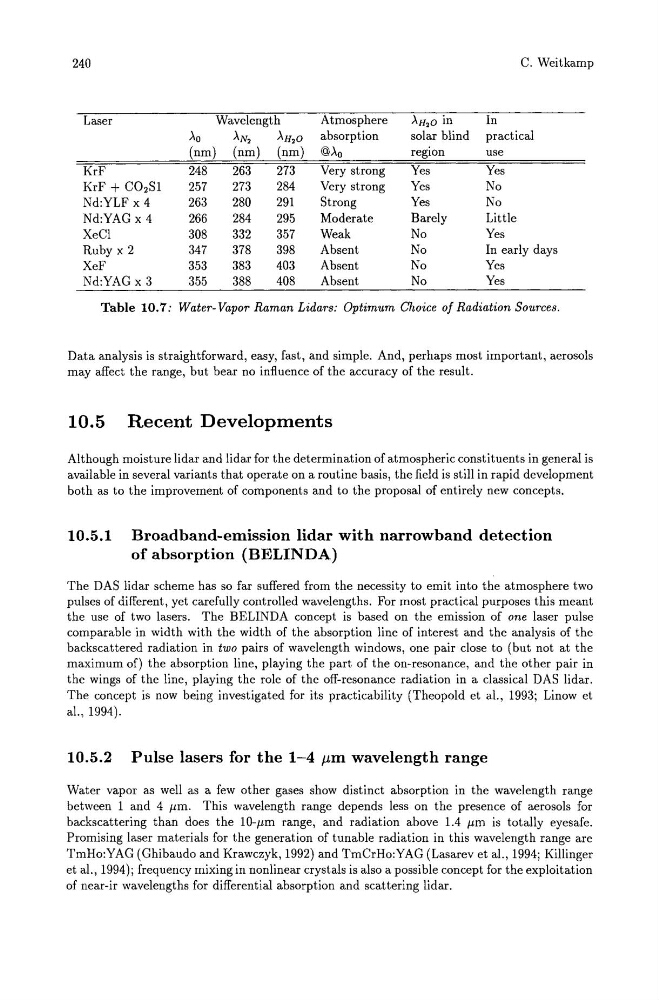
Table 10.7: Water-Vapor Raman Lidars: Optimum Choice of Radiation Sources.
Data analysis is straightforward, easy, fast, and simple. And, perhaps most important. aerosols
may affect the range, but bear no influence of the accuracy of the result.
10.5 Recent Developments
Although moisture lidar and Ii dar for the determination of atmospheric constituents in general is
available in several variants that operate on a routine basis, the field is still in rapid development
both as to the improvement of components and to the proposal of entirely new concepts.
10.5.1 Broadband-emission lidar with narrowband detection
of absorption (BELINDA)
The DAS lidar scheme has so far suffered from the necessity to emit into the atmosphere two
pulses of different, yet carefully controlled wavelengths. For most practical purposes this meant
the use of two lasers. The BELINDA concept is based on the emission of one laser pulse
comparable in width with the width of the absorption line of interest and the analysis of the
backscattered radiation in two pairs of wavelength windows, one pair close to (but not at the
maximum of) the absorption line, playing the part of the on-resonance, and the other pair in
the wings of the line, playing the role of the off-resonance radiation in a classical DAS Ii dar.
The concept is now being investigated for its practicability (Theopold et al., 1993; Linow et
al., 1994).
10.5.2 Pulse lasers for the 1-4 J.lm wavelength range
Water vapor as well as a few other gases show distinct absorption in the wavelength range
between 1 and 4 J.lm. This wavelength range depends less on the presence of aerosols for
backscattering than does the 10-J.lm range, and radiation above 1.4 J.lm is totally eyesafe.
Promising laser materials for the generation of tunable radiation in this wavelength range are
TmHo:YAG (Ghibaudo and Krawczyk, 1992) and TmCrHo:YAG (Lasarev et al., 1994; Killinger
et al., 1994); frequency mixing in nonlinear crystals is also a possible concept for the exploitation
of near-ir wavelengths for differential absorption and scattering lidar.
C. Weitkamp
Laser
Wavelength
Atmosphere
AH,O in
In
AD
AN,
AH,O absorption
solar blind practical
(nm) (nm) (nm) @Ao
region
use
KrF
248
263
273
Very strong
Yes
Yes
KrF + C02 S1
257
273
284
Very strong
Yes
No
Nd:YLF x 4
263
280
291
Strong
Yes
No
Nd:YAG x 4
266
284
295
Moderate
Barely
Little
XeCI
308
332
357
Weak
No
Yes
Ruby x 2
347
378
398
Absent
No
In early days
XeF
353
383
403
Absent
No
Yes
Nd:YAG x 3
355
388
408
Absent
No
Yes
Table 10.7: Water-Vapor Raman Lidars: Optimum Choice of Radiation Sources.
Data analysis is straightforward, easy, fast, and simple. And, perhaps most important. aerosols
may affect the range, but bear no influence of the accuracy of the result.
10.5 Recent Developments
Although moisture lidar and Ii dar for the determination of atmospheric constituents in general is
available in several variants that operate on a routine basis, the field is still in rapid development
both as to the improvement of components and to the proposal of entirely new concepts.
10.5.1 Broadband-emission lidar with narrowband detection
of absorption (BELINDA)
The DAS lidar scheme has so far suffered from the necessity to emit into the atmosphere two
pulses of different, yet carefully controlled wavelengths. For most practical purposes this meant
the use of two lasers. The BELINDA concept is based on the emission of one laser pulse
comparable in width with the width of the absorption line of interest and the analysis of the
backscattered radiation in two pairs of wavelength windows, one pair close to (but not at the
maximum of) the absorption line, playing the part of the on-resonance, and the other pair in
the wings of the line, playing the role of the off-resonance radiation in a classical DAS Ii dar.
The concept is now being investigated for its practicability (Theopold et al., 1993; Linow et
al., 1994).
10.5.2 Pulse lasers for the 1-4 J.lm wavelength range
Water vapor as well as a few other gases show distinct absorption in the wavelength range
between 1 and 4 J.lm. This wavelength range depends less on the presence of aerosols for
backscattering than does the 10-J.lm range, and radiation above 1.4 J.lm is totally eyesafe.
Promising laser materials for the generation of tunable radiation in this wavelength range are
TmHo:YAG (Ghibaudo and Krawczyk, 1992) and TmCrHo:YAG (Lasarev et al., 1994; Killinger
et al., 1994); frequency mixing in nonlinear crystals is also a possible concept for the exploitation
of near-ir wavelengths for differential absorption and scattering lidar.