

14
INCOMING SOLAR
RADIATION
100
16
REFLECTED SOLAR
RADIATION
6 20 4
E. Raschke
OUTGOING
INFRARED RADIATION
6
38
26
14
NET EMISSION
BY H20, C02
EMISSION
BY CLDUDS@ ~ ",.
,' r. -
ABSORPTION
... ' ,
BY H20, C02
•
~ ~
NET EMISSION OF
SENSIBLE LATENT
HEAT
HEAT
INFRARED RADIATION
FLUX
fLUX
fROM SURfACE
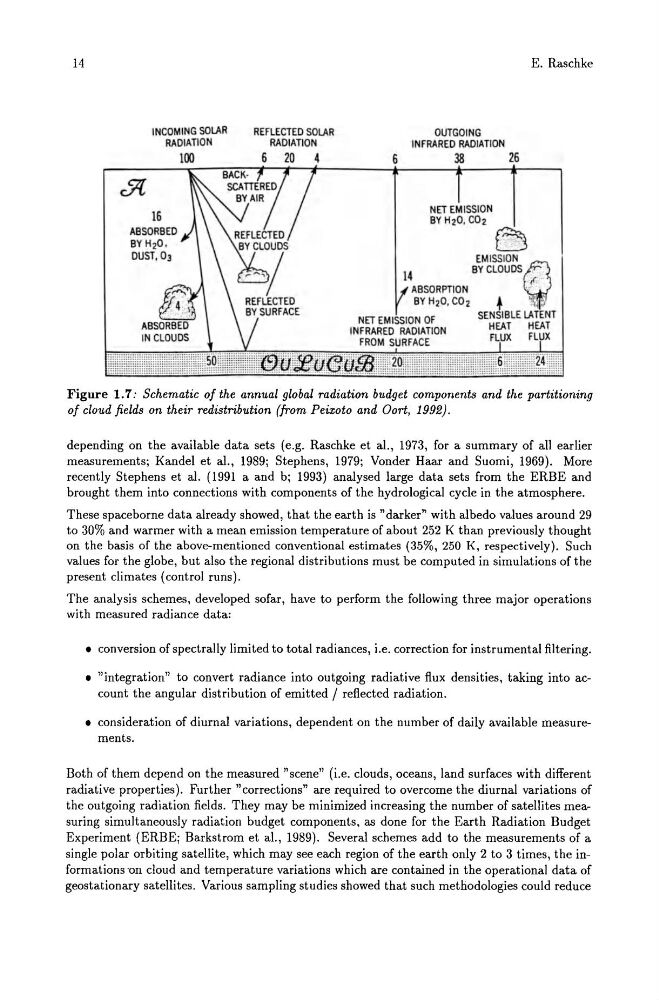
Figure 1.7: Schematic of the annual global radiation budget components and the partitioning
of cloud fields on their redistribution (from Peixoto and Dort, 1992).
depending on the available data sets (e,g. Raschke et aL, 1973, for a summary of all earlier
measurements; Kandel et aL, 1989; Stephens, 1979; Vonder Haar and Suomi, 1969). More
recently Stephens et aL (1991 a and b; 1993) analysed large data sets from the ERBE and
brought them into connections with components of the hydrological cycle in the atmosphere.
These spaceborne data already showed, that the earth is "darker" with albedo values around 29
to 30% and warmer with a mean emission temperature of about 252 K than previously thought
on the basis of the above-mentioned conventional estimates (35%, 250 K, respectively). Such
values for the globe, but also the regional distributions must be computed in simulations of the
present climates (control runs).
The analysis schemes, developed sofar, have to perform the following three major operations
with measured radiance data:
• conversion of spectrally limited to total radiances, i.e. correction for instrumental filtering.
• "integration" to convert radiance into outgoing radiative flux densities, taking into account the angular distribution of emitted / reflected radiation.
• consideration of diurnal variations, dependent on the number of daily available measurements.
Both of them depend on the measured "scene" (i.e. clouds, oceans, land surfaces with different
radiative properties). Further "corrections" are required to overcome the diurnal variations of
the outgoing radiation fields. They may be minimized increasing the number of satellites measuring simultaneously radiation budget components, as done for the Earth Radiation Budget
Experiment (ERBE; Barkstrom et aL, 1989). Several schemes add to the measurements of a
single polar orbiting satellite, which may see each region of the earth only 2 to 3 times, the informations 'On cloud and temperature variations which are contained in the operational data of
geostationary satellites. Various sampling studies showed that such methodologies could reduce
INCOMING SOLAR
RADIATION
100
16
REFLECTED SOLAR
RADIATION
6 20 4
E. Raschke
OUTGOING
INFRARED RADIATION
6
38
26
14
NET EMISSION
BY H20, C02
EMISSION
BY CLDUDS@ ~ ",.
,' r. -
ABSORPTION
... ' ,
BY H20, C02
•
~ ~
NET EMISSION OF
SENSIBLE LATENT
HEAT
HEAT
INFRARED RADIATION
FLUX
fLUX
fROM SURfACE
Figure 1.7: Schematic of the annual global radiation budget components and the partitioning
of cloud fields on their redistribution (from Peixoto and Dort, 1992).
depending on the available data sets (e,g. Raschke et aL, 1973, for a summary of all earlier
measurements; Kandel et aL, 1989; Stephens, 1979; Vonder Haar and Suomi, 1969). More
recently Stephens et aL (1991 a and b; 1993) analysed large data sets from the ERBE and
brought them into connections with components of the hydrological cycle in the atmosphere.
These spaceborne data already showed, that the earth is "darker" with albedo values around 29
to 30% and warmer with a mean emission temperature of about 252 K than previously thought
on the basis of the above-mentioned conventional estimates (35%, 250 K, respectively). Such
values for the globe, but also the regional distributions must be computed in simulations of the
present climates (control runs).
The analysis schemes, developed sofar, have to perform the following three major operations
with measured radiance data:
• conversion of spectrally limited to total radiances, i.e. correction for instrumental filtering.
• "integration" to convert radiance into outgoing radiative flux densities, taking into account the angular distribution of emitted / reflected radiation.
• consideration of diurnal variations, dependent on the number of daily available measurements.
Both of them depend on the measured "scene" (i.e. clouds, oceans, land surfaces with different
radiative properties). Further "corrections" are required to overcome the diurnal variations of
the outgoing radiation fields. They may be minimized increasing the number of satellites measuring simultaneously radiation budget components, as done for the Earth Radiation Budget
Experiment (ERBE; Barkstrom et aL, 1989). Several schemes add to the measurements of a
single polar orbiting satellite, which may see each region of the earth only 2 to 3 times, the informations 'On cloud and temperature variations which are contained in the operational data of
geostationary satellites. Various sampling studies showed that such methodologies could reduce