

Lidar Measurements: Atmospheric Constituents ...
231
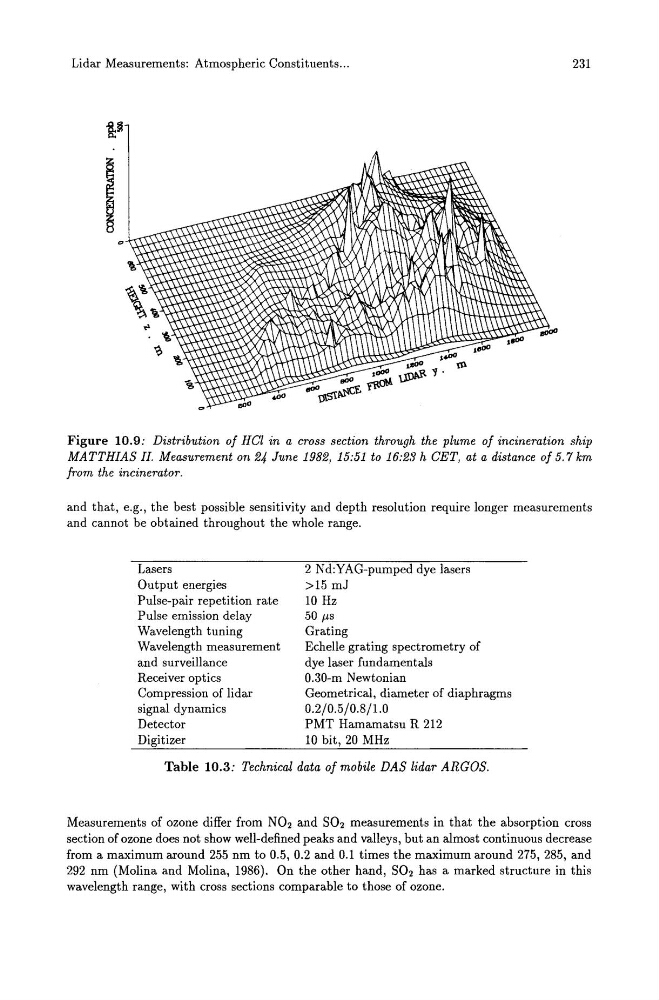
Figure 10.9: Distribution of HGI in a cross section through the plume of incineration ship
MATTHIAS II. Measurement on 24 June 1982, 15:51 to 16:23 h GET, at a distance of 5.7 km
from the incinerator.
and that, e.g., the best possible sensitivity and depth resolution require longer measurements
and cannot be obtained throughout the whole range.
Lasers
Output energies
Pulse-pair repetition rate
Pulse emission delay
Wavelength tuning
Wavelength measurement
and surveillance
Receiver optics
Compression of lidar
signal dynamics
Detector
Digitizer
2 Nd:YAG-pumped dye lasers
>15 mJ
10 Hz
50/-ls
Grating
Echelle grating spectrometry of
dye laser fundamentals
0.30-m Newtonian
Geometrical, diameter of diaphragms
0.2/0.5/0.8/1.0
PMT Hamamatsu R 212
10 bit, 20 MHz
Table 10.3: Technical data of mobile DAS lidar ARGOS.
Measurements of ozone differ from N02 and 802 measurements in that the absorption cross
section of ozone does not show well-defined peaks and valleys, but an almost continuous decrease
from a maximum around 255 nm to 0.5,0.2 and 0.1 times the maximum around 275, 285, and
292 nm (Molina and Molina, 1986). On the other hand, 802 has a marked structure in this
wavelength range, with cross sections comparable to those of ozone.
231
Figure 10.9: Distribution of HGI in a cross section through the plume of incineration ship
MATTHIAS II. Measurement on 24 June 1982, 15:51 to 16:23 h GET, at a distance of 5.7 km
from the incinerator.
and that, e.g., the best possible sensitivity and depth resolution require longer measurements
and cannot be obtained throughout the whole range.
Lasers
Output energies
Pulse-pair repetition rate
Pulse emission delay
Wavelength tuning
Wavelength measurement
and surveillance
Receiver optics
Compression of lidar
signal dynamics
Detector
Digitizer
2 Nd:YAG-pumped dye lasers
>15 mJ
10 Hz
50/-ls
Grating
Echelle grating spectrometry of
dye laser fundamentals
0.30-m Newtonian
Geometrical, diameter of diaphragms
0.2/0.5/0.8/1.0
PMT Hamamatsu R 212
10 bit, 20 MHz
Table 10.3: Technical data of mobile DAS lidar ARGOS.
Measurements of ozone differ from N02 and 802 measurements in that the absorption cross
section of ozone does not show well-defined peaks and valleys, but an almost continuous decrease
from a maximum around 255 nm to 0.5,0.2 and 0.1 times the maximum around 275, 285, and
292 nm (Molina and Molina, 1986). On the other hand, 802 has a marked structure in this
wavelength range, with cross sections comparable to those of ozone.