

226
C. Weitkamp
Rayleigh + Mie = 3xl07
1000
H2O
V> 100
~
O2
N2
::l
>- 10
~
CO2 .:': ....
: ... --..
" . ......
.. ' "
~
0::
-0:
.'
vl·
'.
2v2
:
:
)00
!1i
ifi 0.1
~
0 3
'.
:
~
:
CH4
~
:
vI v3
0.Q1
~
.'
I I
308
320
325
330
335
340
345
WAVELENGTH, nm
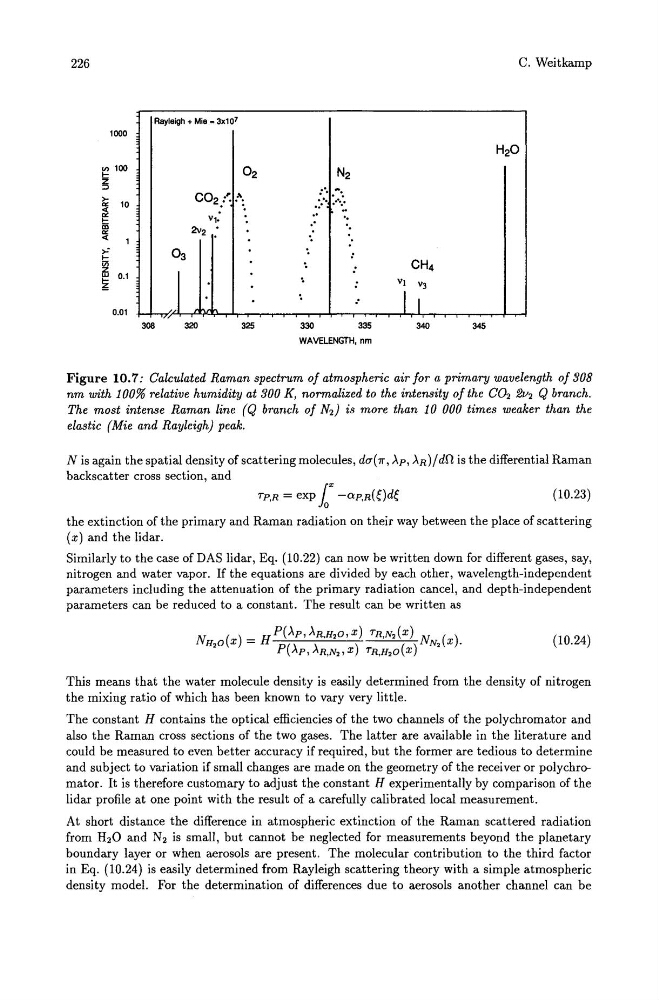
Figure 10.7: Calculated Raman spectrum of atmospheric air for a primary wavelength of 308
nm with 100% relative humidity at 300 K, normalized to the intensity of the CO2 2112 Q branch.
The most intense Raman line (Q branch of N2) is more than 10 000 times weaker than the
elastic (Mie and Rayleigh) peak.
N is again the spatial density of scattering molecules, dO'( 7r, Ap, AR) I do' is the differential Raman
backscatter cross section, and
(10.23)
the extinction of the primary and Raman radiation on their way between the place of scattering
(x) and the lidar.
Similarly to the case of DAS lidar, Eq. (10.22) can now be written down for different gases, say,
nitrogen and water vapor. If the equations are divided by each other, wavelength-independent
parameters including the attenuation of the primary radiation cancel, and depth-independent
parameters can be reduced to a constant. The result can be written as
N
() =HP(AP,AR,H20,X) TR,N2(X) N ( )
H20 X
( \
)
( ) N2 X .
P AP, AR,N2' X TR,H20 X
(10.24)
This means that the water molecule density is easily determined from the density of nitrogen
the mixing ratio of which has been known to vary very little.
The constant H contains the optical efficiencies of the two channels of the polychromator and
also the Raman cross sections of the two gases. The latter are available in the literature and
could be measured to even better accuracy if required, but the former are tedious to determine
and subject to variation if small changes are made on the geometry of the receiver or polychromator. It is therefore customary to adjust the constant H experimentally by comparison of the
lidar profile at one point with the result of a carefully calibrated local measurement.
At short distance the difference in atmospheric extinction of the Raman scattered radiation
from H20 and N2 is small, but cannot be neglected for measurements beyond the planetary
boundary layer or when aerosols are present. The molecular contribution to the third factor
in Eq. (10.24) is easily determined from Rayleigh scattering theory with a simple atmospheric
density model. For the determination of differences due to aerosols another channel can be
C. Weitkamp
Rayleigh + Mie = 3xl07
1000
H2O
V> 100
~
O2
N2
::l
>- 10
~
CO2 .:': ....
: ... --..
" . ......
.. ' "
~
0::
-0:
.'
vl·
'.
2v2
:
:
)00
!1i
ifi 0.1
~
0 3
'.
:
~
:
CH4
~
:
vI v3
0.Q1
~
.'
I I
308
320
325
330
335
340
345
WAVELENGTH, nm
Figure 10.7: Calculated Raman spectrum of atmospheric air for a primary wavelength of 308
nm with 100% relative humidity at 300 K, normalized to the intensity of the CO2 2112 Q branch.
The most intense Raman line (Q branch of N2) is more than 10 000 times weaker than the
elastic (Mie and Rayleigh) peak.
N is again the spatial density of scattering molecules, dO'( 7r, Ap, AR) I do' is the differential Raman
backscatter cross section, and
(10.23)
the extinction of the primary and Raman radiation on their way between the place of scattering
(x) and the lidar.
Similarly to the case of DAS lidar, Eq. (10.22) can now be written down for different gases, say,
nitrogen and water vapor. If the equations are divided by each other, wavelength-independent
parameters including the attenuation of the primary radiation cancel, and depth-independent
parameters can be reduced to a constant. The result can be written as
N
() =HP(AP,AR,H20,X) TR,N2(X) N ( )
H20 X
( \
)
( ) N2 X .
P AP, AR,N2' X TR,H20 X
(10.24)
This means that the water molecule density is easily determined from the density of nitrogen
the mixing ratio of which has been known to vary very little.
The constant H contains the optical efficiencies of the two channels of the polychromator and
also the Raman cross sections of the two gases. The latter are available in the literature and
could be measured to even better accuracy if required, but the former are tedious to determine
and subject to variation if small changes are made on the geometry of the receiver or polychromator. It is therefore customary to adjust the constant H experimentally by comparison of the
lidar profile at one point with the result of a carefully calibrated local measurement.
At short distance the difference in atmospheric extinction of the Raman scattered radiation
from H20 and N2 is small, but cannot be neglected for measurements beyond the planetary
boundary layer or when aerosols are present. The molecular contribution to the third factor
in Eq. (10.24) is easily determined from Rayleigh scattering theory with a simple atmospheric
density model. For the determination of differences due to aerosols another channel can be