

218
Acronym
SONAR
RADAR
SODAR
LIDAR
DAS LIDAR
DIAL
DOAS
c. Weitkamp
Signification
Depth-resolving
SOund NAvigation Ranging
yes
RAdiowave Detection And Ranging
yes
SOund Detection And Ranging
yes
LIght Detection And Ranging, or:
yes
Light Identification, Detection, And Ranging
Differential Absorption and Scattering Lidar yes
DIfferential Absorption Lidar
varying
Differential Optical Absorption Spectrometry no
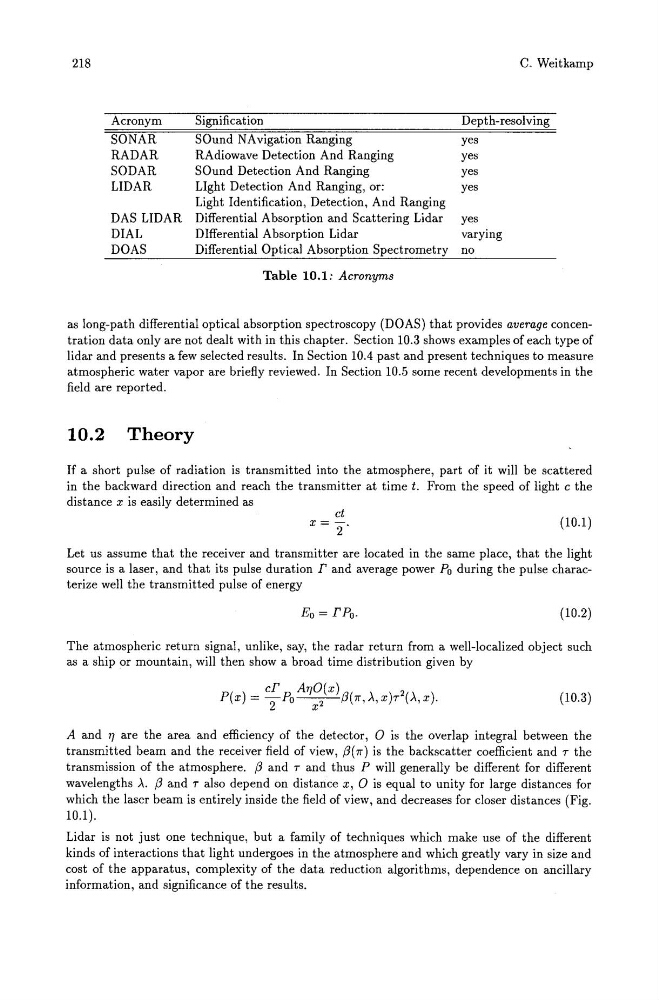
Table 10.1: Acronyms
as long-path differential optical absorption spectroscopy (DO AS) that provides average concentration data only are not dealt with in this chapter. Section 10.3 shows examples of each type of
lidar and presents a few selected results. In Section 10.4 past and present techniques to measure
atmospheric water vapor are briefly reviewed. In Section 10.5 some recent developments in the
field are reported.
10.2 Theory
If a short pulse of radiation is transmitted into the atmosphere, part of it will be scattered
in the backward direction and reach the transmitter at time t. From the speed of light c the
distance x is easily determined as
ct
X= 2.
(10.1)
Let us assume that the receiver and transmitter are located in the same place, that the light
source is a laser, and that its pulse duration r and average power Po during the pulse characterize well the transmitted pulse of energy
Eo=rpo·
(10.2)
The atmospheric return signal, unlike, say, the radar return from a well-localized object such
as a ship or mountain, will then show a broad time distribution given by
cr AI]O(x)
2
P(x) = TPO-x-2 -(3(7r,A, X)T (A,X).
(10.3)
A and I] are the area and efficiency of the detector, 0 is the overlap integral between the
transmitted beam and the receiver field of view, (3( 7r) is the backscatter coefficient and T the
transmission of the atmosphere. f3 and T and thus P will generally be different for different
wavelengths A. f3 and T also depend on distance x, 0 is equal to unity for large distances for
which the laser beam is entirely inside the field of view, and decreases for closer distances (Fig.
10.1).
Lidar is not just one technique, but a family of techniques which make use of the different
kinds of interactions that light undergoes in the atmosphere and which greatly vary in size and
cost of the apparatus, complexity of the data reduction algorithms, dependence on ancillary
information, and significance of the results.
Acronym
SONAR
RADAR
SODAR
LIDAR
DAS LIDAR
DIAL
DOAS
c. Weitkamp
Signification
Depth-resolving
SOund NAvigation Ranging
yes
RAdiowave Detection And Ranging
yes
SOund Detection And Ranging
yes
LIght Detection And Ranging, or:
yes
Light Identification, Detection, And Ranging
Differential Absorption and Scattering Lidar yes
DIfferential Absorption Lidar
varying
Differential Optical Absorption Spectrometry no
Table 10.1: Acronyms
as long-path differential optical absorption spectroscopy (DO AS) that provides average concentration data only are not dealt with in this chapter. Section 10.3 shows examples of each type of
lidar and presents a few selected results. In Section 10.4 past and present techniques to measure
atmospheric water vapor are briefly reviewed. In Section 10.5 some recent developments in the
field are reported.
10.2 Theory
If a short pulse of radiation is transmitted into the atmosphere, part of it will be scattered
in the backward direction and reach the transmitter at time t. From the speed of light c the
distance x is easily determined as
ct
X= 2.
(10.1)
Let us assume that the receiver and transmitter are located in the same place, that the light
source is a laser, and that its pulse duration r and average power Po during the pulse characterize well the transmitted pulse of energy
Eo=rpo·
(10.2)
The atmospheric return signal, unlike, say, the radar return from a well-localized object such
as a ship or mountain, will then show a broad time distribution given by
cr AI]O(x)
2
P(x) = TPO-x-2 -(3(7r,A, X)T (A,X).
(10.3)
A and I] are the area and efficiency of the detector, 0 is the overlap integral between the
transmitted beam and the receiver field of view, (3( 7r) is the backscatter coefficient and T the
transmission of the atmosphere. f3 and T and thus P will generally be different for different
wavelengths A. f3 and T also depend on distance x, 0 is equal to unity for large distances for
which the laser beam is entirely inside the field of view, and decreases for closer distances (Fig.
10.1).
Lidar is not just one technique, but a family of techniques which make use of the different
kinds of interactions that light undergoes in the atmosphere and which greatly vary in size and
cost of the apparatus, complexity of the data reduction algorithms, dependence on ancillary
information, and significance of the results.