

194
W.B. Rossow
and Yung, 1989; Stephens, 1994). The type of radiation measured determines the kind of radiative transfer model. The intensity of reflected sunlight (0.30-4.0 pm wavelengths) can be
measured, as well as its variation with wavelength or, since the source is uni-directional, the
amount and direction of polarization can be determined. The intensity of thermal emission in
the infrared (4.0-200 pm wavelengths) or microwave (1 mm-lO cm wavelengths) can be measured as well as its variations with wavelength; microwave polarization is also a useful indication
of scattering processes. All of these approaches depend on natural sources of radiation, but
satellite instruments can also emit coherent forms of radiation and measure their interaction
with clouds: lidars emit radiation in the wavelength ranges of sunlight and infrared and radars
emit microwave radiation. These types of radiation are much easier to separate from natural
radiation because they are emitted at sharply defined wavelengths and polarizations. Table
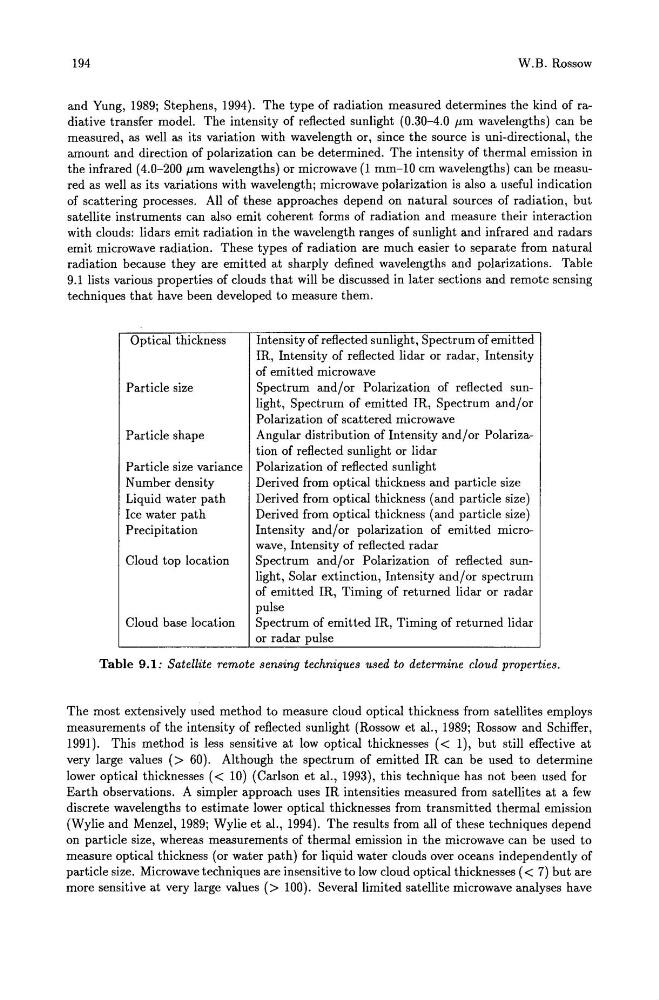
9.1 lists various properties of clouds that will be discussed in later sections and remote sensing
techniques that have been developed to measure them.
Optical thickness
Particle size
Particle shape
Particle size variance
Number density
Liquid water path
Ice water path
Precipitation
Cloud top location
Cloud base location
Intensity of reflected sunlight, Spectrum of emitted
IR, Intensity of reflected lidar or radar, Intensity
of emitted microwave
Spectrum and/or Polarization of reflected sunlight, Spectrum of emitted IR, Spectrum and/or
Polarization of scattered microwave
Angular distribution of Intensity and/or Polarization of reflected sunlight or lidar
Polarization of reflected sunlight
Derived from optical thickness and particle size
Derived from optical thickness (and particle size)
Derived from optical thickness (and particle size)
Intensity and/or polarization of emitted microwave, Intensity of reflected radar
Spectrum and/or Polarization of reflected sunlight, Solar extinction, Intensity and/or spectrum
of emitted IR, Timing of returned lidar or radar
pulse
Spectrum of emitted IR, Timing of returned lidar
or radar pulse
Table 9.1: Satellite remote sensing techniques used to determine cloud properties.
The most extensively used method to measure cloud optical thickness from satellites employs
measurements of the intensity of reflected sunlight (Rossow et al., 1989; Rossow and Schiffer,
1991). This method is less sensitive at low optical thicknesses « 1), but still effective at
very large values (> 60). Although the spectrum of emitted IR can be used to determine
lower optical thicknesses « 10) (Carlson et al., 1993), this technique has not been used for
Earth observations. A simpler approach uses IR intensities measured from satellites at a few
discrete wavelengths to estimate lower optical thicknesses from transmitted thermal emission
(Wylie and Menzel, 1989; Wylie et al., 1994). The results from all of these techniques depend
on particle size, whereas measurements of thermal emission in the microwave can be used to
measure optical thickness (or water path) for liquid water clouds over oceans independently of
particle size. Microwave techniques are insensitive to low cloud optical thicknesses ( < 7) but are
more sensitive at very large values (> 100). Several limited satellite microwave analyses have
W.B. Rossow
and Yung, 1989; Stephens, 1994). The type of radiation measured determines the kind of radiative transfer model. The intensity of reflected sunlight (0.30-4.0 pm wavelengths) can be
measured, as well as its variation with wavelength or, since the source is uni-directional, the
amount and direction of polarization can be determined. The intensity of thermal emission in
the infrared (4.0-200 pm wavelengths) or microwave (1 mm-lO cm wavelengths) can be measured as well as its variations with wavelength; microwave polarization is also a useful indication
of scattering processes. All of these approaches depend on natural sources of radiation, but
satellite instruments can also emit coherent forms of radiation and measure their interaction
with clouds: lidars emit radiation in the wavelength ranges of sunlight and infrared and radars
emit microwave radiation. These types of radiation are much easier to separate from natural
radiation because they are emitted at sharply defined wavelengths and polarizations. Table
9.1 lists various properties of clouds that will be discussed in later sections and remote sensing
techniques that have been developed to measure them.
Optical thickness
Particle size
Particle shape
Particle size variance
Number density
Liquid water path
Ice water path
Precipitation
Cloud top location
Cloud base location
Intensity of reflected sunlight, Spectrum of emitted
IR, Intensity of reflected lidar or radar, Intensity
of emitted microwave
Spectrum and/or Polarization of reflected sunlight, Spectrum of emitted IR, Spectrum and/or
Polarization of scattered microwave
Angular distribution of Intensity and/or Polarization of reflected sunlight or lidar
Polarization of reflected sunlight
Derived from optical thickness and particle size
Derived from optical thickness (and particle size)
Derived from optical thickness (and particle size)
Intensity and/or polarization of emitted microwave, Intensity of reflected radar
Spectrum and/or Polarization of reflected sunlight, Solar extinction, Intensity and/or spectrum
of emitted IR, Timing of returned lidar or radar
pulse
Spectrum of emitted IR, Timing of returned lidar
or radar pulse
Table 9.1: Satellite remote sensing techniques used to determine cloud properties.
The most extensively used method to measure cloud optical thickness from satellites employs
measurements of the intensity of reflected sunlight (Rossow et al., 1989; Rossow and Schiffer,
1991). This method is less sensitive at low optical thicknesses « 1), but still effective at
very large values (> 60). Although the spectrum of emitted IR can be used to determine
lower optical thicknesses « 10) (Carlson et al., 1993), this technique has not been used for
Earth observations. A simpler approach uses IR intensities measured from satellites at a few
discrete wavelengths to estimate lower optical thicknesses from transmitted thermal emission
(Wylie and Menzel, 1989; Wylie et al., 1994). The results from all of these techniques depend
on particle size, whereas measurements of thermal emission in the microwave can be used to
measure optical thickness (or water path) for liquid water clouds over oceans independently of
particle size. Microwave techniques are insensitive to low cloud optical thicknesses ( < 7) but are
more sensitive at very large values (> 100). Several limited satellite microwave analyses have