

176
W.B. Rossow
ANNUAL
- G~OI(
_ :2~:s ~::.-:-::-:-: ~_::._~_;;:_::._::._=_:_::: -:..::_
- -- tH
6
2
10
15
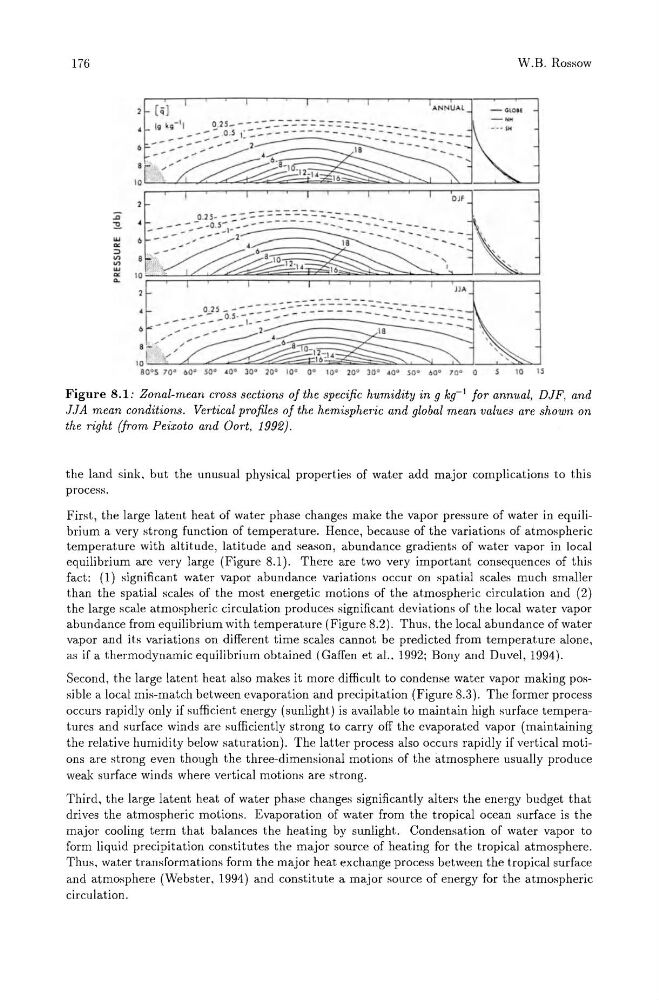
Figure 8.1: Zonal-mean cross sections of the specific humidity in g kg- 1 for annual, DIF, and
JJA mean conditions. Vertical profiles of the hemispheTic and global mean values are shown on
the right (from Peixoto and Oort, 1992).
the land sink, but the unusual physical properties of water add major complications to this
process.
First, the large latent heat of water phase changes make the vapor pressure of water in equilibrium a very strong function of temperature. Hence, because of the variations of atmospheric
temperature with altitude, latitude and season, abundance gradients of water vapor in local
equilibrium are very large (Figure 8.1). There are two very important consequences of this
fact: (1) significant water vapor abundance variations occur on spatial scales much smaller
than the spatial scales of the most energetic motions of the atmospheric circulation and (2)
the large scale atmospheric circulation produces significant deviations of the local water vapor
abundance from equilibrium with temperature (Figure 8.2). Thus, the local abundance of water
vapor and its variations on different time scales cannot be predicted from temperature alone,
as if a thermodynamic equilibrium obtained (Gaffen et al., 1992; Bony and Duvel, 1994).
Second, the large latent heat also makes it more difficult to condense water vapor making possible a local mis-match between evaporation and precipitation (Figure 8.3). The former process
occurs rapidly only if sufficient energy (sunlight) is available to maintain high surface temperatures and surface winds are sufficiently strong to carry off the evaporated vapor (maintaining
the relative humidity below saturation). The latter process also occurs rapidly if vertical motions are strong even though the three-dimensional motions of the atmosphere usually produce
weak surface winds where vertical motions are strong.
Third, the large latent heat of water phase changes significantly alters the energy budget that
drives the atmospheric motions. Evaporation of water from the tropical ocean surface is the
major cooling term that balances the heating by sunlight. Condensation of water vapor to
form liquid precipitation constitutes the major source of heating for the tropical atmosphere.
Thus, water transformations form the major heat exchange process between the tropical surface
and atmosphere (Webster, 1994) and constitute a major source of energy for the atmospheric
circulation.
W.B. Rossow
ANNUAL
- G~OI(
_ :2~:s ~::.-:-::-:-: ~_::._~_;;:_::._::._=_:_::: -:..::_
- -- tH
6
2
10
15
Figure 8.1: Zonal-mean cross sections of the specific humidity in g kg- 1 for annual, DIF, and
JJA mean conditions. Vertical profiles of the hemispheTic and global mean values are shown on
the right (from Peixoto and Oort, 1992).
the land sink, but the unusual physical properties of water add major complications to this
process.
First, the large latent heat of water phase changes make the vapor pressure of water in equilibrium a very strong function of temperature. Hence, because of the variations of atmospheric
temperature with altitude, latitude and season, abundance gradients of water vapor in local
equilibrium are very large (Figure 8.1). There are two very important consequences of this
fact: (1) significant water vapor abundance variations occur on spatial scales much smaller
than the spatial scales of the most energetic motions of the atmospheric circulation and (2)
the large scale atmospheric circulation produces significant deviations of the local water vapor
abundance from equilibrium with temperature (Figure 8.2). Thus, the local abundance of water
vapor and its variations on different time scales cannot be predicted from temperature alone,
as if a thermodynamic equilibrium obtained (Gaffen et al., 1992; Bony and Duvel, 1994).
Second, the large latent heat also makes it more difficult to condense water vapor making possible a local mis-match between evaporation and precipitation (Figure 8.3). The former process
occurs rapidly only if sufficient energy (sunlight) is available to maintain high surface temperatures and surface winds are sufficiently strong to carry off the evaporated vapor (maintaining
the relative humidity below saturation). The latter process also occurs rapidly if vertical motions are strong even though the three-dimensional motions of the atmosphere usually produce
weak surface winds where vertical motions are strong.
Third, the large latent heat of water phase changes significantly alters the energy budget that
drives the atmospheric motions. Evaporation of water from the tropical ocean surface is the
major cooling term that balances the heating by sunlight. Condensation of water vapor to
form liquid precipitation constitutes the major source of heating for the tropical atmosphere.
Thus, water transformations form the major heat exchange process between the tropical surface
and atmosphere (Webster, 1994) and constitute a major source of energy for the atmospheric
circulation.