

Clouds and the Radiative Heating ...
/
/
I
/
/
/
./
./
./
./
./
./
./
0 .05 0.10 0 . 15 0 . 20 0 .25 0 . 30 0 .35 0 . 40 0 . 45 0 .50 0 . 55 0 .60
Change In A lbedo
159
200
150
100
50
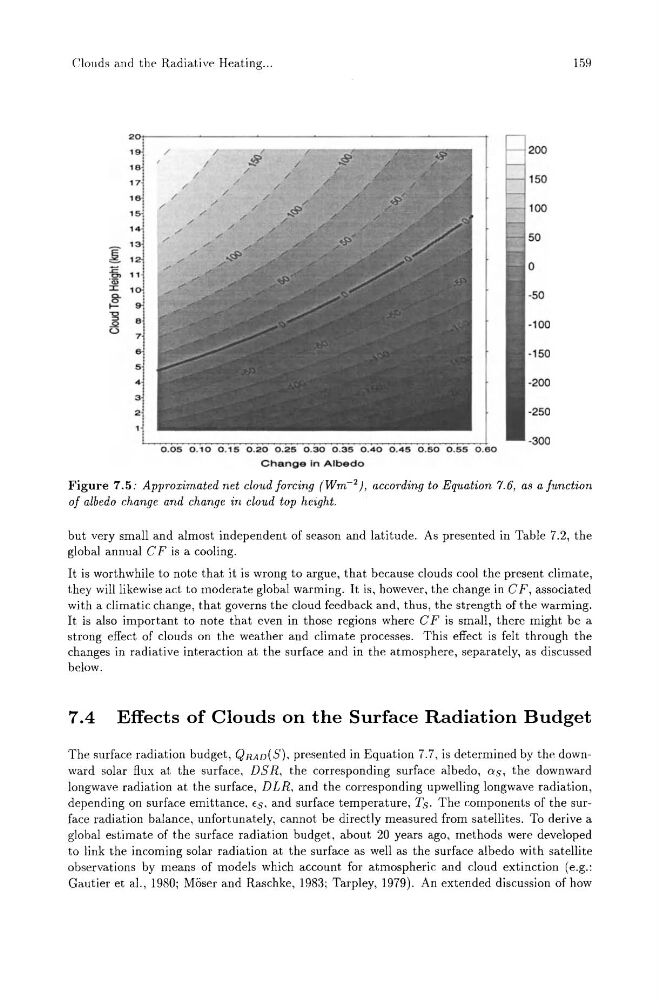
Figure 7.5: Approximated net cloud forcing (Wm- 2 ), according to Equation 7.6, as a function
of albedo change and change in cloud top height.
but very small and almost independent of season and latitude. As presented in Table 7.2, the
global annual C F is a cooling.
It is worthwhile to note that it is wrong to argue, that because clouds cool the present climate,
they will likewise act to moderate global warming. It is, however, the change in C F, associated
with a climatic change, that governs the cloud feedback and, thus, the strength of the warming.
It is also important to note that even in those regions where C F is small, there might be a
strong effect of clouds on the weather and climate processes. This effect is felt through the
changes in radiative interaction at the surface and in the atmosphere, separately, as discussed
below.
7.4 Effects of Clouds on the Surface Radiation Budget
The surface radiation budget, QRAD(S). presented in Equation 7.7, is determined by the downward solar flux at the surface. DSR. the corresponding surface albedo, as, the downward
longwave radiation at the surface, DLR, and the corresponding upwelling longwave radiation,
depending on surface emittance. ES. and surface temperature, Ts. The components of the surface radiation balance. unfortunately. cannot be directly measured from satellites. To derive a
global estimate of the surface radiation budget, about 20 years ago. methods were developed
to link the incoming solar radiation at the surface as well as the surface albedo with satellite
observations by means of models which account for atmospheric and cloud extinction (e.g.:
Gautier et al., 1980; Moser and Raschke, 1983; Tarpley, 1979). An extended discussion of how
/
/
I
/
/
/
./
./
./
./
./
./
./
0 .05 0.10 0 . 15 0 . 20 0 .25 0 . 30 0 .35 0 . 40 0 . 45 0 .50 0 . 55 0 .60
Change In A lbedo
159
200
150
100
50
Figure 7.5: Approximated net cloud forcing (Wm- 2 ), according to Equation 7.6, as a function
of albedo change and change in cloud top height.
but very small and almost independent of season and latitude. As presented in Table 7.2, the
global annual C F is a cooling.
It is worthwhile to note that it is wrong to argue, that because clouds cool the present climate,
they will likewise act to moderate global warming. It is, however, the change in C F, associated
with a climatic change, that governs the cloud feedback and, thus, the strength of the warming.
It is also important to note that even in those regions where C F is small, there might be a
strong effect of clouds on the weather and climate processes. This effect is felt through the
changes in radiative interaction at the surface and in the atmosphere, separately, as discussed
below.
7.4 Effects of Clouds on the Surface Radiation Budget
The surface radiation budget, QRAD(S). presented in Equation 7.7, is determined by the downward solar flux at the surface. DSR. the corresponding surface albedo, as, the downward
longwave radiation at the surface, DLR, and the corresponding upwelling longwave radiation,
depending on surface emittance. ES. and surface temperature, Ts. The components of the surface radiation balance. unfortunately. cannot be directly measured from satellites. To derive a
global estimate of the surface radiation budget, about 20 years ago. methods were developed
to link the incoming solar radiation at the surface as well as the surface albedo with satellite
observations by means of models which account for atmospheric and cloud extinction (e.g.:
Gautier et al., 1980; Moser and Raschke, 1983; Tarpley, 1979). An extended discussion of how