

Priciples of Active and Passive Remote Measurements ...
125
Radar uses microwave transmitter whereas LIDAR uses a Laser. Most of them ("pulsed" radar
or lidar) emit a pulse of radiation, and the time lag t:;.t between emission and measurement of
backscattered radiation specifies the depth 6.r of the sounded region since 6.r = ct:;.t/2, with
c speed of electromagnetic radiation. With several measurements at successive time lags after
emission of the pulse, a profile can be built.
In the following, the radar and lidar equation are introduced, as well as the underlying physical
concepts. Dedicated lectures on these topics are given by Ackerman (cloud radar), Joe (radar
for precipitation), and Weitkamp (lidar measurements), this volume.
5.7.1 Radar equation
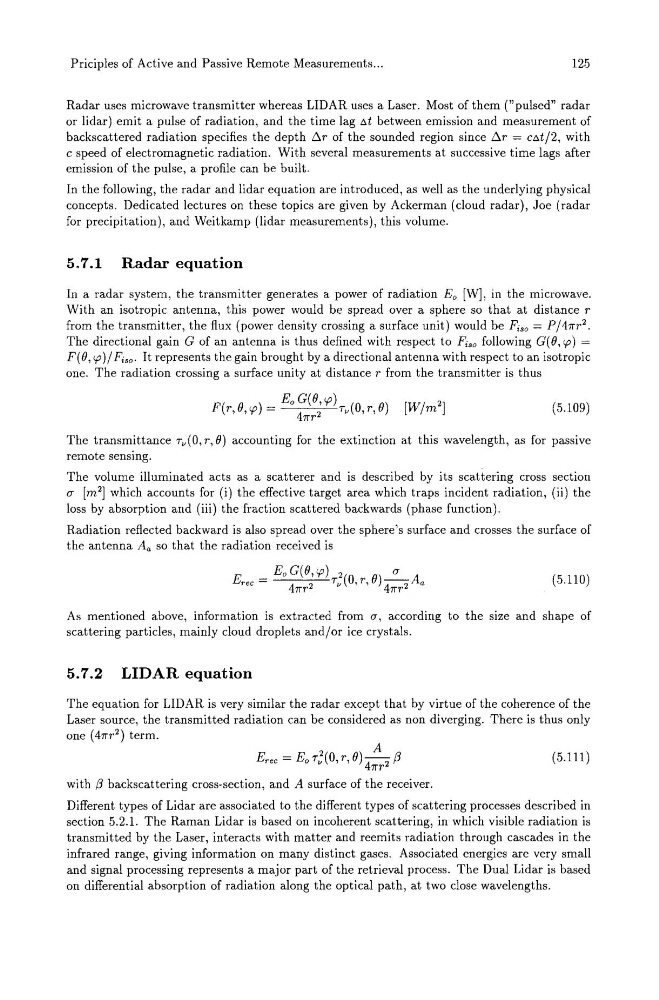
In a radar system, the transmitter generates a power of radiation Eo [W], in the microwave.
With an isotropic antenna, this power would be spread over a sphere so that at distance r
from the transmitter, the flux (power density crossing a surface unit) would be Fiso = P/4rrr2.
The directional gain G of an antenna is thus defined with respect to Fiso following G( 0, r.p) =
F( 0, r.p)/ Fiso. It represents the gain brought by a directional antenna with respect to an isotropic
one. The radiation crossing a surface unity at distance r from the transmitter is thus
Eo G( 0, r.p)
[ 2 ]
F(r,O,r.p) = 4rrr2 Tv(O,r,O) W/m
(5.109)
The transmittance Tv(O, r, 0) accounting for the extinction at this wavelength, as for passive
remote sensing.
The volume illuminated acts as a scatterer and is described by its scattering cross section
(T
[m 2 ] which accounts for (i) the effective target area which traps incident radiation, (ii) the
loss by absorption and (iii) the fraction scattered backwards (phase function).
Radiation reflected backward is also spread over the sphere's surface and crosses the surface of
the antenna Aa so that the radiation received is
(5.110)
As mentioned above, information is extracted from (T, according to the size and shape of
scattering particles, mainly cloud droplets and/or ice crystals.
5.7.2 LIDAR equation
The equation for LIDAR is very similar the radar except that by virtue of the coherence of the
Laser source, the transmitted radiation can be considered as non diverging. There is thus only
one (4rrr2) term.
(5.111)
with (3 backscattering cross-section, and A surface of the receiver.
Different types of Lidar are associated to the different types of scattering processes described in
section 5.2.1. The Raman Lidar is based on incoherent scattering, in which visible radiation is
transmitted by the Laser, interacts with matter and reemits radiation through cascades in the
infrared range, giving information on many distinct gases. Associated energies are very small
and signal processing represents a major part of the retrieval process. The Dual Lidar is based
on differential absorption of radiation along the optical path, at two close wavelengths.
125
Radar uses microwave transmitter whereas LIDAR uses a Laser. Most of them ("pulsed" radar
or lidar) emit a pulse of radiation, and the time lag t:;.t between emission and measurement of
backscattered radiation specifies the depth 6.r of the sounded region since 6.r = ct:;.t/2, with
c speed of electromagnetic radiation. With several measurements at successive time lags after
emission of the pulse, a profile can be built.
In the following, the radar and lidar equation are introduced, as well as the underlying physical
concepts. Dedicated lectures on these topics are given by Ackerman (cloud radar), Joe (radar
for precipitation), and Weitkamp (lidar measurements), this volume.
5.7.1 Radar equation
In a radar system, the transmitter generates a power of radiation Eo [W], in the microwave.
With an isotropic antenna, this power would be spread over a sphere so that at distance r
from the transmitter, the flux (power density crossing a surface unit) would be Fiso = P/4rrr2.
The directional gain G of an antenna is thus defined with respect to Fiso following G( 0, r.p) =
F( 0, r.p)/ Fiso. It represents the gain brought by a directional antenna with respect to an isotropic
one. The radiation crossing a surface unity at distance r from the transmitter is thus
Eo G( 0, r.p)
[ 2 ]
F(r,O,r.p) = 4rrr2 Tv(O,r,O) W/m
(5.109)
The transmittance Tv(O, r, 0) accounting for the extinction at this wavelength, as for passive
remote sensing.
The volume illuminated acts as a scatterer and is described by its scattering cross section
(T
[m 2 ] which accounts for (i) the effective target area which traps incident radiation, (ii) the
loss by absorption and (iii) the fraction scattered backwards (phase function).
Radiation reflected backward is also spread over the sphere's surface and crosses the surface of
the antenna Aa so that the radiation received is
(5.110)
As mentioned above, information is extracted from (T, according to the size and shape of
scattering particles, mainly cloud droplets and/or ice crystals.
5.7.2 LIDAR equation
The equation for LIDAR is very similar the radar except that by virtue of the coherence of the
Laser source, the transmitted radiation can be considered as non diverging. There is thus only
one (4rrr2) term.
(5.111)
with (3 backscattering cross-section, and A surface of the receiver.
Different types of Lidar are associated to the different types of scattering processes described in
section 5.2.1. The Raman Lidar is based on incoherent scattering, in which visible radiation is
transmitted by the Laser, interacts with matter and reemits radiation through cascades in the
infrared range, giving information on many distinct gases. Associated energies are very small
and signal processing represents a major part of the retrieval process. The Dual Lidar is based
on differential absorption of radiation along the optical path, at two close wavelengths.