

angle of incidence of the reflected solar radiation on the MODIS scanning mirror,
and, in the case of the Terra MODIS, it depends on which side of the mirror is
involved, i.e., mirror side 1 (ms1) or mirror side 2 (ms2). This difference occurred
due to a procedural anomaly that occurred during the prelaunch testing of the Terra
MODIS. No such difference has to be accounted for in the case of the Aqua
MODIS. Figure 3.3 depicts the changes in Terra MODIS detector responses. For
the near-infrared (NIR), the short-wave infrared (SWIR), and thermal infrared
emissive bands (TEB), the changes in detector responses have been generally small.
Table 3.1 (continued)
Primary use
Band Bandwidth
a
Spectral radiance
b
Required NEAT (K)
d
Ozone
30
9.580–9.880
3.69
0.25
Surface/cloud temperature 31
10.780–11.280 9.55
0.05
32
11.770–12.270 8.94
0.05
Cloud top altitude
33
13.185–13.485 4.52
0.25
34
13.485–13.785 3.76
0.25
35
13.785–14.085 3.11
0.25
36
14.085–14.385 2.08
0.35
a
Bands 1–19 nm; bands 20–36 μm
b
W/m
2
-μm-sr
c
SNR signal-to-noise ratio
performance goal is 30–40%
NEΔT noise-equivalent temperature difference: g better than required
d
SNR
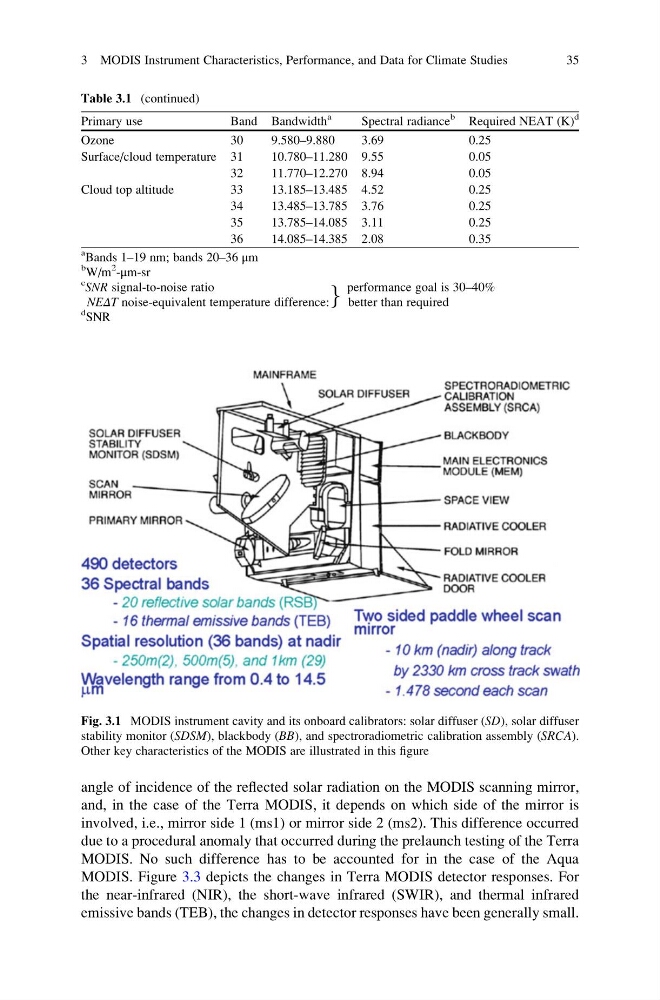
Fig. 3.1 MODIS instrument cavity and its onboard calibrators: solar diffuser (SD), solar diffuser
stability monitor (SDSM), blackbody (BB), and spectroradiometric calibration assembly (SRCA).
Other key characteristics of the MODIS are illustrated in this figure
3 MODIS Instrument Characteristics, Performance, and Data for Climate Studies
35
and, in the case of the Terra MODIS, it depends on which side of the mirror is
involved, i.e., mirror side 1 (ms1) or mirror side 2 (ms2). This difference occurred
due to a procedural anomaly that occurred during the prelaunch testing of the Terra
MODIS. No such difference has to be accounted for in the case of the Aqua
MODIS. Figure 3.3 depicts the changes in Terra MODIS detector responses. For
the near-infrared (NIR), the short-wave infrared (SWIR), and thermal infrared
emissive bands (TEB), the changes in detector responses have been generally small.
Table 3.1 (continued)
Primary use
Band Bandwidth
a
Spectral radiance
b
Required NEAT (K)
d
Ozone
30
9.580–9.880
3.69
0.25
Surface/cloud temperature 31
10.780–11.280 9.55
0.05
32
11.770–12.270 8.94
0.05
Cloud top altitude
33
13.185–13.485 4.52
0.25
34
13.485–13.785 3.76
0.25
35
13.785–14.085 3.11
0.25
36
14.085–14.385 2.08
0.35
a
Bands 1–19 nm; bands 20–36 μm
b
W/m
2
-μm-sr
c
SNR signal-to-noise ratio
performance goal is 30–40%
NEΔT noise-equivalent temperature difference: g better than required
d
SNR
Fig. 3.1 MODIS instrument cavity and its onboard calibrators: solar diffuser (SD), solar diffuser
stability monitor (SDSM), blackbody (BB), and spectroradiometric calibration assembly (SRCA).
Other key characteristics of the MODIS are illustrated in this figure
3 MODIS Instrument Characteristics, Performance, and Data for Climate Studies
35