

where T 1 and T 2 represent the 3.9 and 11 μm band uncertainties resulting from the
uncertainties of the mean emissivity (ε) and emissivity difference (Δε), respectively. Using the Sobrino et al. (1994) split-window algorithm as an example, these
two components are
δT 1 ¼ A 3 À
A 4
ε 2
δε and δT 2 ¼
A 4
ε
δðΔεÞ
(19.59)
Therefore, the maximum LST uncertainty is
δT s ¼
ffiffiffiffiffiffiffiffiffiffiffiffiffiffiffiffiffiffiffiffiffiffiffiffiffiffiffiffiffiffiffiffiffiffiffiffiffiffiffiffiffiffiffiffiffiffiffiffiffiffiffiffiffiffiffiffiffiffiffiffiffiffiffiffiffiffiffiffi
A 3 À
A 4
ε 2
δε
2
þ
A 4
ε
δðΔεÞ
2
s
(19.60)
Considering that ε ¼ ε 11 þ ε 12
ð
Þ =2 and Δε ¼ ε 11 À ε 12
ð
Þ, and assuming the
emissivity uncertainties in each band are the same, i.e., δε ¼ δε 11 ¼ δε 12 , the
maximum uncertainty of the emissivity difference is δðΔεÞ ¼ δε 11
j
jþ δε 12
j
j ¼ 2δε.
Thus, the LST uncertainty, Ts, due to the emissivity uncertainty can be calculated
using the above equation.
From the above equations, we can see, in order to reduce the LST algorithm
sensitivity to the emissivity error, the emissivity difference should not be included
in the algorithm formulation.
19.6 Summary and Discussion
In recent years, LST products have been successfully generated from polar-orbiting
instruments, such as MODIS and ASTER. The polar-orbiting system has the
advantage of global coverage. Surface temperature, especially land surface temperature, has a strong diurnal cycle, which cannot be captured by the temporal
0.50%
1.6
1.00%
2.00%
3.00%
4.00%
5.00%
1.2
0.8
BT error (K)
0.4
0
0
3.9
10.8
Wavelength (micrometer)
12
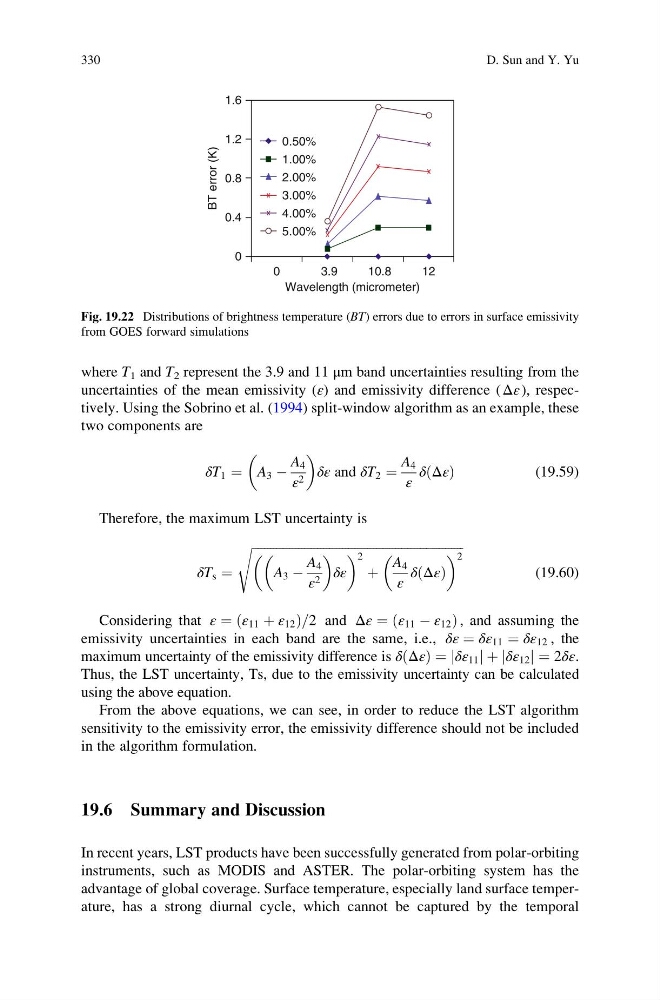
Fig. 19.22 Distributions of brightness temperature (BT) errors due to errors in surface emissivity
from GOES forward simulations
330
D. Sun and Y. Yu
uncertainties of the mean emissivity (ε) and emissivity difference (Δε), respectively. Using the Sobrino et al. (1994) split-window algorithm as an example, these
two components are
δT 1 ¼ A 3 À
A 4
ε 2
δε and δT 2 ¼
A 4
ε
δðΔεÞ
(19.59)
Therefore, the maximum LST uncertainty is
δT s ¼
ffiffiffiffiffiffiffiffiffiffiffiffiffiffiffiffiffiffiffiffiffiffiffiffiffiffiffiffiffiffiffiffiffiffiffiffiffiffiffiffiffiffiffiffiffiffiffiffiffiffiffiffiffiffiffiffiffiffiffiffiffiffiffiffiffiffiffiffi
A 3 À
A 4
ε 2
δε
2
þ
A 4
ε
δðΔεÞ
2
s
(19.60)
Considering that ε ¼ ε 11 þ ε 12
ð
Þ =2 and Δε ¼ ε 11 À ε 12
ð
Þ, and assuming the
emissivity uncertainties in each band are the same, i.e., δε ¼ δε 11 ¼ δε 12 , the
maximum uncertainty of the emissivity difference is δðΔεÞ ¼ δε 11
j
jþ δε 12
j
j ¼ 2δε.
Thus, the LST uncertainty, Ts, due to the emissivity uncertainty can be calculated
using the above equation.
From the above equations, we can see, in order to reduce the LST algorithm
sensitivity to the emissivity error, the emissivity difference should not be included
in the algorithm formulation.
19.6 Summary and Discussion
In recent years, LST products have been successfully generated from polar-orbiting
instruments, such as MODIS and ASTER. The polar-orbiting system has the
advantage of global coverage. Surface temperature, especially land surface temperature, has a strong diurnal cycle, which cannot be captured by the temporal
0.50%
1.6
1.00%
2.00%
3.00%
4.00%
5.00%
1.2
0.8
BT error (K)
0.4
0
0
3.9
10.8
Wavelength (micrometer)
12
Fig. 19.22 Distributions of brightness temperature (BT) errors due to errors in surface emissivity
from GOES forward simulations
330
D. Sun and Y. Yu