

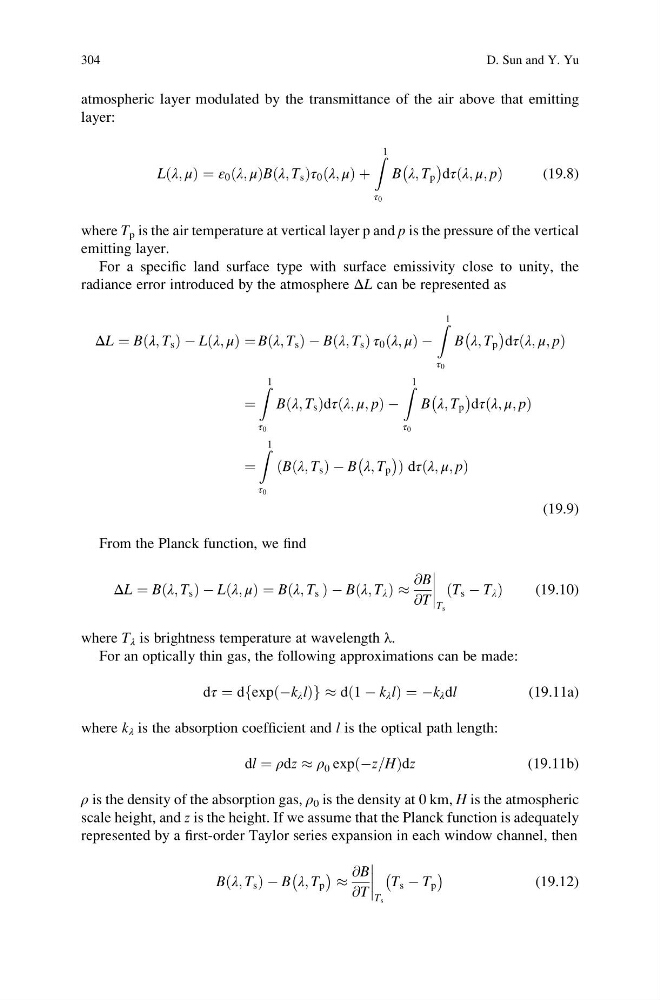
atmospheric layer modulated by the transmittance of the air above that emitting
layer:
Lðλ; μÞ ¼ ε 0 ðλ; μÞB λ; T s
ð
Þτ 0 ðλ; μÞ þ
Z 1
τ 0
B λ; T p
À
Á
dτðλ; μ; pÞ
(19.8)
where T p is the air temperature at vertical layer p and p is the pressure of the vertical
emitting layer.
For a specific land surface type with surface emissivity close to unity, the
radiance error introduced by the atmosphere ΔL can be represented as
ΔL ¼ B λ; T s
ð
ÞÀLðλ; μÞ ¼ B λ; T s
ð
ÞÀB λ; T s
ð
Þτ 0 ðλ; μÞ À
Z 1
τ 0
B λ; T p
À
Á
dτðλ; μ; pÞ
¼
Z 1
τ 0
B λ; T s
ð
Þdτðλ; μ; pÞ À
Z 1
τ 0
B λ; T p
À
Á
dτðλ; μ; pÞ
¼
Z 1
τ 0
ðB λ; T s
ð
ÞÀB λ; T p
À
Á
Þ dτðλ; μ; pÞ
(19.9)
From the Planck function, we find
ΔL ¼ B λ; T s
ð
ÞÀLðλ; μÞ ¼ B λ; T s
ð
ÞÀB λ; T λ
ð
Þ%
@B
@T
T s
T s À T λ
ð
Þ
(19.10)
where T λ is brightness temperature at wavelength λ.
For an optically thin gas, the following approximations can be made:
dτ ¼ d exp Àk λ l
ð
Þ
f
g% d 1 À k λ l
ð
Þ¼Àk λ dl
(19.11a)
where k λ is the absorption coefficient and l is the optical path length:
dl ¼ ρdz % ρ 0 expðÀz=HÞdz
(19.11b)
ρ is the density of the absorption gas, ρ 0 is the density at 0 km, H is the atmospheric
scale height, and z is the height. If we assume that the Planck function is adequately
represented by a first-order Taylor series expansion in each window channel, then
B λ; T s
ð
ÞÀB λ; T p
À
Á %
@B
@T
T s
T s À T p
À
Á
(19.12)
304
D. Sun and Y. Yu
layer:
Lðλ; μÞ ¼ ε 0 ðλ; μÞB λ; T s
ð
Þτ 0 ðλ; μÞ þ
Z 1
τ 0
B λ; T p
À
Á
dτðλ; μ; pÞ
(19.8)
where T p is the air temperature at vertical layer p and p is the pressure of the vertical
emitting layer.
For a specific land surface type with surface emissivity close to unity, the
radiance error introduced by the atmosphere ΔL can be represented as
ΔL ¼ B λ; T s
ð
ÞÀLðλ; μÞ ¼ B λ; T s
ð
ÞÀB λ; T s
ð
Þτ 0 ðλ; μÞ À
Z 1
τ 0
B λ; T p
À
Á
dτðλ; μ; pÞ
¼
Z 1
τ 0
B λ; T s
ð
Þdτðλ; μ; pÞ À
Z 1
τ 0
B λ; T p
À
Á
dτðλ; μ; pÞ
¼
Z 1
τ 0
ðB λ; T s
ð
ÞÀB λ; T p
À
Á
Þ dτðλ; μ; pÞ
(19.9)
From the Planck function, we find
ΔL ¼ B λ; T s
ð
ÞÀLðλ; μÞ ¼ B λ; T s
ð
ÞÀB λ; T λ
ð
Þ%
@B
@T
T s
T s À T λ
ð
Þ
(19.10)
where T λ is brightness temperature at wavelength λ.
For an optically thin gas, the following approximations can be made:
dτ ¼ d exp Àk λ l
ð
Þ
f
g% d 1 À k λ l
ð
Þ¼Àk λ dl
(19.11a)
where k λ is the absorption coefficient and l is the optical path length:
dl ¼ ρdz % ρ 0 expðÀz=HÞdz
(19.11b)
ρ is the density of the absorption gas, ρ 0 is the density at 0 km, H is the atmospheric
scale height, and z is the height. If we assume that the Planck function is adequately
represented by a first-order Taylor series expansion in each window channel, then
B λ; T s
ð
ÞÀB λ; T p
À
Á %
@B
@T
T s
T s À T p
À
Á
(19.12)
304
D. Sun and Y. Yu