

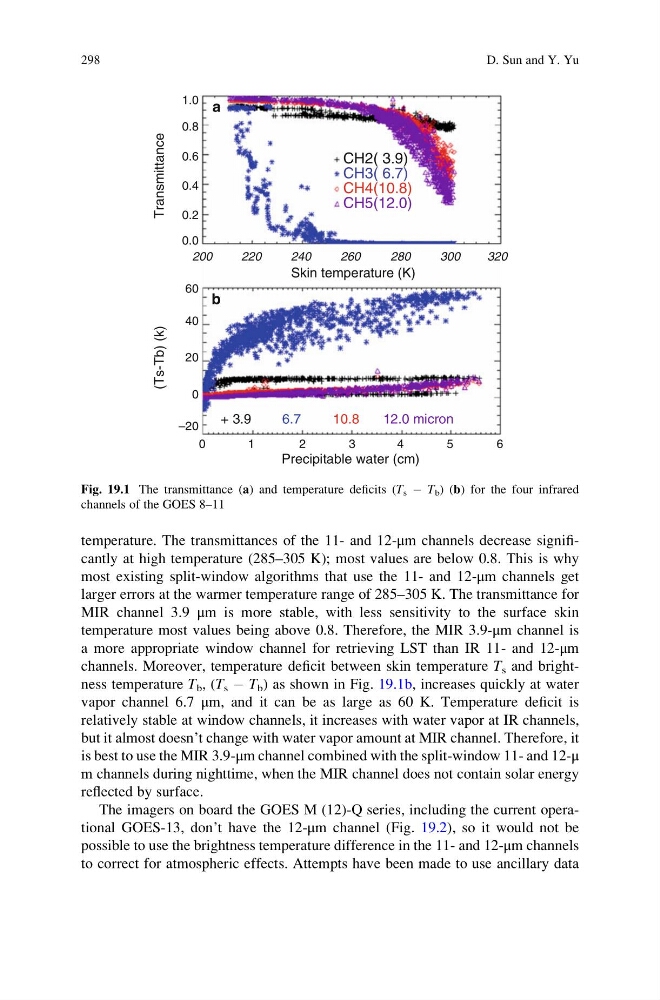
temperature. The transmittances of the 11- and 12-μm channels decrease significantly at high temperature (285–305 K); most values are below 0.8. This is why
most existing split-window algorithms that use the 11- and 12-μm channels get
larger errors at the warmer temperature range of 285–305 K. The transmittance for
MIR channel 3.9 μm is more stable, with less sensitivity to the surface skin
temperature most values being above 0.8. Therefore, the MIR 3.9-μm channel is
a more appropriate window channel for retrieving LST than IR 11- and 12-μm
channels. Moreover, temperature deficit between skin temperature T s and brightness temperature T b , (T s À T b ) as shown in Fig. 19.1b, increases quickly at water
vapor channel 6.7 μm, and it can be as large as 60 K. Temperature deficit is
relatively stable at window channels, it increases with water vapor at IR channels,
but it almost doesn’t change with water vapor amount at MIR channel. Therefore, it
is best to use the MIR 3.9-μm channel combined with the split-window 11- and 12-μ
m channels during nighttime, when the MIR channel does not contain solar energy
reflected by surface.
The imagers on board the GOES M (12)-Q series, including the current operational GOES-13, don’t have the 12-μm channel (Fig. 19.2), so it would not be
possible to use the brightness temperature difference in the 11- and 12-μm channels
to correct for atmospheric effects. Attempts have been made to use ancillary data
1.0 a
b
0.8
0.6
+ 3.9
6.7
10.8
12.0 micron
CH2( 3.9)
CH3( 6.7)
CH4(10.8)
CH5(12.0)
0.4
0.2
Skin temperature (K)
Precipitable water (cm)
Transmittance
(Ts-Tb) (k)
0.0
0
1
2
3
4
5
6
60
40
20
0
–20
200
220
240
260
280
300
320
Fig. 19.1 The transmittance (a) and temperature deficits (T s À T b ) (b) for the four infrared
channels of the GOES 8–11
298
D. Sun and Y. Yu
most existing split-window algorithms that use the 11- and 12-μm channels get
larger errors at the warmer temperature range of 285–305 K. The transmittance for
MIR channel 3.9 μm is more stable, with less sensitivity to the surface skin
temperature most values being above 0.8. Therefore, the MIR 3.9-μm channel is
a more appropriate window channel for retrieving LST than IR 11- and 12-μm
channels. Moreover, temperature deficit between skin temperature T s and brightness temperature T b , (T s À T b ) as shown in Fig. 19.1b, increases quickly at water
vapor channel 6.7 μm, and it can be as large as 60 K. Temperature deficit is
relatively stable at window channels, it increases with water vapor at IR channels,
but it almost doesn’t change with water vapor amount at MIR channel. Therefore, it
is best to use the MIR 3.9-μm channel combined with the split-window 11- and 12-μ
m channels during nighttime, when the MIR channel does not contain solar energy
reflected by surface.
The imagers on board the GOES M (12)-Q series, including the current operational GOES-13, don’t have the 12-μm channel (Fig. 19.2), so it would not be
possible to use the brightness temperature difference in the 11- and 12-μm channels
to correct for atmospheric effects. Attempts have been made to use ancillary data
1.0 a
b
0.8
0.6
+ 3.9
6.7
10.8
12.0 micron
CH2( 3.9)
CH3( 6.7)
CH4(10.8)
CH5(12.0)
0.4
0.2
Skin temperature (K)
Precipitable water (cm)
Transmittance
(Ts-Tb) (k)
0.0
0
1
2
3
4
5
6
60
40
20
0
–20
200
220
240
260
280
300
320
Fig. 19.1 The transmittance (a) and temperature deficits (T s À T b ) (b) for the four infrared
channels of the GOES 8–11
298
D. Sun and Y. Yu