

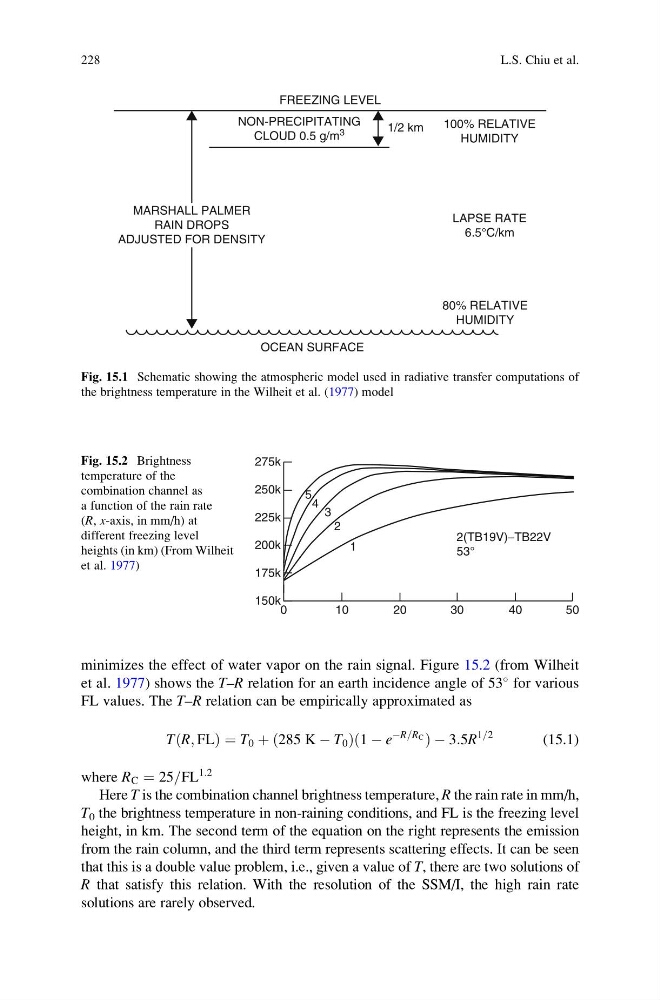
minimizes the effect of water vapor on the rain signal. Figure 15.2 (from Wilheit
et al. 1977) shows the T–R relation for an earth incidence angle of 53
for various
FL values. The T–R relation can be empirically approximated as
TðR; FLÞ ¼ T 0 þ ð285 K À T 0 Þð1 À e
ÀR=R C Þ À 3:5R
1=2
(15.1)
where R C ¼ 25=FL
1:2
Here T is the combination channel brightness temperature, R the rain rate in mm/h,
T 0 the brightness temperature in non-raining conditions, and FL is the freezing level
height, in km. The second term of the equation on the right represents the emission
from the rain column, and the third term represents scattering effects. It can be seen
that this is a double value problem, i.e., given a value of T, there are two solutions of
R that satisfy this relation. With the resolution of the SSM/I, the high rain rate
solutions are rarely observed.
FREEZING LEVEL
1/2 km
100% RELATIVE
HUMIDITY
NON-PRECIPITATING
CLOUD 0.5 g/m 3
MARSHALL PALMER
RAIN DROPS
ADJUSTED FOR DENSITY
OCEAN SURFACE
LAPSE RATE
6.5°C/km
80% RELATIVE
HUMIDITY
Fig. 15.1 Schematic showing the atmospheric model used in radiative transfer computations of
the brightness temperature in the Wilheit et al. (1977) model
275k
250k
225k
200k
175k
150k
0
1 0
5
4
3
2
1
20
2(TB19V)−TB22V
53°
30
40
50
Fig. 15.2 Brightness
temperature of the
combination channel as
a function of the rain rate
(R, x-axis, in mm/h) at
different freezing level
heights (in km) (From Wilheit
et al. 1977)
228
L.S. Chiu et al.
et al. 1977) shows the T–R relation for an earth incidence angle of 53
for various
FL values. The T–R relation can be empirically approximated as
TðR; FLÞ ¼ T 0 þ ð285 K À T 0 Þð1 À e
ÀR=R C Þ À 3:5R
1=2
(15.1)
where R C ¼ 25=FL
1:2
Here T is the combination channel brightness temperature, R the rain rate in mm/h,
T 0 the brightness temperature in non-raining conditions, and FL is the freezing level
height, in km. The second term of the equation on the right represents the emission
from the rain column, and the third term represents scattering effects. It can be seen
that this is a double value problem, i.e., given a value of T, there are two solutions of
R that satisfy this relation. With the resolution of the SSM/I, the high rain rate
solutions are rarely observed.
FREEZING LEVEL
1/2 km
100% RELATIVE
HUMIDITY
NON-PRECIPITATING
CLOUD 0.5 g/m 3
MARSHALL PALMER
RAIN DROPS
ADJUSTED FOR DENSITY
OCEAN SURFACE
LAPSE RATE
6.5°C/km
80% RELATIVE
HUMIDITY
Fig. 15.1 Schematic showing the atmospheric model used in radiative transfer computations of
the brightness temperature in the Wilheit et al. (1977) model
275k
250k
225k
200k
175k
150k
0
1 0
5
4
3
2
1
20
2(TB19V)−TB22V
53°
30
40
50
Fig. 15.2 Brightness
temperature of the
combination channel as
a function of the rain rate
(R, x-axis, in mm/h) at
different freezing level
heights (in km) (From Wilheit
et al. 1977)
228
L.S. Chiu et al.