

is described in Bastiaanssen et al. (1998, 2005) and Bastiaanssen (2000). The basis
and principles for METRIC are described in Allen et al. (2005, 2007a). ET is
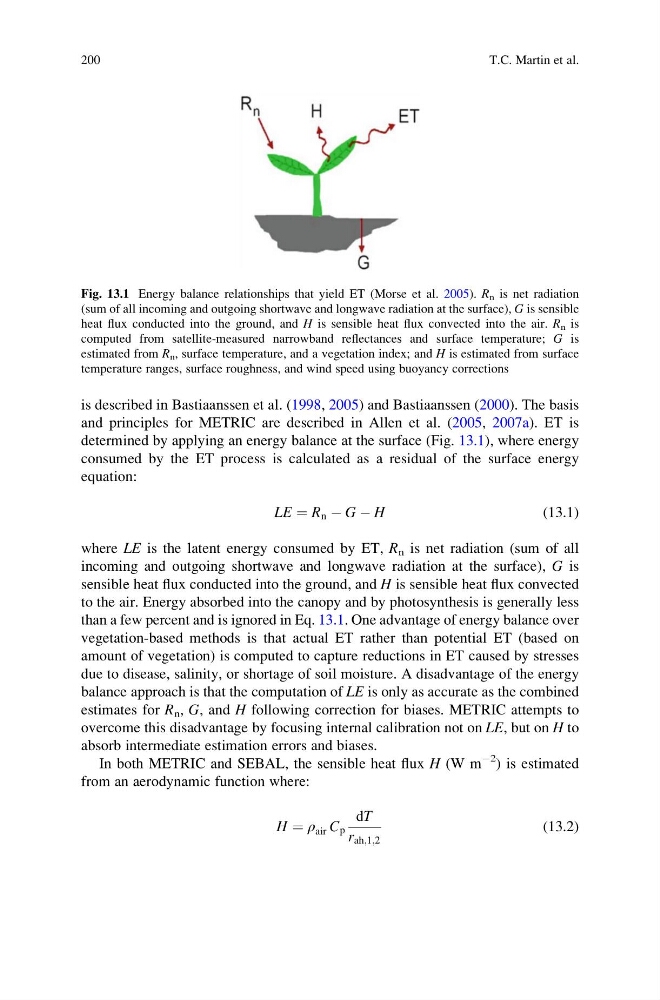
determined by applying an energy balance at the surface (Fig. 13.1), where energy
consumed by the ET process is calculated as a residual of the surface energy
equation:
LE ¼ R n À G À H
(13.1)
where LE is the latent energy consumed by ET, R n is net radiation (sum of all
incoming and outgoing shortwave and longwave radiation at the surface), G is
sensible heat flux conducted into the ground, and H is sensible heat flux convected
to the air. Energy absorbed into the canopy and by photosynthesis is generally less
than a few percent and is ignored in Eq. 13.1. One advantage of energy balance over
vegetation-based methods is that actual ET rather than potential ET (based on
amount of vegetation) is computed to capture reductions in ET caused by stresses
due to disease, salinity, or shortage of soil moisture. A disadvantage of the energy
balance approach is that the computation of LE is only as accurate as the combined
estimates for R n , G, and H following correction for biases. METRIC attempts to
overcome this disadvantage by focusing internal calibration not on LE, but on H to
absorb intermediate estimation errors and biases.
In both METRIC and SEBAL, the sensible heat flux H (W m
À2 ) is estimated
from an aerodynamic function where:
H ¼ ρ air C p
dT
r ah;1;2
(13.2)
Fig. 13.1 Energy balance relationships that yield ET (Morse et al. 2005). R n is net radiation
(sum of all incoming and outgoing shortwave and longwave radiation at the surface), G is sensible
heat flux conducted into the ground, and H is sensible heat flux convected into the air. R n is
computed from satellite-measured narrowband reflectances and surface temperature; G is
estimated from R n , surface temperature, and a vegetation index; and H is estimated from surface
temperature ranges, surface roughness, and wind speed using buoyancy corrections
200
T.C. Martin et al.
and principles for METRIC are described in Allen et al. (2005, 2007a). ET is
determined by applying an energy balance at the surface (Fig. 13.1), where energy
consumed by the ET process is calculated as a residual of the surface energy
equation:
LE ¼ R n À G À H
(13.1)
where LE is the latent energy consumed by ET, R n is net radiation (sum of all
incoming and outgoing shortwave and longwave radiation at the surface), G is
sensible heat flux conducted into the ground, and H is sensible heat flux convected
to the air. Energy absorbed into the canopy and by photosynthesis is generally less
than a few percent and is ignored in Eq. 13.1. One advantage of energy balance over
vegetation-based methods is that actual ET rather than potential ET (based on
amount of vegetation) is computed to capture reductions in ET caused by stresses
due to disease, salinity, or shortage of soil moisture. A disadvantage of the energy
balance approach is that the computation of LE is only as accurate as the combined
estimates for R n , G, and H following correction for biases. METRIC attempts to
overcome this disadvantage by focusing internal calibration not on LE, but on H to
absorb intermediate estimation errors and biases.
In both METRIC and SEBAL, the sensible heat flux H (W m
À2 ) is estimated
from an aerodynamic function where:
H ¼ ρ air C p
dT
r ah;1;2
(13.2)
Fig. 13.1 Energy balance relationships that yield ET (Morse et al. 2005). R n is net radiation
(sum of all incoming and outgoing shortwave and longwave radiation at the surface), G is sensible
heat flux conducted into the ground, and H is sensible heat flux convected into the air. R n is
computed from satellite-measured narrowband reflectances and surface temperature; G is
estimated from R n , surface temperature, and a vegetation index; and H is estimated from surface
temperature ranges, surface roughness, and wind speed using buoyancy corrections
200
T.C. Martin et al.