

transition layer (Lykossov 2001). A detail discussion of the atmospheric and
oceanic boundary layer is in Kraus and Businger (1994).
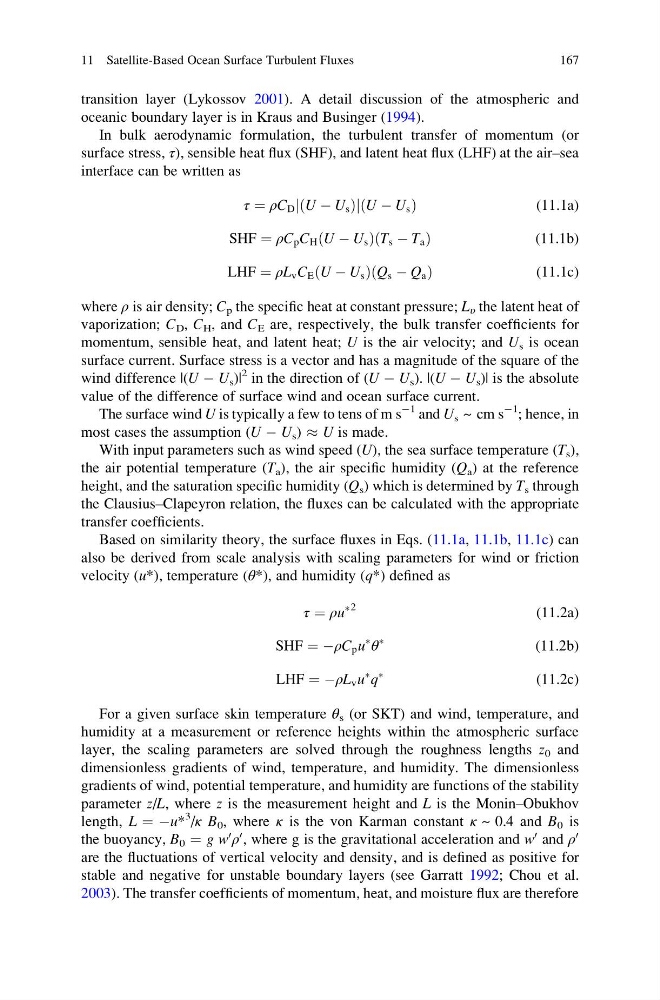
In bulk aerodynamic formulation, the turbulent transfer of momentum (or
surface stress, τ), sensible heat flux (SHF), and latent heat flux (LHF) at the air–sea
interface can be written as
τ ¼ ρC D ðU À U s Þ
j
j ð U À U s Þ
(11.1a)
SHF ¼ ρC p C H ðU À U s ÞðT s À T a Þ
(11.1b)
LHF ¼ ρL v C E ðU À U s ÞðQ s À Q a Þ
(11.1c)
where ρ is air density; C p the specific heat at constant pressure; L υ the latent heat of
vaporization; C D , C H , and C E are, respectively, the bulk transfer coefficients for
momentum, sensible heat, and latent heat; U is the air velocity; and U s is ocean
surface current. Surface stress is a vector and has a magnitude of the square of the
wind difference |(U À U s )|
2 in the direction of (U À U s ). |(U À U s )| is the absolute
value of the difference of surface wind and ocean surface current.
The surface wind U is typically a few to tens of m s
À1 and U s ~ cm s
À1 ; hence, in
most cases the assumption (U À U s ) % U is made.
With input parameters such as wind speed (U), the sea surface temperature (T s ),
the air potential temperature (T a ), the air specific humidity (Q a ) at the reference
height, and the saturation specific humidity (Q s ) which is determined by T s through
the Clausius–Clapeyron relation, the fluxes can be calculated with the appropriate
transfer coefficients.
Based on similarity theory, the surface fluxes in Eqs. (11.1a, 11.1b, 11.1c) can
also be derived from scale analysis with scaling parameters for wind or friction
velocity (u*), temperature (θ*), and humidity (q*) defined as
τ ¼ ρu
Ã2
(11.2a)
SHF ¼ ÀρC p u
Ã
θ
Ã
(11.2b)
LHF ¼ ÀρL v u
à q
Ã
(11.2c)
For a given surface skin temperature θ s (or SKT) and wind, temperature, and
humidity at a measurement or reference heights within the atmospheric surface
layer, the scaling parameters are solved through the roughness lengths z 0 and
dimensionless gradients of wind, temperature, and humidity. The dimensionless
gradients of wind, potential temperature, and humidity are functions of the stability
parameter z/L, where z is the measurement height and L is the Monin–Obukhov
length, L ¼ Àu*
3 /κ B 0 , where κ is the von Karman constant κ ~ 0.4 and B 0 is
the buoyancy, B 0 ¼ g w
0
ρ
0 , where g is the gravitational acceleration and w
0 and ρ
0
are the fluctuations of vertical velocity and density, and is defined as positive for
stable and negative for unstable boundary layers (see Garratt 1992; Chou et al.
2003). The transfer coefficients of momentum, heat, and moisture flux are therefore
11 Satellite-Based Ocean Surface Turbulent Fluxes
167
oceanic boundary layer is in Kraus and Businger (1994).
In bulk aerodynamic formulation, the turbulent transfer of momentum (or
surface stress, τ), sensible heat flux (SHF), and latent heat flux (LHF) at the air–sea
interface can be written as
τ ¼ ρC D ðU À U s Þ
j
j ð U À U s Þ
(11.1a)
SHF ¼ ρC p C H ðU À U s ÞðT s À T a Þ
(11.1b)
LHF ¼ ρL v C E ðU À U s ÞðQ s À Q a Þ
(11.1c)
where ρ is air density; C p the specific heat at constant pressure; L υ the latent heat of
vaporization; C D , C H , and C E are, respectively, the bulk transfer coefficients for
momentum, sensible heat, and latent heat; U is the air velocity; and U s is ocean
surface current. Surface stress is a vector and has a magnitude of the square of the
wind difference |(U À U s )|
2 in the direction of (U À U s ). |(U À U s )| is the absolute
value of the difference of surface wind and ocean surface current.
The surface wind U is typically a few to tens of m s
À1 and U s ~ cm s
À1 ; hence, in
most cases the assumption (U À U s ) % U is made.
With input parameters such as wind speed (U), the sea surface temperature (T s ),
the air potential temperature (T a ), the air specific humidity (Q a ) at the reference
height, and the saturation specific humidity (Q s ) which is determined by T s through
the Clausius–Clapeyron relation, the fluxes can be calculated with the appropriate
transfer coefficients.
Based on similarity theory, the surface fluxes in Eqs. (11.1a, 11.1b, 11.1c) can
also be derived from scale analysis with scaling parameters for wind or friction
velocity (u*), temperature (θ*), and humidity (q*) defined as
τ ¼ ρu
Ã2
(11.2a)
SHF ¼ ÀρC p u
Ã
θ
Ã
(11.2b)
LHF ¼ ÀρL v u
à q
Ã
(11.2c)
For a given surface skin temperature θ s (or SKT) and wind, temperature, and
humidity at a measurement or reference heights within the atmospheric surface
layer, the scaling parameters are solved through the roughness lengths z 0 and
dimensionless gradients of wind, temperature, and humidity. The dimensionless
gradients of wind, potential temperature, and humidity are functions of the stability
parameter z/L, where z is the measurement height and L is the Monin–Obukhov
length, L ¼ Àu*
3 /κ B 0 , where κ is the von Karman constant κ ~ 0.4 and B 0 is
the buoyancy, B 0 ¼ g w
0
ρ
0 , where g is the gravitational acceleration and w
0 and ρ
0
are the fluctuations of vertical velocity and density, and is defined as positive for
stable and negative for unstable boundary layers (see Garratt 1992; Chou et al.
2003). The transfer coefficients of momentum, heat, and moisture flux are therefore
11 Satellite-Based Ocean Surface Turbulent Fluxes
167