

(e.g., Christy et al 2000; Zou et al. 2006). This indicates inaccurate nonlinearities in
the prelaunch calibration. Essentially, more accurate calibration offsets and
nonlinearities are required to reduce the time-varying inter-satellite biases for
development of more accurate MSU/AMSU FCDRs.
8.2.3 A SNO Technique for Inter-satellite Calibration
and FCDR Development
A SNO approach was developed at NOAA/NESDIS (Zou et al. 2006, 2009) to
remove the solar heating-induced instrument temperature variability and inter-satellite
265
275
285
295
305
1987
1991
1995
1998
2002
2006
Year
Temperature (K)
NOAA10
NOAA11
NOAA12
NOAA14
NOAA15
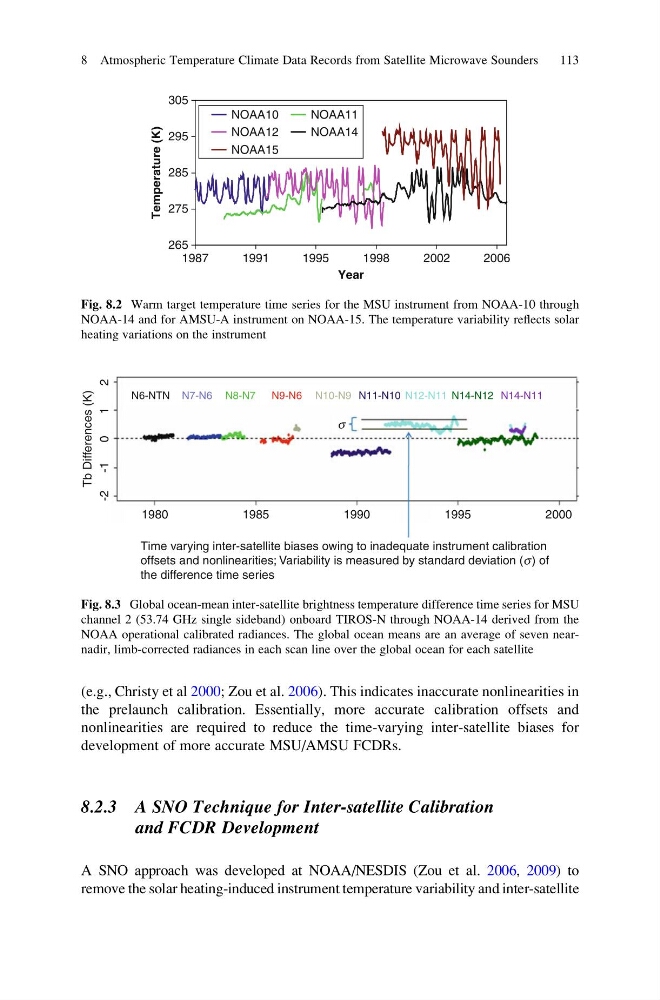
Fig. 8.2 Warm target temperature time series for the MSU instrument from NOAA-10 through
NOAA-14 and for AMSU-A instrument on NOAA-15. The temperature variability reflects solar
heating variations on the instrument
N6-NTN N7-N6 N8-N7
N9-N6 N10-N9 N11-N10 N12-N11 N14-N12 N14-N11
1980
1985
1990
Time varying inter-satellite biases owing to inadequate instrument calibration
offsets and nonlinearities; Variability is measured by standard deviation (s ) of
the difference time series
1995
2000
-2 -1
0
1
2
Tb Differences (K)
s
Fig. 8.3 Global ocean-mean inter-satellite brightness temperature difference time series for MSU
channel 2 (53.74 GHz single sideband) onboard TIROS-N through NOAA-14 derived from the
NOAA operational calibrated radiances. The global ocean means are an average of seven nearnadir, limb-corrected radiances in each scan line over the global ocean for each satellite
8 Atmospheric Temperature Climate Data Records from Satellite Microwave Sounders
113
the prelaunch calibration. Essentially, more accurate calibration offsets and
nonlinearities are required to reduce the time-varying inter-satellite biases for
development of more accurate MSU/AMSU FCDRs.
8.2.3 A SNO Technique for Inter-satellite Calibration
and FCDR Development
A SNO approach was developed at NOAA/NESDIS (Zou et al. 2006, 2009) to
remove the solar heating-induced instrument temperature variability and inter-satellite
265
275
285
295
305
1987
1991
1995
1998
2002
2006
Year
Temperature (K)
NOAA10
NOAA11
NOAA12
NOAA14
NOAA15
Fig. 8.2 Warm target temperature time series for the MSU instrument from NOAA-10 through
NOAA-14 and for AMSU-A instrument on NOAA-15. The temperature variability reflects solar
heating variations on the instrument
N6-NTN N7-N6 N8-N7
N9-N6 N10-N9 N11-N10 N12-N11 N14-N12 N14-N11
1980
1985
1990
Time varying inter-satellite biases owing to inadequate instrument calibration
offsets and nonlinearities; Variability is measured by standard deviation (s ) of
the difference time series
1995
2000
-2 -1
0
1
2
Tb Differences (K)
s
Fig. 8.3 Global ocean-mean inter-satellite brightness temperature difference time series for MSU
channel 2 (53.74 GHz single sideband) onboard TIROS-N through NOAA-14 derived from the
NOAA operational calibrated radiances. The global ocean means are an average of seven nearnadir, limb-corrected radiances in each scan line over the global ocean for each satellite
8 Atmospheric Temperature Climate Data Records from Satellite Microwave Sounders
113