

development. (3) Achievement motivation: Every man/woman has a desire to
achieve certain things in their life. Achievement motivation is considered as the
extent to which an individual is oriented toward maximizing profits. Achievement
motivation as a social value that emphasizes a desire for excellence in order for an
individual to attain a sense of personal accomplishment. So, achievement motivation increases efficiency of professionals and important for bioresource conservation and livelihood development (4) Information seeking ability: It refers to the
frequency of contact by professional with various information sources. This is the
pattern by which an individual gets information either on his/her own seeking or as
a consequence of his/her being a part of the network. This component is important
for bioresource conservation and livelihood development. (5) Risk taking ability:
Some take more risk, some others take moderate risk and many hesitate to take risk.
Risk taking ability considered an individual orientation toward risk and uncertainty
in adopting new ideas and courage to face the problems for bioresource conservation and livelihood development demands ability to take risk by professionals.
(6) Coordinating ability: In order to complete the required work in stipulated
period, one has to harmonize and synchronize the various activities for better profit.
It is an individual coordinates action in a time dimension. This ability helps to
increase the efficiency of professional for bioresource conservation and livelihood
development. (7) Leadership ability: To get things done properly, a professional
has to initiate the action, motivate the followers and decision should be taken. It is
an individual initiates or motivates the action of the other fellows. Hence, leadership
ability is an important component in professional for bioresource conservation and
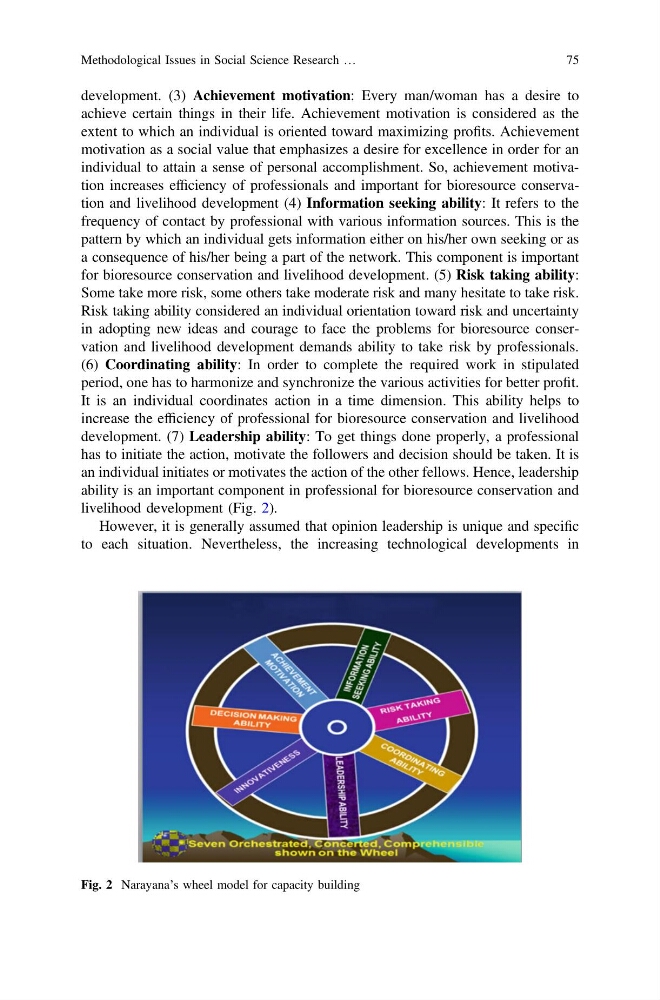
livelihood development (Fig. 2).
However, it is generally assumed that opinion leadership is unique and specific
to each situation. Nevertheless, the increasing technological developments in
Fig. 2 Narayana’s wheel model for capacity building
Methodological Issues in Social Science Research …
75
achieve certain things in their life. Achievement motivation is considered as the
extent to which an individual is oriented toward maximizing profits. Achievement
motivation as a social value that emphasizes a desire for excellence in order for an
individual to attain a sense of personal accomplishment. So, achievement motivation increases efficiency of professionals and important for bioresource conservation and livelihood development (4) Information seeking ability: It refers to the
frequency of contact by professional with various information sources. This is the
pattern by which an individual gets information either on his/her own seeking or as
a consequence of his/her being a part of the network. This component is important
for bioresource conservation and livelihood development. (5) Risk taking ability:
Some take more risk, some others take moderate risk and many hesitate to take risk.
Risk taking ability considered an individual orientation toward risk and uncertainty
in adopting new ideas and courage to face the problems for bioresource conservation and livelihood development demands ability to take risk by professionals.
(6) Coordinating ability: In order to complete the required work in stipulated
period, one has to harmonize and synchronize the various activities for better profit.
It is an individual coordinates action in a time dimension. This ability helps to
increase the efficiency of professional for bioresource conservation and livelihood
development. (7) Leadership ability: To get things done properly, a professional
has to initiate the action, motivate the followers and decision should be taken. It is
an individual initiates or motivates the action of the other fellows. Hence, leadership
ability is an important component in professional for bioresource conservation and
livelihood development (Fig. 2).
However, it is generally assumed that opinion leadership is unique and specific
to each situation. Nevertheless, the increasing technological developments in
Fig. 2 Narayana’s wheel model for capacity building
Methodological Issues in Social Science Research …
75