

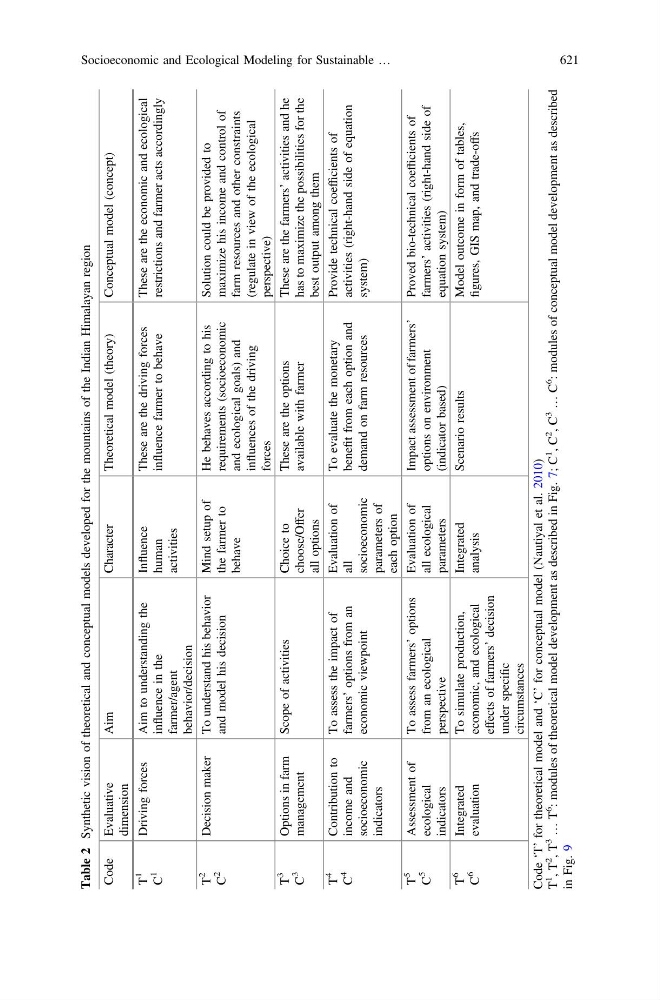
Table 2
Synthetic vision of theoretical and conceptual models developed for the mountains of the Indian Himalayan region
Code
Evaluative
dimension
Aim
Character
Theoretical model (theory)
Conceptual model (concept)
T
1
C
1
Driving forces
Aim to understanding the
influence in the
farmer/agent
behavior/decision
Influence
human
activities
These are the driving forces
influence farmer to behave
These are the economic and ecological
restrictions and farmer acts accordingly
T
2
C
2
Decision maker
To understand his behavior
and model his decision
Mind setup of
the farmer to
behave
He behaves according to his
requirements (socioeconomic
and ecological goals) and
influences of the driving
forces
Solution could be provided to
maximize his income and control of
farm resources and other constraints
(regulate in view of the ecological
perspective)
T
3
C
3
Options in farm
management
Scope of activities
Choice to
choose/Offer
all options
These are the options
available with farmer
These are the farmers’ activities and he
has to maximize the possibilities for the
best output among them
T
4
C
4
Contribution to
income and
socioeconomic
indicators
To assess the impact of
farmers’ options from an
economic viewpoint
Evaluation of
all
socioeconomic
parameters of
each option
To evaluate the monetary
benefit from each option and
demand on farm resources
Provide technical coefficients of
activities (right-hand side of equation
system)
T
5
C
5
Assessment of
ecological
indicators
To assess farmers’ options
from an ecological
perspective
Evaluation of
all ecological
parameters
Impact assessment of farmers’
options on environment
(indicator based)
Proved bio-technical coefficients of
farmers’ activities (right-hand side of
equation system)
T
6
C
6
Integrated
evaluation
To simulate production,
economic, and ecological
effects of farmers’ decision
under specific
circumstances
Integrated
analysis
Scenario results
Model outcome in form of tables,
figures, GIS map, and trade-offs
Code
‘T’ for theoretical model and
‘C’ for conceptual model (Nautiyal et al. 2010)
T
1
, T
2
, T
3
… T
6
: modules of theoretical model development as described in Fig. 7; C
1
, C
2
, C
3
… C
6
: modules of conceptual model development as described
in Fig. 9
Socioeconomic and Ecological Modeling for Sustainable …
621