

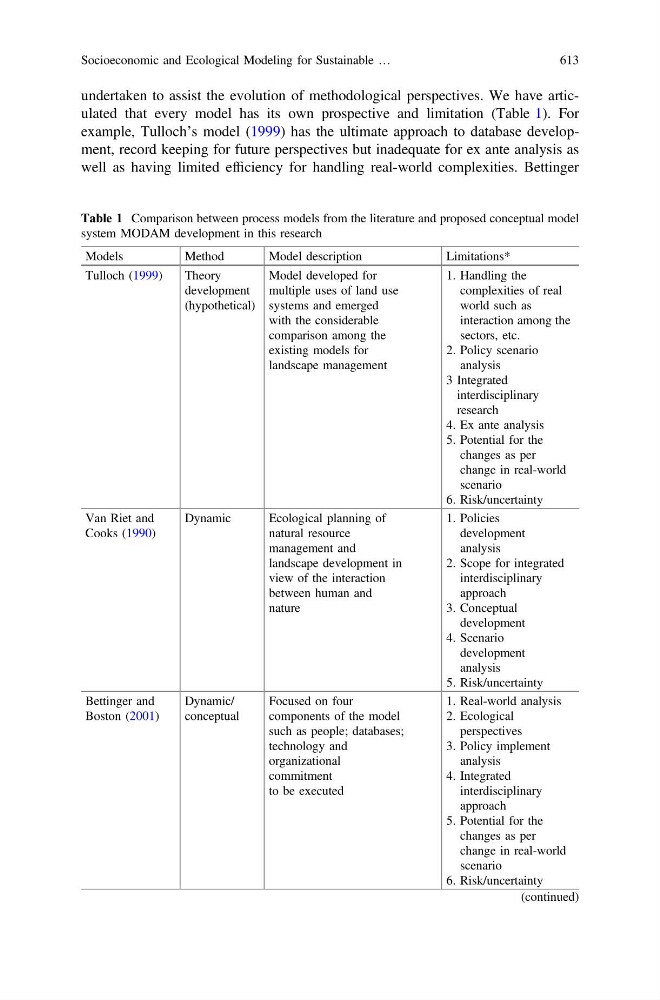
undertaken to assist the evolution of methodological perspectives. We have articulated that every model has its own prospective and limitation (Table 1). For
example, Tulloch’s model (1999) has the ultimate approach to database development, record keeping for future perspectives but inadequate for ex ante analysis as
well as having limited efficiency for handling real-world complexities. Bettinger
Table 1 Comparison between process models from the literature and proposed conceptual model
system MODAM development in this research
Models
Method
Model description
Limitations*
Tulloch (1999)
Theory
development
(hypothetical)
Model developed for
multiple uses of land use
systems and emerged
with the considerable
comparison among the
existing models for
landscape management
1. Handling the
complexities of real
world such as
interaction among the
sectors, etc.
2. Policy scenario
analysis
3 Integrated
interdisciplinary
research
4. Ex ante analysis
5. Potential for the
changes as per
change in real-world
scenario
6. Risk/uncertainty
Van Riet and
Cooks (1990)
Dynamic
Ecological planning of
natural resource
management and
landscape development in
view of the interaction
between human and
nature
1. Policies
development
analysis
2. Scope for integrated
interdisciplinary
approach
3. Conceptual
development
4. Scenario
development
analysis
5. Risk/uncertainty
Bettinger and
Boston (2001)
Dynamic/
conceptual
Focused on four
components of the model
such as people; databases;
technology and
organizational
commitment
to be executed
1. Real-world analysis
2. Ecological
perspectives
3. Policy implement
analysis
4. Integrated
interdisciplinary
approach
5. Potential for the
changes as per
change in real-world
scenario
6. Risk/uncertainty
(continued)
Socioeconomic and Ecological Modeling for Sustainable …
613