

Programme implementation at various sites also indicates that technologies
should be such as would upgrade traditional skills and capabilities; be innovative
and capable of easy assimilation; generate significant and assured added value to
existing methods of operation; generate employment and use local resources; be
capable of replication and adoption and should blend harmoniously with existing
ecosystems leading to tangible improvements in the living conditions and self
sustained development of the people as well as PAs (Gladwin et al. 2002; Agarwal
and Joshi 2006).
Thus, analysis of data from project sites clearly suggests that technology-led
livelihood diversification is an appropriate alternative strategy as adopted by
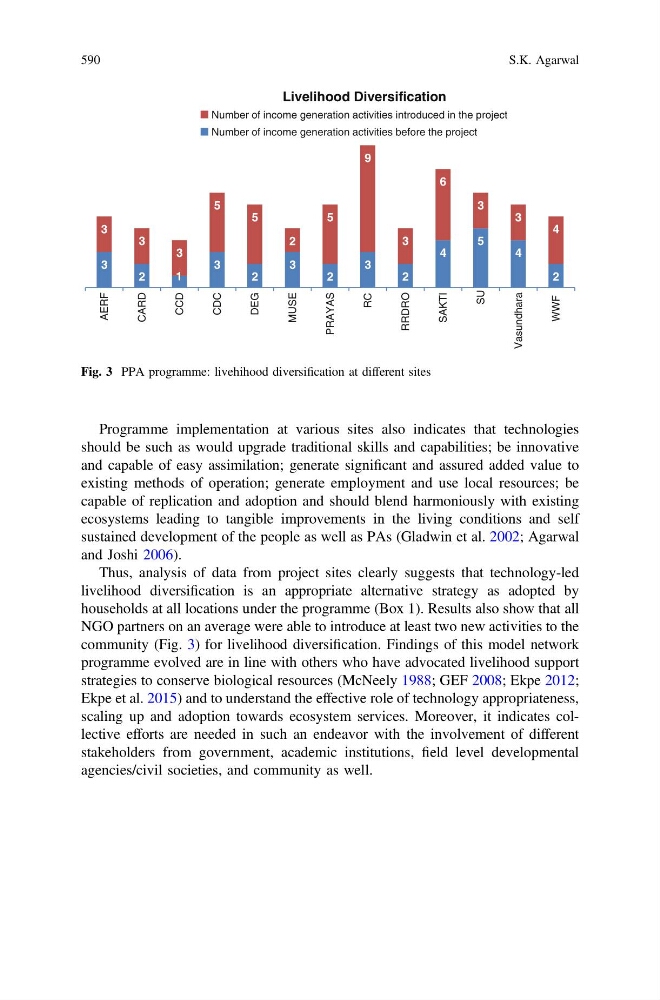
households at all locations under the programme (Box 1). Results also show that all
NGO partners on an average were able to introduce at least two new activities to the
community (Fig. 3) for livelihood diversification. Findings of this model network
programme evolved are in line with others who have advocated livelihood support
strategies to conserve biological resources (McNeely 1988; GEF 2008; Ekpe 2012;
Ekpe et al. 2015) and to understand the effective role of technology appropriateness,
scaling up and adoption towards ecosystem services. Moreover, it indicates collective efforts are needed in such an endeavor with the involvement of different
stakeholders from government, academic institutions, field level developmental
agencies/civil societies, and community as well.
3
2
1
3
2
3
2
3
2
4
5
4
2
3
3
3
5
5
2
5
9
3
6
3
3
4
AERF
CARD
CCD
CDC
DEG
MUSE
PRAYAS
RC
RRDRO
SAKTI
SU
Vasundhara
WWF
Livelihood Diversification
Number of income generation activities introduced in the project
Number of income generation activities before the project
Fig. 3 PPA programme: livehihood diversification at different sites
590
S.K. Agarwal