

10 Model Validation
• Validation will mainly be done through model development for the well known
area with data from past ‘t − x’ (x = 1, up to 30 years into the past); model
validation for well known area with present data on the basis of data from year
‘t − x’; model application—Model application of the model to year t and
comparing with data from year t.
• After validation (t − x), the model needs to be applied for the future ‘t + x’
(x = 1, towards future)
11 Overall Scenario Analysis
Through the process of model development the linkages of the modules of the
integrated interdisciplinary modeling research efforts are to be associated with each
other by means of dynamic LandSHIFT model (Schaldach et al. 2011a, b; Alcamo
et al. 2010; Lapola et al. 2010). For multidisciplinary problem of the real world, we
argue for bio-economic models which are helpful to solve the problems of economics and ecological complexities simultaneously. The bio-economic models
evaluate possible changes in landscape (land use land cover) under different sets of
technological and socioeconomic and environmental conditions. The complex rural
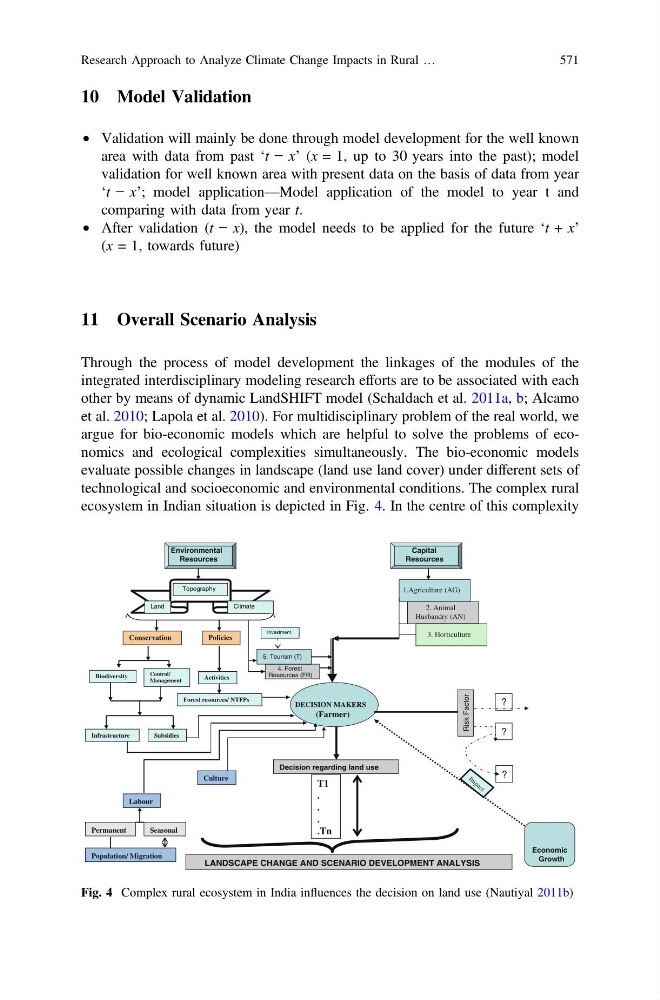
ecosystem in Indian situation is depicted in Fig. 4. In the centre of this complexity
Environmental
Resources
1.Agriculture (AG)
2. Animal
Husbandry (AN)
3. Horticulture
DECISION MAKERS
(Farmer)
LANDSCAPE CHANGE AND SCENARIO DEVELOPMENT ANALYSIS
Land
Topography
Climate
Conservation
4. Forest
Resources (FR)
5. Tourism (T)
Biodiversity
Control/
Management
Activities
Forest resources/ NTFPs
Subsidies
Infrastructure
Population/ Migration
Seasonal
Permanent
Labour
Economic
Growth
Risk Factor
?
?
Decision regarding land use
?
Investment
Im
p a c t
T1
.
.
.
.Tn
Capital
Resources
Policies
Culture
Fig. 4 Complex rural ecosystem in India influences the decision on land use (Nautiyal 2011b)
Research Approach to Analyze Climate Change Impacts in Rural …
571
• Validation will mainly be done through model development for the well known
area with data from past ‘t − x’ (x = 1, up to 30 years into the past); model
validation for well known area with present data on the basis of data from year
‘t − x’; model application—Model application of the model to year t and
comparing with data from year t.
• After validation (t − x), the model needs to be applied for the future ‘t + x’
(x = 1, towards future)
11 Overall Scenario Analysis
Through the process of model development the linkages of the modules of the
integrated interdisciplinary modeling research efforts are to be associated with each
other by means of dynamic LandSHIFT model (Schaldach et al. 2011a, b; Alcamo
et al. 2010; Lapola et al. 2010). For multidisciplinary problem of the real world, we
argue for bio-economic models which are helpful to solve the problems of economics and ecological complexities simultaneously. The bio-economic models
evaluate possible changes in landscape (land use land cover) under different sets of
technological and socioeconomic and environmental conditions. The complex rural
ecosystem in Indian situation is depicted in Fig. 4. In the centre of this complexity
Environmental
Resources
1.Agriculture (AG)
2. Animal
Husbandry (AN)
3. Horticulture
DECISION MAKERS
(Farmer)
LANDSCAPE CHANGE AND SCENARIO DEVELOPMENT ANALYSIS
Land
Topography
Climate
Conservation
4. Forest
Resources (FR)
5. Tourism (T)
Biodiversity
Control/
Management
Activities
Forest resources/ NTFPs
Subsidies
Infrastructure
Population/ Migration
Seasonal
Permanent
Labour
Economic
Growth
Risk Factor
?
?
Decision regarding land use
?
Investment
Im
p a c t
T1
.
.
.
.Tn
Capital
Resources
Policies
Culture
Fig. 4 Complex rural ecosystem in India influences the decision on land use (Nautiyal 2011b)
Research Approach to Analyze Climate Change Impacts in Rural …
571