

sustainable socio-ecological development pathways particularly regarding the
relationship between human land use activities and environmental processes.
The aim of research studies should be to build and to apply an integrated
interdisciplinary model that supports the decision-making of stakeholders (farmers,
policy makers, decision takers, researchers etc.) in the geo-climatic regions they are
located. Consequently, the modeling of farmer decision-making processes stands in
the centre of research efforts. These processes are not unidirectional but always
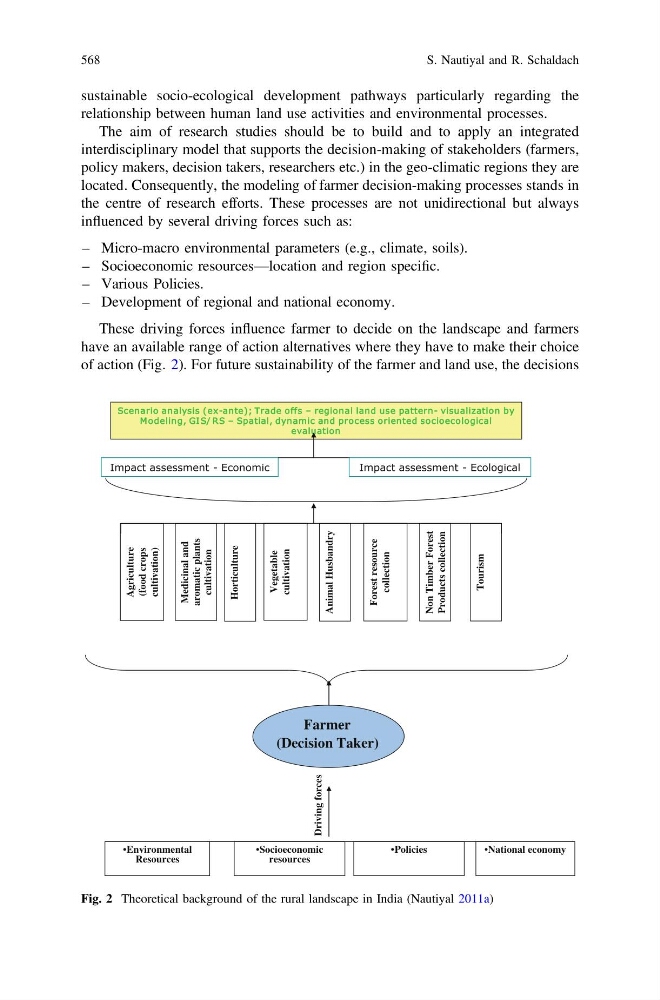
influenced by several driving forces such as:
– Micro-macro environmental parameters (e.g., climate, soils).
– Socioeconomic resources—location and region specific.
– Various Policies.
– Development of regional and national economy.
These driving forces influence farmer to decide on the landscape and farmers
have an available range of action alternatives where they have to make their choice
of action (Fig. 2). For future sustainability of the farmer and land use, the decisions
•Environmental
Resources
•Socioeconomic
resources
•Policies
•National economy
Farmer
(Decision Taker)
Agriculture
(food crops
cultivation)
Medicinal and
aromatic plants
cultivation
Animal Husbandry
Non Timber Forest
Products collection
Tourism
Horticulture
Vegetable
cultivation
Forest resource
collection
Driving forces
Fig. 2 Theoretical background of the rural landscape in India (Nautiyal 2011a)
568
S. Nautiyal and R. Schaldach
relationship between human land use activities and environmental processes.
The aim of research studies should be to build and to apply an integrated
interdisciplinary model that supports the decision-making of stakeholders (farmers,
policy makers, decision takers, researchers etc.) in the geo-climatic regions they are
located. Consequently, the modeling of farmer decision-making processes stands in
the centre of research efforts. These processes are not unidirectional but always
influenced by several driving forces such as:
– Micro-macro environmental parameters (e.g., climate, soils).
– Socioeconomic resources—location and region specific.
– Various Policies.
– Development of regional and national economy.
These driving forces influence farmer to decide on the landscape and farmers
have an available range of action alternatives where they have to make their choice
of action (Fig. 2). For future sustainability of the farmer and land use, the decisions
•Environmental
Resources
•Socioeconomic
resources
•Policies
•National economy
Farmer
(Decision Taker)
Agriculture
(food crops
cultivation)
Medicinal and
aromatic plants
cultivation
Animal Husbandry
Non Timber Forest
Products collection
Tourism
Horticulture
Vegetable
cultivation
Forest resource
collection
Driving forces
Fig. 2 Theoretical background of the rural landscape in India (Nautiyal 2011a)
568
S. Nautiyal and R. Schaldach