

• A diverse feed base provides flexibility to take advantage of rainfall when it
occurs as opposed to a reliance on one or two species limited to a particular
growing season. This may include a shift towards annual crops and pastures
where pasture persistence is a problem and livestock.
• Shade, sprinklers, timing of activities can all help to reduce heat stress. The Cool
Cows program provides information on managing heat stress.
• Securing supplementary feeds through the use of forward contracts.
• Ensuring your farm is water efficient, and you have sufficient and secure supplies of water available to meet your needs and those of their stock. Shade can
help significantly here as it reduces daily stock drinking requirements.
A range of case studies is available that demonstrate farmers taking action to
adapt to climate change.
It is important for farmers to
• Know the risks, plan ahead and allow time for implementation, for varying
breeds rather than needing to undertake poorly thought-out actions or local
cows.
• Assess any adaptation strategy in context of their own personal and farm
business goals, and
• Focus on what they can control.
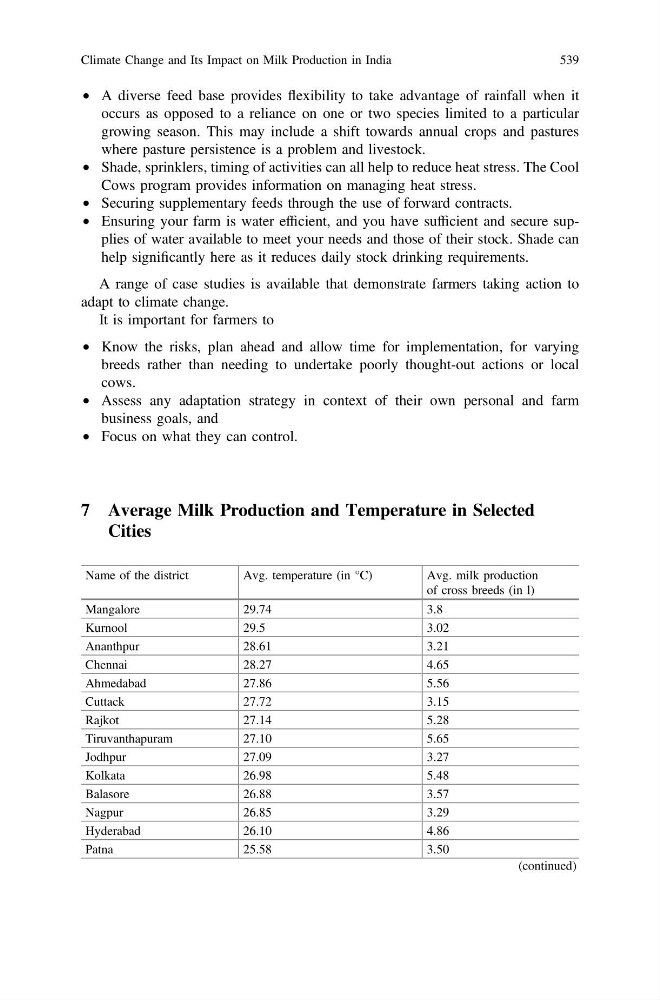
7 Average Milk Production and Temperature in Selected
Cities
Name of the district
Avg. temperature (in °C)
Avg. milk production
of cross breeds (in l)
Mangalore
29.74
3.8
Kurnool
29.5
3.02
Ananthpur
28.61
3.21
Chennai
28.27
4.65
Ahmedabad
27.86
5.56
Cuttack
27.72
3.15
Rajkot
27.14
5.28
Tiruvanthapuram
27.10
5.65
Jodhpur
27.09
3.27
Kolkata
26.98
5.48
Balasore
26.88
3.57
Nagpur
26.85
3.29
Hyderabad
26.10
4.86
Patna
25.58
3.50
(continued)
Climate Change and Its Impact on Milk Production in India
539
occurs as opposed to a reliance on one or two species limited to a particular
growing season. This may include a shift towards annual crops and pastures
where pasture persistence is a problem and livestock.
• Shade, sprinklers, timing of activities can all help to reduce heat stress. The Cool
Cows program provides information on managing heat stress.
• Securing supplementary feeds through the use of forward contracts.
• Ensuring your farm is water efficient, and you have sufficient and secure supplies of water available to meet your needs and those of their stock. Shade can
help significantly here as it reduces daily stock drinking requirements.
A range of case studies is available that demonstrate farmers taking action to
adapt to climate change.
It is important for farmers to
• Know the risks, plan ahead and allow time for implementation, for varying
breeds rather than needing to undertake poorly thought-out actions or local
cows.
• Assess any adaptation strategy in context of their own personal and farm
business goals, and
• Focus on what they can control.
7 Average Milk Production and Temperature in Selected
Cities
Name of the district
Avg. temperature (in °C)
Avg. milk production
of cross breeds (in l)
Mangalore
29.74
3.8
Kurnool
29.5
3.02
Ananthpur
28.61
3.21
Chennai
28.27
4.65
Ahmedabad
27.86
5.56
Cuttack
27.72
3.15
Rajkot
27.14
5.28
Tiruvanthapuram
27.10
5.65
Jodhpur
27.09
3.27
Kolkata
26.98
5.48
Balasore
26.88
3.57
Nagpur
26.85
3.29
Hyderabad
26.10
4.86
Patna
25.58
3.50
(continued)
Climate Change and Its Impact on Milk Production in India
539