

3.3.2 Two Decades Post Brimstowad
The most crucial adaptation strategy for Mumbai—the much-hyped
BRIMSTOWAD (Brihanmumbai Storm Water Drainage) project—still remains
incomplete. Way back in 1989, MCGM appointed M/s Watson Hawksley India Pvt.
Ltd. to study the storm water drainage system of the entire city. The consultant
submitted its final report in 1993, 20 years ago, with a series of recommendations.
Apart from other measures, the report recommended increasing the capacity of
storm water drains considering rainfall of 50 mm/h. The present capacity of
Mumbai’s storm water drains is 25 mm rainfall/h. “As per the latest estimates, the
rainfall has increased and we need to prepare the drainage system for 55 mm/h
capacity. Municipal corporation is already working on it,” said Jalota.
In 1993, the total cost of the project was Rs. 616.30 crore. However, the projects
could not be undertaken systematically due to financial constraints and encroachments on various sites. Twenty years later, the cost of the project has jumped up to
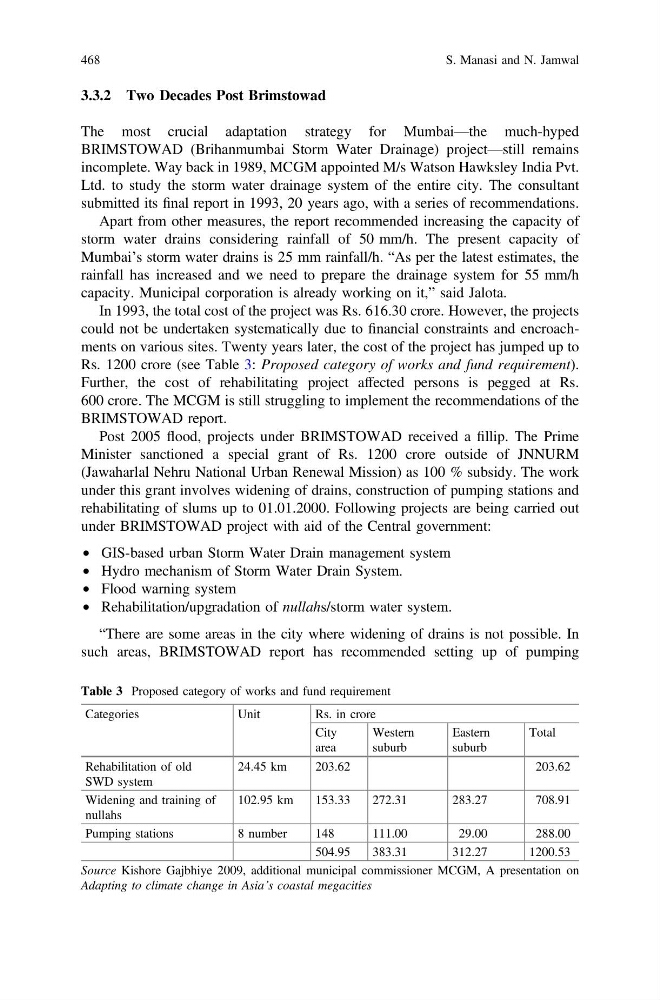
Rs. 1200 crore (see Table 3: Proposed category of works and fund requirement).
Further, the cost of rehabilitating project affected persons is pegged at Rs.
600 crore. The MCGM is still struggling to implement the recommendations of the
BRIMSTOWAD report.
Post 2005 flood, projects under BRIMSTOWAD received a fillip. The Prime
Minister sanctioned a special grant of Rs. 1200 crore outside of JNNURM
(Jawaharlal Nehru National Urban Renewal Mission) as 100 % subsidy. The work
under this grant involves widening of drains, construction of pumping stations and
rehabilitating of slums up to 01.01.2000. Following projects are being carried out
under BRIMSTOWAD project with aid of the Central government:
• GIS-based urban Storm Water Drain management system
• Hydro mechanism of Storm Water Drain System.
• Flood warning system
• Rehabilitation/upgradation of nullahs/storm water system.
“There are some areas in the city where widening of drains is not possible. In
such areas, BRIMSTOWAD report has recommended setting up of pumping
Table 3 Proposed category of works and fund requirement
Categories
Unit
Rs. in crore
City
area
Western
suburb
Eastern
suburb
Total
Rehabilitation of old
SWD system
24.45 km
203.62
203.62
Widening and training of
nullahs
102.95 km
153.33
272.31
283.27
708.91
Pumping stations
8 number
148
111.00
29.00
288.00
504.95
383.31
312.27
1200.53
Source Kishore Gajbhiye 2009, additional municipal commissioner MCGM, A presentation on
Adapting to climate change in Asia’s coastal megacities
468
S. Manasi and N. Jamwal
The most crucial adaptation strategy for Mumbai—the much-hyped
BRIMSTOWAD (Brihanmumbai Storm Water Drainage) project—still remains
incomplete. Way back in 1989, MCGM appointed M/s Watson Hawksley India Pvt.
Ltd. to study the storm water drainage system of the entire city. The consultant
submitted its final report in 1993, 20 years ago, with a series of recommendations.
Apart from other measures, the report recommended increasing the capacity of
storm water drains considering rainfall of 50 mm/h. The present capacity of
Mumbai’s storm water drains is 25 mm rainfall/h. “As per the latest estimates, the
rainfall has increased and we need to prepare the drainage system for 55 mm/h
capacity. Municipal corporation is already working on it,” said Jalota.
In 1993, the total cost of the project was Rs. 616.30 crore. However, the projects
could not be undertaken systematically due to financial constraints and encroachments on various sites. Twenty years later, the cost of the project has jumped up to
Rs. 1200 crore (see Table 3: Proposed category of works and fund requirement).
Further, the cost of rehabilitating project affected persons is pegged at Rs.
600 crore. The MCGM is still struggling to implement the recommendations of the
BRIMSTOWAD report.
Post 2005 flood, projects under BRIMSTOWAD received a fillip. The Prime
Minister sanctioned a special grant of Rs. 1200 crore outside of JNNURM
(Jawaharlal Nehru National Urban Renewal Mission) as 100 % subsidy. The work
under this grant involves widening of drains, construction of pumping stations and
rehabilitating of slums up to 01.01.2000. Following projects are being carried out
under BRIMSTOWAD project with aid of the Central government:
• GIS-based urban Storm Water Drain management system
• Hydro mechanism of Storm Water Drain System.
• Flood warning system
• Rehabilitation/upgradation of nullahs/storm water system.
“There are some areas in the city where widening of drains is not possible. In
such areas, BRIMSTOWAD report has recommended setting up of pumping
Table 3 Proposed category of works and fund requirement
Categories
Unit
Rs. in crore
City
area
Western
suburb
Eastern
suburb
Total
Rehabilitation of old
SWD system
24.45 km
203.62
203.62
Widening and training of
nullahs
102.95 km
153.33
272.31
283.27
708.91
Pumping stations
8 number
148
111.00
29.00
288.00
504.95
383.31
312.27
1200.53
Source Kishore Gajbhiye 2009, additional municipal commissioner MCGM, A presentation on
Adapting to climate change in Asia’s coastal megacities
468
S. Manasi and N. Jamwal