

The officials at MCGM claim that they have now finally woken up to the
challenge. “We are following a variety of measures, such as widening and deepening of nallahs, setting up pumping stations, widening of underground drainage
network in island city, widening of open drains in the suburbs, contour mapping,
etc. Some of these activities have been finished, whereas others are ongoing,”
informed L S Vhatkar, director (ES&P), MCGM.
13 Vhatkar is responsible for the
entire drainage and sewerage network of Mumbai. Mithi river, the main channel for
draining excess water from the city, has come to the centre stage. Every year before
the onset of monsoon, tenders are floated for desilting of the river to increase its
capacity to carry storm water and run-off. This has become a business in itself.
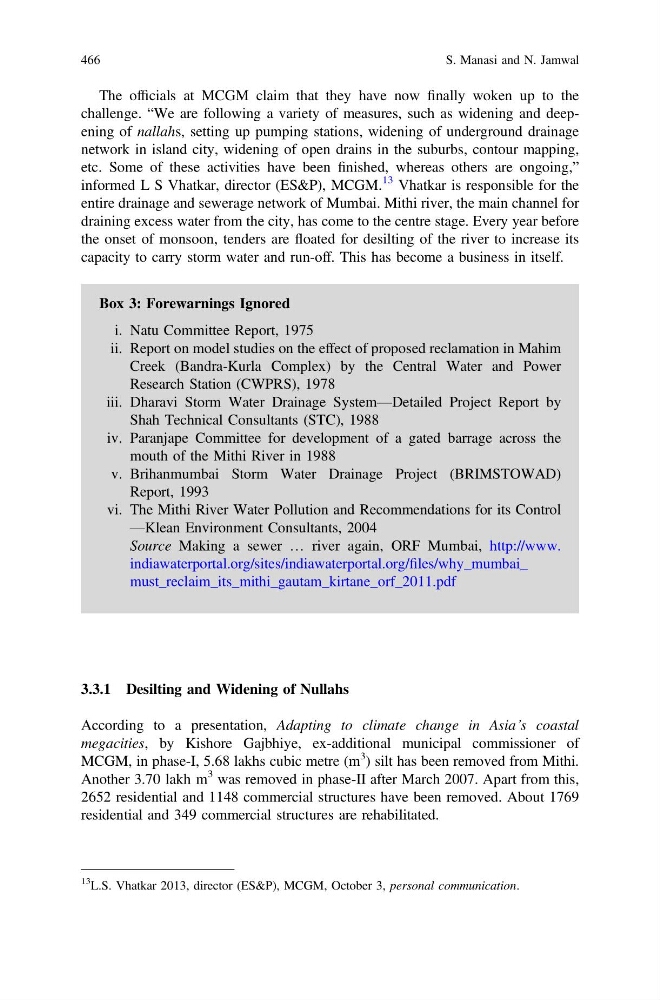
Box 3: Forewarnings Ignored
i. Natu Committee Report, 1975
ii. Report on model studies on the effect of proposed reclamation in Mahim
Creek (Bandra-Kurla Complex) by the Central Water and Power
Research Station (CWPRS), 1978
iii. Dharavi Storm Water Drainage System—Detailed Project Report by
Shah Technical Consultants (STC), 1988
iv. Paranjape Committee for development of a gated barrage across the
mouth of the Mithi River in 1988
v. Brihanmumbai Storm Water Drainage Project (BRIMSTOWAD)
Report, 1993
vi. The Mithi River Water Pollution and Recommendations for its Control
—Klean Environment Consultants, 2004
Source Making a sewer … river again, ORF Mumbai, http://www.
indiawaterportal.org/sites/indiawaterportal.org/files/why_mumbai_
must_reclaim_its_mithi_gautam_kirtane_orf_2011.pdf
3.3.1 Desilting and Widening of Nullahs
According to a presentation, Adapting to climate change in Asia’s coastal
megacities, by Kishore Gajbhiye, ex-additional municipal commissioner of
MCGM, in phase-I, 5.68 lakhs cubic metre (m
3 ) silt has been removed from Mithi.
Another 3.70 lakh m
3 was removed in phase-II after March 2007. Apart from this,
2652 residential and 1148 commercial structures have been removed. About 1769
residential and 349 commercial structures are rehabilitated.
13
L.S. Vhatkar 2013, director (ES&P), MCGM, October 3, personal communication.
466
S. Manasi and N. Jamwal
challenge. “We are following a variety of measures, such as widening and deepening of nallahs, setting up pumping stations, widening of underground drainage
network in island city, widening of open drains in the suburbs, contour mapping,
etc. Some of these activities have been finished, whereas others are ongoing,”
informed L S Vhatkar, director (ES&P), MCGM.
13 Vhatkar is responsible for the
entire drainage and sewerage network of Mumbai. Mithi river, the main channel for
draining excess water from the city, has come to the centre stage. Every year before
the onset of monsoon, tenders are floated for desilting of the river to increase its
capacity to carry storm water and run-off. This has become a business in itself.
Box 3: Forewarnings Ignored
i. Natu Committee Report, 1975
ii. Report on model studies on the effect of proposed reclamation in Mahim
Creek (Bandra-Kurla Complex) by the Central Water and Power
Research Station (CWPRS), 1978
iii. Dharavi Storm Water Drainage System—Detailed Project Report by
Shah Technical Consultants (STC), 1988
iv. Paranjape Committee for development of a gated barrage across the
mouth of the Mithi River in 1988
v. Brihanmumbai Storm Water Drainage Project (BRIMSTOWAD)
Report, 1993
vi. The Mithi River Water Pollution and Recommendations for its Control
—Klean Environment Consultants, 2004
Source Making a sewer … river again, ORF Mumbai, http://www.
indiawaterportal.org/sites/indiawaterportal.org/files/why_mumbai_
must_reclaim_its_mithi_gautam_kirtane_orf_2011.pdf
3.3.1 Desilting and Widening of Nullahs
According to a presentation, Adapting to climate change in Asia’s coastal
megacities, by Kishore Gajbhiye, ex-additional municipal commissioner of
MCGM, in phase-I, 5.68 lakhs cubic metre (m
3 ) silt has been removed from Mithi.
Another 3.70 lakh m
3 was removed in phase-II after March 2007. Apart from this,
2652 residential and 1148 commercial structures have been removed. About 1769
residential and 349 commercial structures are rehabilitated.
13
L.S. Vhatkar 2013, director (ES&P), MCGM, October 3, personal communication.
466
S. Manasi and N. Jamwal