

elevation of 920 m indicating that water can percolate on its own down the slopes,
thus sustained through careful networking of numerous water bodies like lakes
1 and
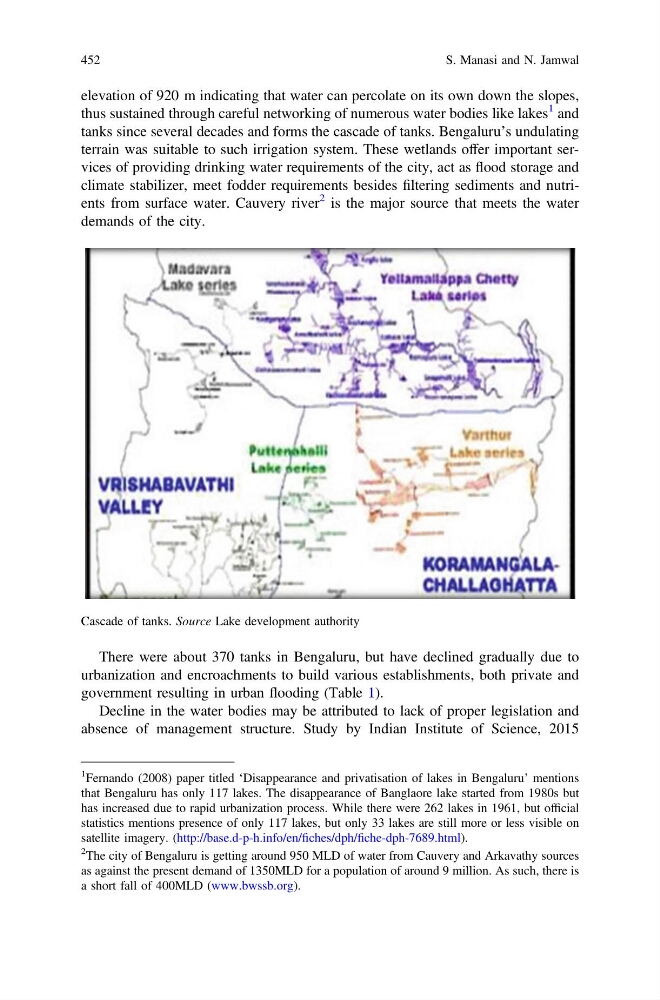
tanks since several decades and forms the cascade of tanks. Bengaluru’s undulating
terrain was suitable to such irrigation system. These wetlands offer important services of providing drinking water requirements of the city, act as flood storage and
climate stabilizer, meet fodder requirements besides filtering sediments and nutrients from surface water. Cauvery river
2 is the major source that meets the water
demands of the city.
There were about 370 tanks in Bengaluru, but have declined gradually due to
urbanization and encroachments to build various establishments, both private and
government resulting in urban flooding (Table 1).
Decline in the water bodies may be attributed to lack of proper legislation and
absence of management structure. Study by Indian Institute of Science, 2015
Cascade of tanks. Source Lake development authority
1
Fernando (2008) paper titled ‘Disappearance and privatisation of lakes in Bengaluru’ mentions
that Bengaluru has only 117 lakes. The disappearance of Banglaore lake started from 1980s but
has increased due to rapid urbanization process. While there were 262 lakes in 1961, but official
statistics mentions presence of only 117 lakes, but only 33 lakes are still more or less visible on
satellite imagery. (http://base.d-p-h.info/en/fiches/dph/fiche-dph-7689.html).
2
The city of Bengaluru is getting around 950 MLD of water from Cauvery and Arkavathy sources
as against the present demand of 1350MLD for a population of around 9 million. As such, there is
a short fall of 400MLD (www.bwssb.org).
452
S. Manasi and N. Jamwal
thus sustained through careful networking of numerous water bodies like lakes
1 and
tanks since several decades and forms the cascade of tanks. Bengaluru’s undulating
terrain was suitable to such irrigation system. These wetlands offer important services of providing drinking water requirements of the city, act as flood storage and
climate stabilizer, meet fodder requirements besides filtering sediments and nutrients from surface water. Cauvery river
2 is the major source that meets the water
demands of the city.
There were about 370 tanks in Bengaluru, but have declined gradually due to
urbanization and encroachments to build various establishments, both private and
government resulting in urban flooding (Table 1).
Decline in the water bodies may be attributed to lack of proper legislation and
absence of management structure. Study by Indian Institute of Science, 2015
Cascade of tanks. Source Lake development authority
1
Fernando (2008) paper titled ‘Disappearance and privatisation of lakes in Bengaluru’ mentions
that Bengaluru has only 117 lakes. The disappearance of Banglaore lake started from 1980s but
has increased due to rapid urbanization process. While there were 262 lakes in 1961, but official
statistics mentions presence of only 117 lakes, but only 33 lakes are still more or less visible on
satellite imagery. (http://base.d-p-h.info/en/fiches/dph/fiche-dph-7689.html).
2
The city of Bengaluru is getting around 950 MLD of water from Cauvery and Arkavathy sources
as against the present demand of 1350MLD for a population of around 9 million. As such, there is
a short fall of 400MLD (www.bwssb.org).
452
S. Manasi and N. Jamwal