

common property resources directly influences the economy of the rural poor.
Jodha (1992) rightly suggested certain key elements of such an approach. Some of
them are (1) introduction of technological investments and creation of economic
incentives to conserve such resources while raising their productivity and (2) regulation of common resource use with the involvement of user groups and mobilization of a community strategy that complements state interventions with the
essential participation of local people.
An effort was made to analyze the impact of climate change on livestock
farming, in Chitradurga and Kolar districts of Karnataka state, through a combination of quantitative and qualitative methods, with the objective to assess the
vulnerability of Indian livestock farming to climate variability and socio-economic
impact of climate variability and to study the coping strategies of Indian livestock
farmers to impacts of climate vulnerability.
2 Methodology
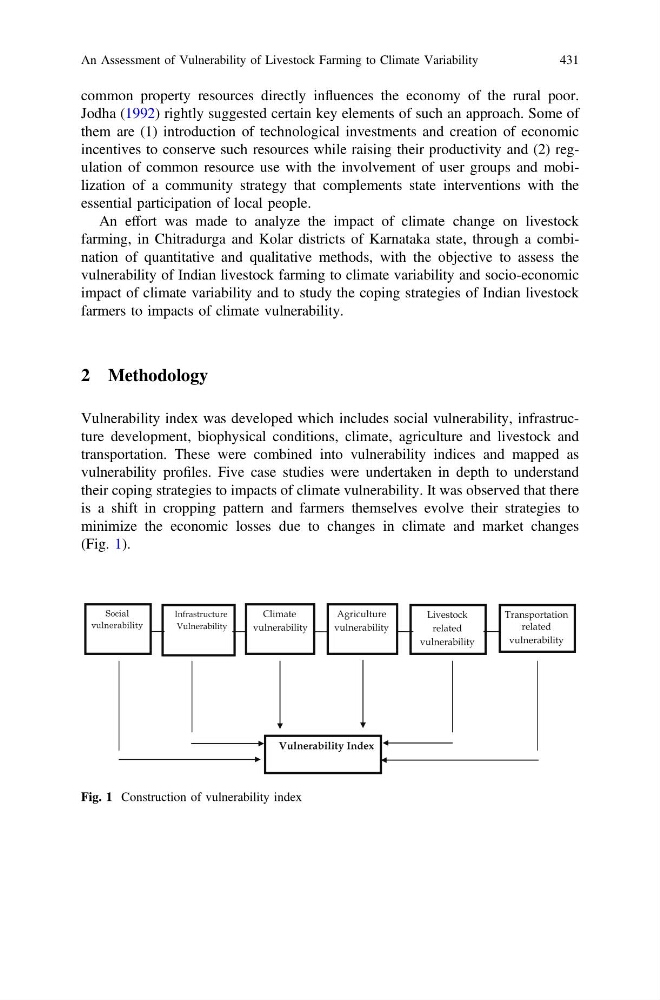
Vulnerability index was developed which includes social vulnerability, infrastructure development, biophysical conditions, climate, agriculture and livestock and
transportation. These were combined into vulnerability indices and mapped as
vulnerability profiles. Five case studies were undertaken in depth to understand
their coping strategies to impacts of climate vulnerability. It was observed that there
is a shift in cropping pattern and farmers themselves evolve their strategies to
minimize the economic losses due to changes in climate and market changes
(Fig. 1).
Fig. 1 Construction of vulnerability index
An Assessment of Vulnerability of Livestock Farming to Climate Variability
431
Jodha (1992) rightly suggested certain key elements of such an approach. Some of
them are (1) introduction of technological investments and creation of economic
incentives to conserve such resources while raising their productivity and (2) regulation of common resource use with the involvement of user groups and mobilization of a community strategy that complements state interventions with the
essential participation of local people.
An effort was made to analyze the impact of climate change on livestock
farming, in Chitradurga and Kolar districts of Karnataka state, through a combination of quantitative and qualitative methods, with the objective to assess the
vulnerability of Indian livestock farming to climate variability and socio-economic
impact of climate variability and to study the coping strategies of Indian livestock
farmers to impacts of climate vulnerability.
2 Methodology
Vulnerability index was developed which includes social vulnerability, infrastructure development, biophysical conditions, climate, agriculture and livestock and
transportation. These were combined into vulnerability indices and mapped as
vulnerability profiles. Five case studies were undertaken in depth to understand
their coping strategies to impacts of climate vulnerability. It was observed that there
is a shift in cropping pattern and farmers themselves evolve their strategies to
minimize the economic losses due to changes in climate and market changes
(Fig. 1).
Fig. 1 Construction of vulnerability index
An Assessment of Vulnerability of Livestock Farming to Climate Variability
431