

these families are generally unable to attend the school; instead they assist the
earning member of the family to add-up some extra income. The primary and
elementary schools are located within the villages whereas the high school and
higher secondary schools are situated outside village boundaries. Most villages
have poor connectivity from one place to another and as a result children have to
walk miles mostly to reach the schools which often lead to demotivation among
them. Access to education is differently perceived for male and female in these rural
areas. If a family has to choose between educating a son or a daughter due to
financial limitations, typically the son will be preferred for that purpose. Girls are
often taken out of school to share the family responsibilities such as caring for
younger siblings, etc.
7.1.3 Economic Domain
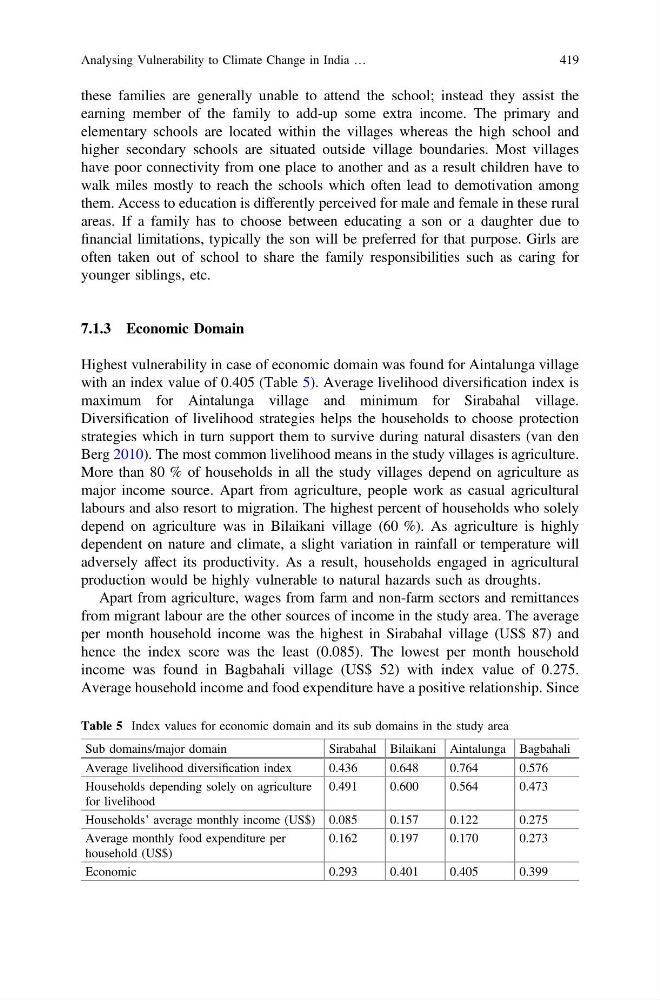
Highest vulnerability in case of economic domain was found for Aintalunga village
with an index value of 0.405 (Table 5). Average livelihood diversification index is
maximum for Aintalunga village and minimum for Sirabahal village.
Diversification of livelihood strategies helps the households to choose protection
strategies which in turn support them to survive during natural disasters (van den
Berg 2010). The most common livelihood means in the study villages is agriculture.
More than 80 % of households in all the study villages depend on agriculture as
major income source. Apart from agriculture, people work as casual agricultural
labours and also resort to migration. The highest percent of households who solely
depend on agriculture was in Bilaikani village (60 %). As agriculture is highly
dependent on nature and climate, a slight variation in rainfall or temperature will
adversely affect its productivity. As a result, households engaged in agricultural
production would be highly vulnerable to natural hazards such as droughts.
Apart from agriculture, wages from farm and non-farm sectors and remittances
from migrant labour are the other sources of income in the study area. The average
per month household income was the highest in Sirabahal village (US$ 87) and
hence the index score was the least (0.085). The lowest per month household
income was found in Bagbahali village (US$ 52) with index value of 0.275.
Average household income and food expenditure have a positive relationship. Since
Table 5 Index values for economic domain and its sub domains in the study area
Sub domains/major domain
Sirabahal Bilaikani Aintalunga Bagbahali
Average livelihood diversification index
0.436
0.648
0.764
0.576
Households depending solely on agriculture
for livelihood
0.491
0.600
0.564
0.473
Households’ average monthly income (US$) 0.085
0.157
0.122
0.275
Average monthly food expenditure per
household (US$)
0.162
0.197
0.170
0.273
Economic
0.293
0.401
0.405
0.399
Analysing Vulnerability to Climate Change in India …
419
earning member of the family to add-up some extra income. The primary and
elementary schools are located within the villages whereas the high school and
higher secondary schools are situated outside village boundaries. Most villages
have poor connectivity from one place to another and as a result children have to
walk miles mostly to reach the schools which often lead to demotivation among
them. Access to education is differently perceived for male and female in these rural
areas. If a family has to choose between educating a son or a daughter due to
financial limitations, typically the son will be preferred for that purpose. Girls are
often taken out of school to share the family responsibilities such as caring for
younger siblings, etc.
7.1.3 Economic Domain
Highest vulnerability in case of economic domain was found for Aintalunga village
with an index value of 0.405 (Table 5). Average livelihood diversification index is
maximum for Aintalunga village and minimum for Sirabahal village.
Diversification of livelihood strategies helps the households to choose protection
strategies which in turn support them to survive during natural disasters (van den
Berg 2010). The most common livelihood means in the study villages is agriculture.
More than 80 % of households in all the study villages depend on agriculture as
major income source. Apart from agriculture, people work as casual agricultural
labours and also resort to migration. The highest percent of households who solely
depend on agriculture was in Bilaikani village (60 %). As agriculture is highly
dependent on nature and climate, a slight variation in rainfall or temperature will
adversely affect its productivity. As a result, households engaged in agricultural
production would be highly vulnerable to natural hazards such as droughts.
Apart from agriculture, wages from farm and non-farm sectors and remittances
from migrant labour are the other sources of income in the study area. The average
per month household income was the highest in Sirabahal village (US$ 87) and
hence the index score was the least (0.085). The lowest per month household
income was found in Bagbahali village (US$ 52) with index value of 0.275.
Average household income and food expenditure have a positive relationship. Since
Table 5 Index values for economic domain and its sub domains in the study area
Sub domains/major domain
Sirabahal Bilaikani Aintalunga Bagbahali
Average livelihood diversification index
0.436
0.648
0.764
0.576
Households depending solely on agriculture
for livelihood
0.491
0.600
0.564
0.473
Households’ average monthly income (US$) 0.085
0.157
0.122
0.275
Average monthly food expenditure per
household (US$)
0.162
0.197
0.170
0.273
Economic
0.293
0.401
0.405
0.399
Analysing Vulnerability to Climate Change in India …
419