

7.1 Domain-Wise Vulnerability
7.1.1 Demographic Domain
Several researchers argue that a better demographic profile can enhance the adaptive capacity of households to any shocks related to environment (e.g. Yohe and Tol
2002; Frank et al. 2011). The present study has identified specific sub domains
related to demographic features that are likely to affect vulnerability to and coping
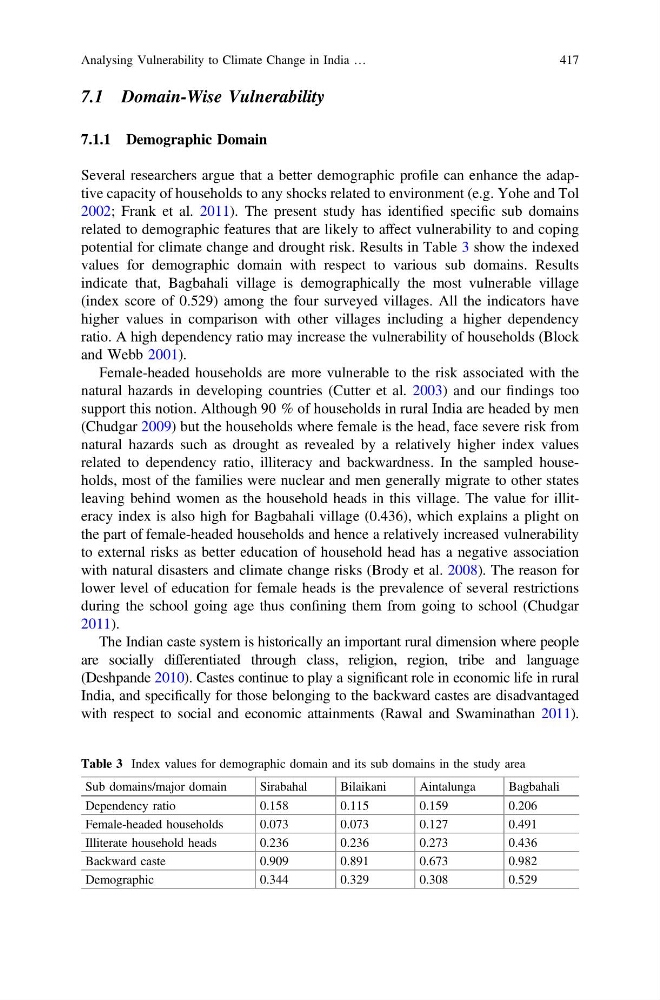
potential for climate change and drought risk. Results in Table 3 show the indexed
values for demographic domain with respect to various sub domains. Results
indicate that, Bagbahali village is demographically the most vulnerable village
(index score of 0.529) among the four surveyed villages. All the indicators have
higher values in comparison with other villages including a higher dependency
ratio. A high dependency ratio may increase the vulnerability of households (Block
and Webb 2001).
Female-headed households are more vulnerable to the risk associated with the
natural hazards in developing countries (Cutter et al. 2003) and our findings too
support this notion. Although 90 % of households in rural India are headed by men
(Chudgar 2009) but the households where female is the head, face severe risk from
natural hazards such as drought as revealed by a relatively higher index values
related to dependency ratio, illiteracy and backwardness. In the sampled households, most of the families were nuclear and men generally migrate to other states
leaving behind women as the household heads in this village. The value for illiteracy index is also high for Bagbahali village (0.436), which explains a plight on
the part of female-headed households and hence a relatively increased vulnerability
to external risks as better education of household head has a negative association
with natural disasters and climate change risks (Brody et al. 2008). The reason for
lower level of education for female heads is the prevalence of several restrictions
during the school going age thus confining them from going to school (Chudgar
2011).
The Indian caste system is historically an important rural dimension where people
are socially differentiated through class, religion, region, tribe and language
(Deshpande 2010). Castes continue to play a significant role in economic life in rural
India, and specifically for those belonging to the backward castes are disadvantaged
with respect to social and economic attainments (Rawal and Swaminathan 2011).
Table 3 Index values for demographic domain and its sub domains in the study area
Sub domains/major domain
Sirabahal
Bilaikani
Aintalunga
Bagbahali
Dependency ratio
0.158
0.115
0.159
0.206
Female-headed households
0.073
0.073
0.127
0.491
Illiterate household heads
0.236
0.236
0.273
0.436
Backward caste
0.909
0.891
0.673
0.982
Demographic
0.344
0.329
0.308
0.529
Analysing Vulnerability to Climate Change in India …
417
7.1.1 Demographic Domain
Several researchers argue that a better demographic profile can enhance the adaptive capacity of households to any shocks related to environment (e.g. Yohe and Tol
2002; Frank et al. 2011). The present study has identified specific sub domains
related to demographic features that are likely to affect vulnerability to and coping
potential for climate change and drought risk. Results in Table 3 show the indexed
values for demographic domain with respect to various sub domains. Results
indicate that, Bagbahali village is demographically the most vulnerable village
(index score of 0.529) among the four surveyed villages. All the indicators have
higher values in comparison with other villages including a higher dependency
ratio. A high dependency ratio may increase the vulnerability of households (Block
and Webb 2001).
Female-headed households are more vulnerable to the risk associated with the
natural hazards in developing countries (Cutter et al. 2003) and our findings too
support this notion. Although 90 % of households in rural India are headed by men
(Chudgar 2009) but the households where female is the head, face severe risk from
natural hazards such as drought as revealed by a relatively higher index values
related to dependency ratio, illiteracy and backwardness. In the sampled households, most of the families were nuclear and men generally migrate to other states
leaving behind women as the household heads in this village. The value for illiteracy index is also high for Bagbahali village (0.436), which explains a plight on
the part of female-headed households and hence a relatively increased vulnerability
to external risks as better education of household head has a negative association
with natural disasters and climate change risks (Brody et al. 2008). The reason for
lower level of education for female heads is the prevalence of several restrictions
during the school going age thus confining them from going to school (Chudgar
2011).
The Indian caste system is historically an important rural dimension where people
are socially differentiated through class, religion, region, tribe and language
(Deshpande 2010). Castes continue to play a significant role in economic life in rural
India, and specifically for those belonging to the backward castes are disadvantaged
with respect to social and economic attainments (Rawal and Swaminathan 2011).
Table 3 Index values for demographic domain and its sub domains in the study area
Sub domains/major domain
Sirabahal
Bilaikani
Aintalunga
Bagbahali
Dependency ratio
0.158
0.115
0.159
0.206
Female-headed households
0.073
0.073
0.127
0.491
Illiterate household heads
0.236
0.236
0.273
0.436
Backward caste
0.909
0.891
0.673
0.982
Demographic
0.344
0.329
0.308
0.529
Analysing Vulnerability to Climate Change in India …
417