

Index sv ¼
S v À S min
S max À S min
ð1Þ
where
S v
is the original sub-domain for village v,
S min and S max are the minimum and maximum values, respectively, for each
sub-domain which was determined using data from selected
villages.
In addition, the index scores for major domains were calculated by taking the
average of the standardised sub domains and then multiplied with their corresponding weights to get the weighted major domain score index. A balanced
weighted approach was used in CVI assuming that each of the sub domains had an
equal contribution to the overall index (Sullivan et al. 2002). The weights of each
major domain were determined by the number of sub domain of which they are
comprised. Once the weighted major domain index score was calculated, the index
for exposure (Exp) (Eq. 2), adaptive capacity (Ada cap) (Eq. 3) and sensitivity
(Sen) (Eq. 4) were calculated as follows:
Exp ¼
W Dro Dro V þ W CV CV V
W ND þ W CV
ð2Þ
Adp Cap ¼
W Soc Soc V þ W Dem Dem V
W Soc þ W Dem
ð3Þ
Sen ¼
W Eco Eco V þ W Phy Phy V
W Eco þ W Phy
ð4Þ
The indexed values for exposure, sensitivity and adaptive capacity were combined for calculating CVI as following:
CVI v ¼ 1 À l
N 1 Exp À N 2 Ada Cap
N 1 þ N 2
l Ã
1
Sen
ð5Þ
where N i is the number of major domains in the ith dimension of vulnerability.
The values of CVI range between 0 (least vulnerable) to 1 (most vulnerable).
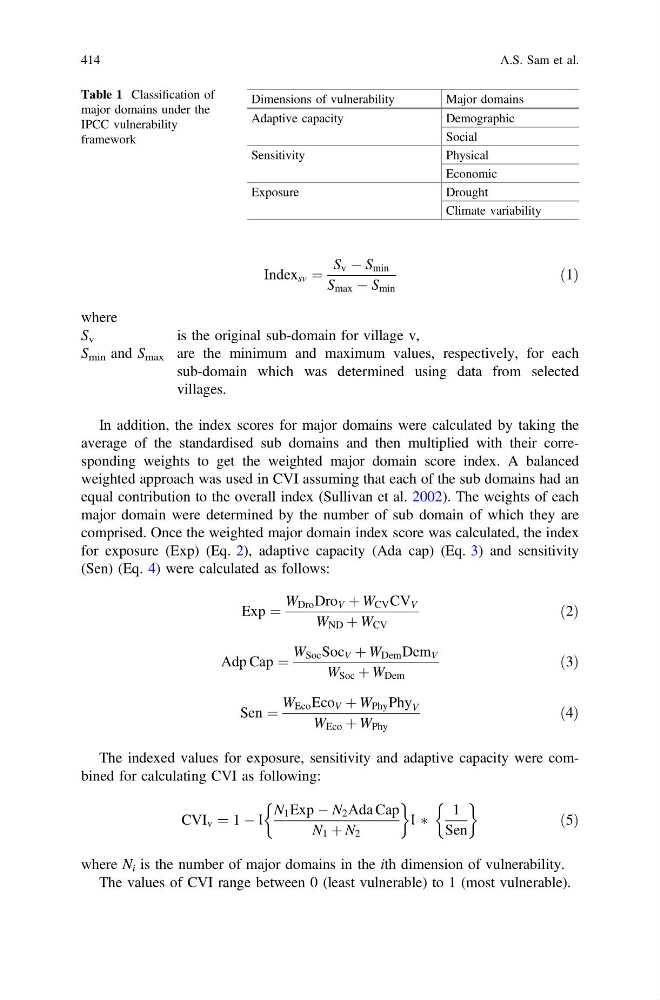
Table 1 Classification of
major domains under the
IPCC vulnerability
framework
Dimensions of vulnerability
Major domains
Adaptive capacity
Demographic
Social
Sensitivity
Physical
Economic
Exposure
Drought
Climate variability
414
A.S. Sam et al.
S v À S min
S max À S min
ð1Þ
where
S v
is the original sub-domain for village v,
S min and S max are the minimum and maximum values, respectively, for each
sub-domain which was determined using data from selected
villages.
In addition, the index scores for major domains were calculated by taking the
average of the standardised sub domains and then multiplied with their corresponding weights to get the weighted major domain score index. A balanced
weighted approach was used in CVI assuming that each of the sub domains had an
equal contribution to the overall index (Sullivan et al. 2002). The weights of each
major domain were determined by the number of sub domain of which they are
comprised. Once the weighted major domain index score was calculated, the index
for exposure (Exp) (Eq. 2), adaptive capacity (Ada cap) (Eq. 3) and sensitivity
(Sen) (Eq. 4) were calculated as follows:
Exp ¼
W Dro Dro V þ W CV CV V
W ND þ W CV
ð2Þ
Adp Cap ¼
W Soc Soc V þ W Dem Dem V
W Soc þ W Dem
ð3Þ
Sen ¼
W Eco Eco V þ W Phy Phy V
W Eco þ W Phy
ð4Þ
The indexed values for exposure, sensitivity and adaptive capacity were combined for calculating CVI as following:
CVI v ¼ 1 À l
N 1 Exp À N 2 Ada Cap
N 1 þ N 2
l Ã
1
Sen
ð5Þ
where N i is the number of major domains in the ith dimension of vulnerability.
The values of CVI range between 0 (least vulnerable) to 1 (most vulnerable).
Table 1 Classification of
major domains under the
IPCC vulnerability
framework
Dimensions of vulnerability
Major domains
Adaptive capacity
Demographic
Social
Sensitivity
Physical
Economic
Exposure
Drought
Climate variability
414
A.S. Sam et al.