

people in these countries are forced to make choices regarding the necessary
adjustments in social, economic, cultural and environmental contexts that are
framed within the vulnerability of different systems constituted by both the human
and natural environment (Bhattacharya-Mis and Lamond 2014). Henceforth, it is
pertinent to analyse the magnitude and extent of the influence of such changes in a
bid to effectively evaluate existing risk and coping potential of vulnerable communities. Many studies have focussed vulnerability to climate change and natural
disasters but very little is known about the vulnerability to drought in South Asian
countries in general and India in particular (Pandey and Jha 2011; O’Brien et al.
2007). Nonetheless, there exists a huge body of evidence which points towards
increased risk of droughts in the country but very little is known about the vulnerability of local communities to such hazards. This gap is considered to lead to
ineffective policy formulation and poor planning process thereof in mitigating
drought risk. Moreover, a micro level household vulnerability analysis would be
helpful in identifying the most vulnerable segments of the society to the natural
hazards like drought (Aryal et al. 2014).
Therefore the aim of current study is to fill the above mentioned gap by quantifying the degree of vulnerability of the rural farming households that are prone to
droughts in India.
4 Study Region
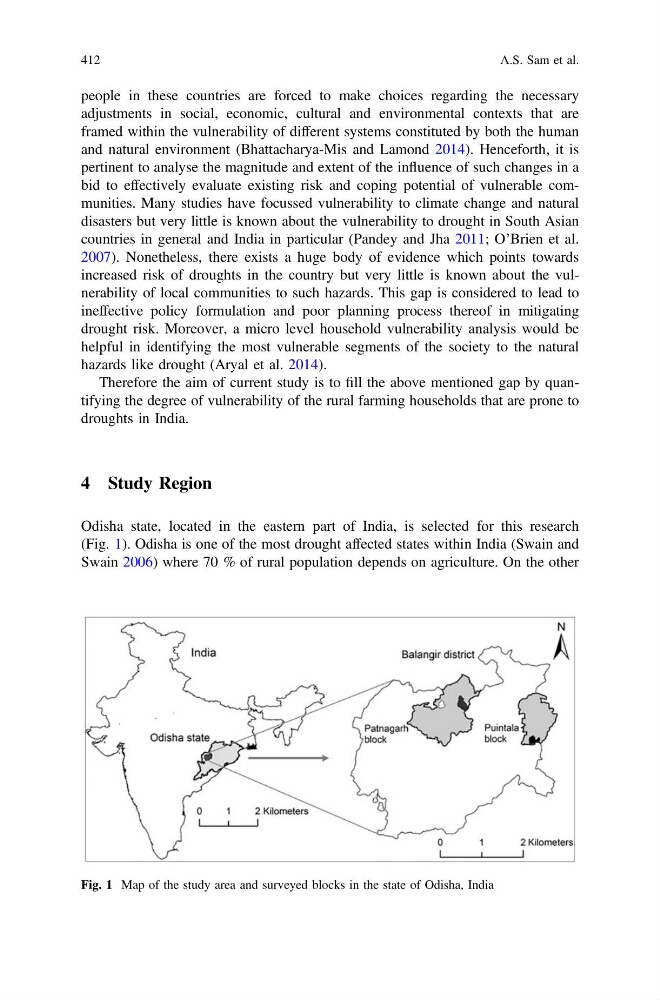
Odisha state, located in the eastern part of India, is selected for this research
(Fig. 1). Odisha is one of the most drought affected states within India (Swain and
Swain 2006) where 70 % of rural population depends on agriculture. On the other
Fig. 1 Map of the study area and surveyed blocks in the state of Odisha, India
412
A.S. Sam et al.
adjustments in social, economic, cultural and environmental contexts that are
framed within the vulnerability of different systems constituted by both the human
and natural environment (Bhattacharya-Mis and Lamond 2014). Henceforth, it is
pertinent to analyse the magnitude and extent of the influence of such changes in a
bid to effectively evaluate existing risk and coping potential of vulnerable communities. Many studies have focussed vulnerability to climate change and natural
disasters but very little is known about the vulnerability to drought in South Asian
countries in general and India in particular (Pandey and Jha 2011; O’Brien et al.
2007). Nonetheless, there exists a huge body of evidence which points towards
increased risk of droughts in the country but very little is known about the vulnerability of local communities to such hazards. This gap is considered to lead to
ineffective policy formulation and poor planning process thereof in mitigating
drought risk. Moreover, a micro level household vulnerability analysis would be
helpful in identifying the most vulnerable segments of the society to the natural
hazards like drought (Aryal et al. 2014).
Therefore the aim of current study is to fill the above mentioned gap by quantifying the degree of vulnerability of the rural farming households that are prone to
droughts in India.
4 Study Region
Odisha state, located in the eastern part of India, is selected for this research
(Fig. 1). Odisha is one of the most drought affected states within India (Swain and
Swain 2006) where 70 % of rural population depends on agriculture. On the other
Fig. 1 Map of the study area and surveyed blocks in the state of Odisha, India
412
A.S. Sam et al.