

wide is one of the important steps not only from conservation perspective but also
for sustainable harvest and utilisation. The debate about the quality of the heartwood and oil from those trees grown outside its natural habitat is one issue which
may often be questioned, but some of the preliminary results reveal that heartwood
formation and oil accumulation has been observed in places such as Rajasthan and
Uttarakhand where Sandalwood has been introduced. Sandalwood cultivation has
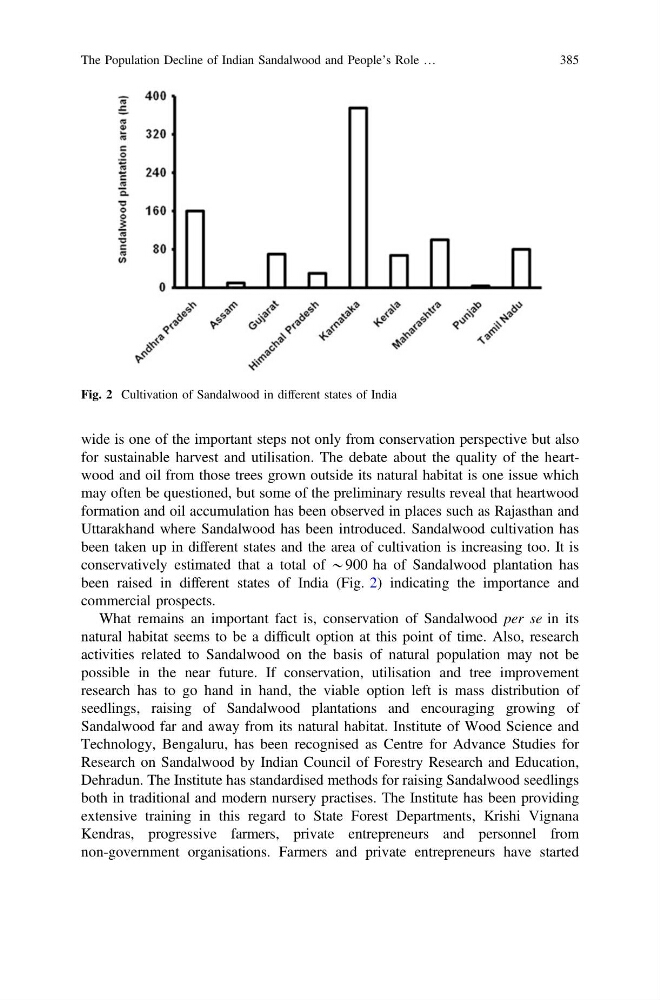
been taken up in different states and the area of cultivation is increasing too. It is
conservatively estimated that a total of *900 ha of Sandalwood plantation has
been raised in different states of India (Fig. 2) indicating the importance and
commercial prospects.
What remains an important fact is, conservation of Sandalwood per se in its
natural habitat seems to be a difficult option at this point of time. Also, research
activities related to Sandalwood on the basis of natural population may not be
possible in the near future. If conservation, utilisation and tree improvement
research has to go hand in hand, the viable option left is mass distribution of
seedlings, raising of Sandalwood plantations and encouraging growing of
Sandalwood far and away from its natural habitat. Institute of Wood Science and
Technology, Bengaluru, has been recognised as Centre for Advance Studies for
Research on Sandalwood by Indian Council of Forestry Research and Education,
Dehradun. The Institute has standardised methods for raising Sandalwood seedlings
both in traditional and modern nursery practises. The Institute has been providing
extensive training in this regard to State Forest Departments, Krishi Vignana
Kendras, progressive farmers, private entrepreneurs and personnel from
non-government organisations. Farmers and private entrepreneurs have started
Fig. 2 Cultivation of Sandalwood in different states of India
The Population Decline of Indian Sandalwood and People’s Role …
385
for sustainable harvest and utilisation. The debate about the quality of the heartwood and oil from those trees grown outside its natural habitat is one issue which
may often be questioned, but some of the preliminary results reveal that heartwood
formation and oil accumulation has been observed in places such as Rajasthan and
Uttarakhand where Sandalwood has been introduced. Sandalwood cultivation has
been taken up in different states and the area of cultivation is increasing too. It is
conservatively estimated that a total of *900 ha of Sandalwood plantation has
been raised in different states of India (Fig. 2) indicating the importance and
commercial prospects.
What remains an important fact is, conservation of Sandalwood per se in its
natural habitat seems to be a difficult option at this point of time. Also, research
activities related to Sandalwood on the basis of natural population may not be
possible in the near future. If conservation, utilisation and tree improvement
research has to go hand in hand, the viable option left is mass distribution of
seedlings, raising of Sandalwood plantations and encouraging growing of
Sandalwood far and away from its natural habitat. Institute of Wood Science and
Technology, Bengaluru, has been recognised as Centre for Advance Studies for
Research on Sandalwood by Indian Council of Forestry Research and Education,
Dehradun. The Institute has standardised methods for raising Sandalwood seedlings
both in traditional and modern nursery practises. The Institute has been providing
extensive training in this regard to State Forest Departments, Krishi Vignana
Kendras, progressive farmers, private entrepreneurs and personnel from
non-government organisations. Farmers and private entrepreneurs have started
Fig. 2 Cultivation of Sandalwood in different states of India
The Population Decline of Indian Sandalwood and People’s Role …
385