

money on building houses. At times, households with a number of members
working outside and who own land in the centre of the village take the risk of
building a sturdy two storeyed houses or else they make do with their mud houses
with thatched roofs.
1.5.2 Outmigration
I mentioned already that the farmers in Sunderbans are subsistence farmers. The
fishermen risk their lives for getting a good catch. People become landless because
of high tides. They loose their homes every time there is a devastating cyclone. Yes,
climate change is definitely making their lives worse, but it would seem that their
lives were never comfortable. Economic distress was always there. Thus for almost
three decades now, male members from Sunderbans have been migrating out
seasonally to big metro cities in search for greener pastures. Most of them find work
in cities as unskilled construction labourers or artisans in textile or jewelery factories. They do go back to help during harvests. In the recent past this tendency to
go out has increased. I found several instances where the entire family had out
migrated after losing their land or house to a cyclone. Young women are also going
out in large numbers. Some of them find genuine jobs and work as maids or care
giver in cities while others end up in the hands of traffickers. During the course of
interaction with the people of Sunderbans over a course of two years I found the
elderlies, women with young children and school going children are mainly the
ones left behind in these islands. The men keep coming and going. Though, some
of the households benefit from the extra money, again at times, these men and
women come back so sick working under inhuman conditions that their savings dry
off paying their medical bills. But these people are not alone. All over the world
climate refugees are increasing in numbers.
Beguakhali Masjidbari
Gosaba
Pakhiralay Rangabelia
0
10
20
30
40
50
41
14
28
32
43
25
10
15
20
30
#Household interviewed
#Household where atleast one family member is working outside
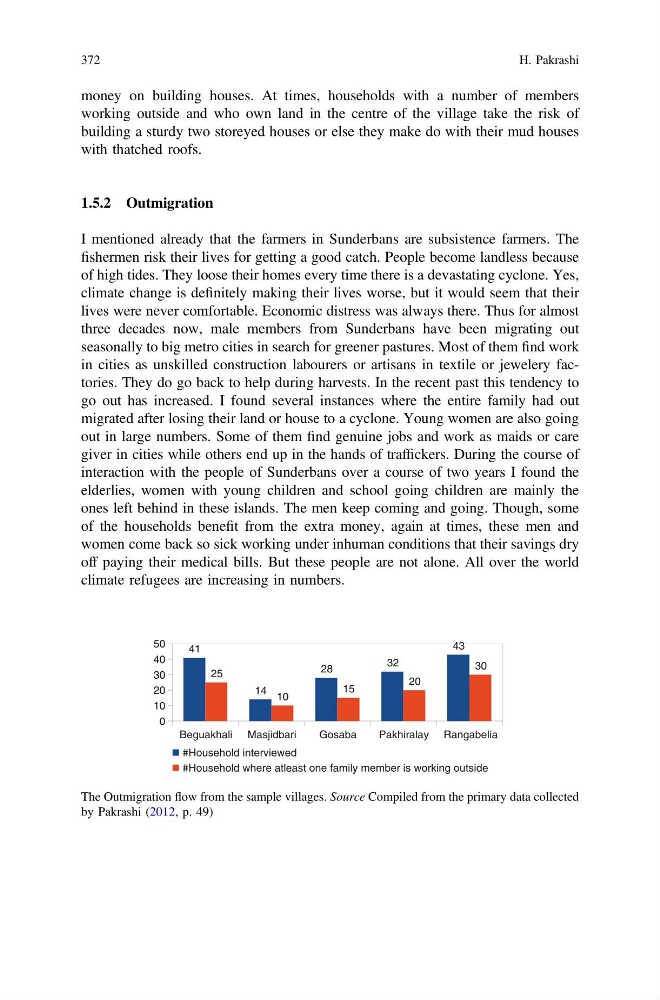
The Outmigration flow from the sample villages. Source Compiled from the primary data collected
by Pakrashi (2012, p. 49)
372
H. Pakrashi
working outside and who own land in the centre of the village take the risk of
building a sturdy two storeyed houses or else they make do with their mud houses
with thatched roofs.
1.5.2 Outmigration
I mentioned already that the farmers in Sunderbans are subsistence farmers. The
fishermen risk their lives for getting a good catch. People become landless because
of high tides. They loose their homes every time there is a devastating cyclone. Yes,
climate change is definitely making their lives worse, but it would seem that their
lives were never comfortable. Economic distress was always there. Thus for almost
three decades now, male members from Sunderbans have been migrating out
seasonally to big metro cities in search for greener pastures. Most of them find work
in cities as unskilled construction labourers or artisans in textile or jewelery factories. They do go back to help during harvests. In the recent past this tendency to
go out has increased. I found several instances where the entire family had out
migrated after losing their land or house to a cyclone. Young women are also going
out in large numbers. Some of them find genuine jobs and work as maids or care
giver in cities while others end up in the hands of traffickers. During the course of
interaction with the people of Sunderbans over a course of two years I found the
elderlies, women with young children and school going children are mainly the
ones left behind in these islands. The men keep coming and going. Though, some
of the households benefit from the extra money, again at times, these men and
women come back so sick working under inhuman conditions that their savings dry
off paying their medical bills. But these people are not alone. All over the world
climate refugees are increasing in numbers.
Beguakhali Masjidbari
Gosaba
Pakhiralay Rangabelia
0
10
20
30
40
50
41
14
28
32
43
25
10
15
20
30
#Household interviewed
#Household where atleast one family member is working outside
The Outmigration flow from the sample villages. Source Compiled from the primary data collected
by Pakrashi (2012, p. 49)
372
H. Pakrashi