

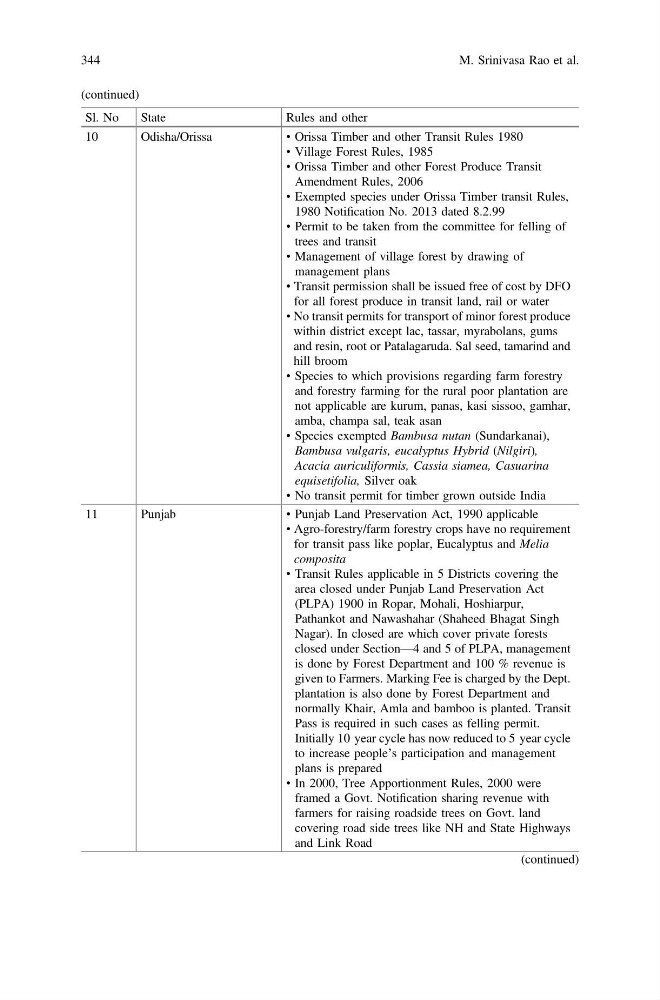
(continued)
Sl. No
State
Rules and other
10
Odisha/Orissa
• Orissa Timber and other Transit Rules 1980
• Village Forest Rules, 1985
• Orissa Timber and other Forest Produce Transit
Amendment Rules, 2006
• Exempted species under Orissa Timber transit Rules,
1980 Notification No. 2013 dated 8.2.99
• Permit to be taken from the committee for felling of
trees and transit
• Management of village forest by drawing of
management plans
• Transit permission shall be issued free of cost by DFO
for all forest produce in transit land, rail or water
• No transit permits for transport of minor forest produce
within district except lac, tassar, myrabolans, gums
and resin, root or Patalagaruda. Sal seed, tamarind and
hill broom
• Species to which provisions regarding farm forestry
and forestry farming for the rural poor plantation are
not applicable are kurum, panas, kasi sissoo, gamhar,
amba, champa sal, teak asan
• Species exempted Bambusa nutan (Sundarkanai),
Bambusa vulgaris, eucalyptus Hybrid (Nilgiri),
Acacia auriculiformis, Cassia siamea, Casuarina
equisetifolia, Silver oak
• No transit permit for timber grown outside India
11
Punjab
• Punjab Land Preservation Act, 1990 applicable
• Agro-forestry/farm forestry crops have no requirement
for transit pass like poplar, Eucalyptus and Melia
composita
• Transit Rules applicable in 5 Districts covering the
area closed under Punjab Land Preservation Act
(PLPA) 1900 in Ropar, Mohali, Hoshiarpur,
Pathankot and Nawashahar (Shaheed Bhagat Singh
Nagar). In closed are which cover private forests
closed under Section—4 and 5 of PLPA, management
is done by Forest Department and 100 % revenue is
given to Farmers. Marking Fee is charged by the Dept.
plantation is also done by Forest Department and
normally Khair, Amla and bamboo is planted. Transit
Pass is required in such cases as felling permit.
Initially 10 year cycle has now reduced to 5 year cycle
to increase people’s participation and management
plans is prepared
• In 2000, Tree Apportionment Rules, 2000 were
framed a Govt. Notification sharing revenue with
farmers for raising roadside trees on Govt. land
covering road side trees like NH and State Highways
and Link Road
(continued)
344
M. Srinivasa Rao et al.
Sl. No
State
Rules and other
10
Odisha/Orissa
• Orissa Timber and other Transit Rules 1980
• Village Forest Rules, 1985
• Orissa Timber and other Forest Produce Transit
Amendment Rules, 2006
• Exempted species under Orissa Timber transit Rules,
1980 Notification No. 2013 dated 8.2.99
• Permit to be taken from the committee for felling of
trees and transit
• Management of village forest by drawing of
management plans
• Transit permission shall be issued free of cost by DFO
for all forest produce in transit land, rail or water
• No transit permits for transport of minor forest produce
within district except lac, tassar, myrabolans, gums
and resin, root or Patalagaruda. Sal seed, tamarind and
hill broom
• Species to which provisions regarding farm forestry
and forestry farming for the rural poor plantation are
not applicable are kurum, panas, kasi sissoo, gamhar,
amba, champa sal, teak asan
• Species exempted Bambusa nutan (Sundarkanai),
Bambusa vulgaris, eucalyptus Hybrid (Nilgiri),
Acacia auriculiformis, Cassia siamea, Casuarina
equisetifolia, Silver oak
• No transit permit for timber grown outside India
11
Punjab
• Punjab Land Preservation Act, 1990 applicable
• Agro-forestry/farm forestry crops have no requirement
for transit pass like poplar, Eucalyptus and Melia
composita
• Transit Rules applicable in 5 Districts covering the
area closed under Punjab Land Preservation Act
(PLPA) 1900 in Ropar, Mohali, Hoshiarpur,
Pathankot and Nawashahar (Shaheed Bhagat Singh
Nagar). In closed are which cover private forests
closed under Section—4 and 5 of PLPA, management
is done by Forest Department and 100 % revenue is
given to Farmers. Marking Fee is charged by the Dept.
plantation is also done by Forest Department and
normally Khair, Amla and bamboo is planted. Transit
Pass is required in such cases as felling permit.
Initially 10 year cycle has now reduced to 5 year cycle
to increase people’s participation and management
plans is prepared
• In 2000, Tree Apportionment Rules, 2000 were
framed a Govt. Notification sharing revenue with
farmers for raising roadside trees on Govt. land
covering road side trees like NH and State Highways
and Link Road
(continued)
344
M. Srinivasa Rao et al.