

Sl. No
State
Rules and other
1
Karnataka
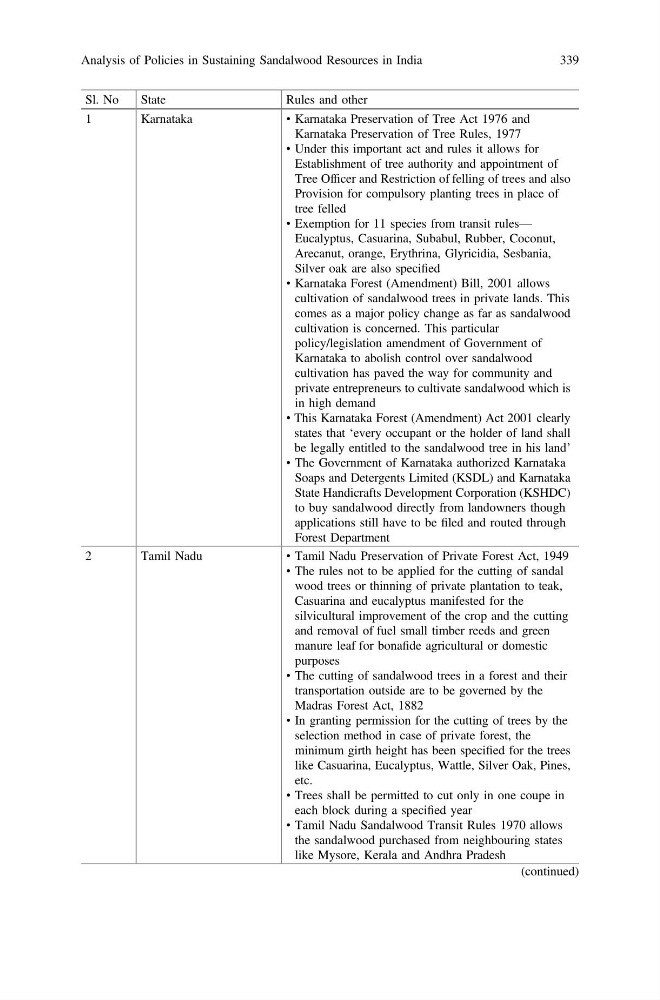
• Karnataka Preservation of Tree Act 1976 and
Karnataka Preservation of Tree Rules, 1977
• Under this important act and rules it allows for
Establishment of tree authority and appointment of
Tree Officer and Restriction of felling of trees and also
Provision for compulsory planting trees in place of
tree felled
• Exemption for 11 species from transit rules—
Eucalyptus, Casuarina, Subabul, Rubber, Coconut,
Arecanut, orange, Erythrina, Glyricidia, Sesbania,
Silver oak are also specified
• Karnataka Forest (Amendment) Bill, 2001 allows
cultivation of sandalwood trees in private lands. This
comes as a major policy change as far as sandalwood
cultivation is concerned. This particular
policy/legislation amendment of Government of
Karnataka to abolish control over sandalwood
cultivation has paved the way for community and
private entrepreneurs to cultivate sandalwood which is
in high demand
• This Karnataka Forest (Amendment) Act 2001 clearly
states that ‘every occupant or the holder of land shall
be legally entitled to the sandalwood tree in his land’
• The Government of Karnataka authorized Karnataka
Soaps and Detergents Limited (KSDL) and Karnataka
State Handicrafts Development Corporation (KSHDC)
to buy sandalwood directly from landowners though
applications still have to be filed and routed through
Forest Department
2
Tamil Nadu
• Tamil Nadu Preservation of Private Forest Act, 1949
• The rules not to be applied for the cutting of sandal
wood trees or thinning of private plantation to teak,
Casuarina and eucalyptus manifested for the
silvicultural improvement of the crop and the cutting
and removal of fuel small timber reeds and green
manure leaf for bonafide agricultural or domestic
purposes
• The cutting of sandalwood trees in a forest and their
transportation outside are to be governed by the
Madras Forest Act, 1882
• In granting permission for the cutting of trees by the
selection method in case of private forest, the
minimum girth height has been specified for the trees
like Casuarina, Eucalyptus, Wattle, Silver Oak, Pines,
etc.
• Trees shall be permitted to cut only in one coupe in
each block during a specified year
• Tamil Nadu Sandalwood Transit Rules 1970 allows
the sandalwood purchased from neighbouring states
like Mysore, Kerala and Andhra Pradesh
(continued)
Analysis of Policies in Sustaining Sandalwood Resources in India
339
State
Rules and other
1
Karnataka
• Karnataka Preservation of Tree Act 1976 and
Karnataka Preservation of Tree Rules, 1977
• Under this important act and rules it allows for
Establishment of tree authority and appointment of
Tree Officer and Restriction of felling of trees and also
Provision for compulsory planting trees in place of
tree felled
• Exemption for 11 species from transit rules—
Eucalyptus, Casuarina, Subabul, Rubber, Coconut,
Arecanut, orange, Erythrina, Glyricidia, Sesbania,
Silver oak are also specified
• Karnataka Forest (Amendment) Bill, 2001 allows
cultivation of sandalwood trees in private lands. This
comes as a major policy change as far as sandalwood
cultivation is concerned. This particular
policy/legislation amendment of Government of
Karnataka to abolish control over sandalwood
cultivation has paved the way for community and
private entrepreneurs to cultivate sandalwood which is
in high demand
• This Karnataka Forest (Amendment) Act 2001 clearly
states that ‘every occupant or the holder of land shall
be legally entitled to the sandalwood tree in his land’
• The Government of Karnataka authorized Karnataka
Soaps and Detergents Limited (KSDL) and Karnataka
State Handicrafts Development Corporation (KSHDC)
to buy sandalwood directly from landowners though
applications still have to be filed and routed through
Forest Department
2
Tamil Nadu
• Tamil Nadu Preservation of Private Forest Act, 1949
• The rules not to be applied for the cutting of sandal
wood trees or thinning of private plantation to teak,
Casuarina and eucalyptus manifested for the
silvicultural improvement of the crop and the cutting
and removal of fuel small timber reeds and green
manure leaf for bonafide agricultural or domestic
purposes
• The cutting of sandalwood trees in a forest and their
transportation outside are to be governed by the
Madras Forest Act, 1882
• In granting permission for the cutting of trees by the
selection method in case of private forest, the
minimum girth height has been specified for the trees
like Casuarina, Eucalyptus, Wattle, Silver Oak, Pines,
etc.
• Trees shall be permitted to cut only in one coupe in
each block during a specified year
• Tamil Nadu Sandalwood Transit Rules 1970 allows
the sandalwood purchased from neighbouring states
like Mysore, Kerala and Andhra Pradesh
(continued)
Analysis of Policies in Sustaining Sandalwood Resources in India
339