

(c) Financial and credit risk
(d) Institutional risk
(e) Technology risk
(f) Personal risk.
As these factors not only affect the income of farmers but also the viability of
agriculture, understanding the possible strategies and mechanisms to mitigate risk
assumes importance. World Bank in its World Development Report (2001) classifies
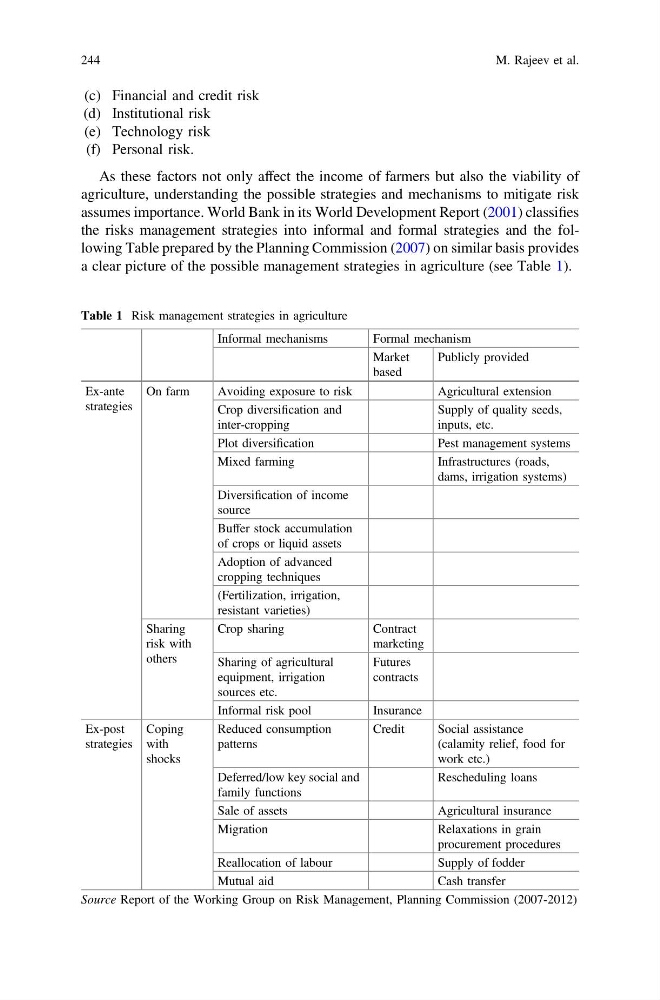
the risks management strategies into informal and formal strategies and the following Table prepared by the Planning Commission (2007) on similar basis provides
a clear picture of the possible management strategies in agriculture (see Table 1).
Table 1 Risk management strategies in agriculture
Informal mechanisms
Formal mechanism
Market
based
Publicly provided
Ex-ante
strategies
On farm
Avoiding exposure to risk
Agricultural extension
Crop diversification and
inter-cropping
Supply of quality seeds,
inputs, etc.
Plot diversification
Pest management systems
Mixed farming
Infrastructures (roads,
dams, irrigation systems)
Diversification of income
source
Buffer stock accumulation
of crops or liquid assets
Adoption of advanced
cropping techniques
(Fertilization, irrigation,
resistant varieties)
Sharing
risk with
others
Crop sharing
Contract
marketing
Sharing of agricultural
equipment, irrigation
sources etc.
Futures
contracts
Informal risk pool
Insurance
Ex-post
strategies
Coping
with
shocks
Reduced consumption
patterns
Credit
Social assistance
(calamity relief, food for
work etc.)
Deferred/low key social and
family functions
Rescheduling loans
Sale of assets
Agricultural insurance
Migration
Relaxations in grain
procurement procedures
Reallocation of labour
Supply of fodder
Mutual aid
Cash transfer
Source Report of the Working Group on Risk Management, Planning Commission (2007-2012)
244
M. Rajeev et al.
(d) Institutional risk
(e) Technology risk
(f) Personal risk.
As these factors not only affect the income of farmers but also the viability of
agriculture, understanding the possible strategies and mechanisms to mitigate risk
assumes importance. World Bank in its World Development Report (2001) classifies
the risks management strategies into informal and formal strategies and the following Table prepared by the Planning Commission (2007) on similar basis provides
a clear picture of the possible management strategies in agriculture (see Table 1).
Table 1 Risk management strategies in agriculture
Informal mechanisms
Formal mechanism
Market
based
Publicly provided
Ex-ante
strategies
On farm
Avoiding exposure to risk
Agricultural extension
Crop diversification and
inter-cropping
Supply of quality seeds,
inputs, etc.
Plot diversification
Pest management systems
Mixed farming
Infrastructures (roads,
dams, irrigation systems)
Diversification of income
source
Buffer stock accumulation
of crops or liquid assets
Adoption of advanced
cropping techniques
(Fertilization, irrigation,
resistant varieties)
Sharing
risk with
others
Crop sharing
Contract
marketing
Sharing of agricultural
equipment, irrigation
sources etc.
Futures
contracts
Informal risk pool
Insurance
Ex-post
strategies
Coping
with
shocks
Reduced consumption
patterns
Credit
Social assistance
(calamity relief, food for
work etc.)
Deferred/low key social and
family functions
Rescheduling loans
Sale of assets
Agricultural insurance
Migration
Relaxations in grain
procurement procedures
Reallocation of labour
Supply of fodder
Mutual aid
Cash transfer
Source Report of the Working Group on Risk Management, Planning Commission (2007-2012)
244
M. Rajeev et al.